
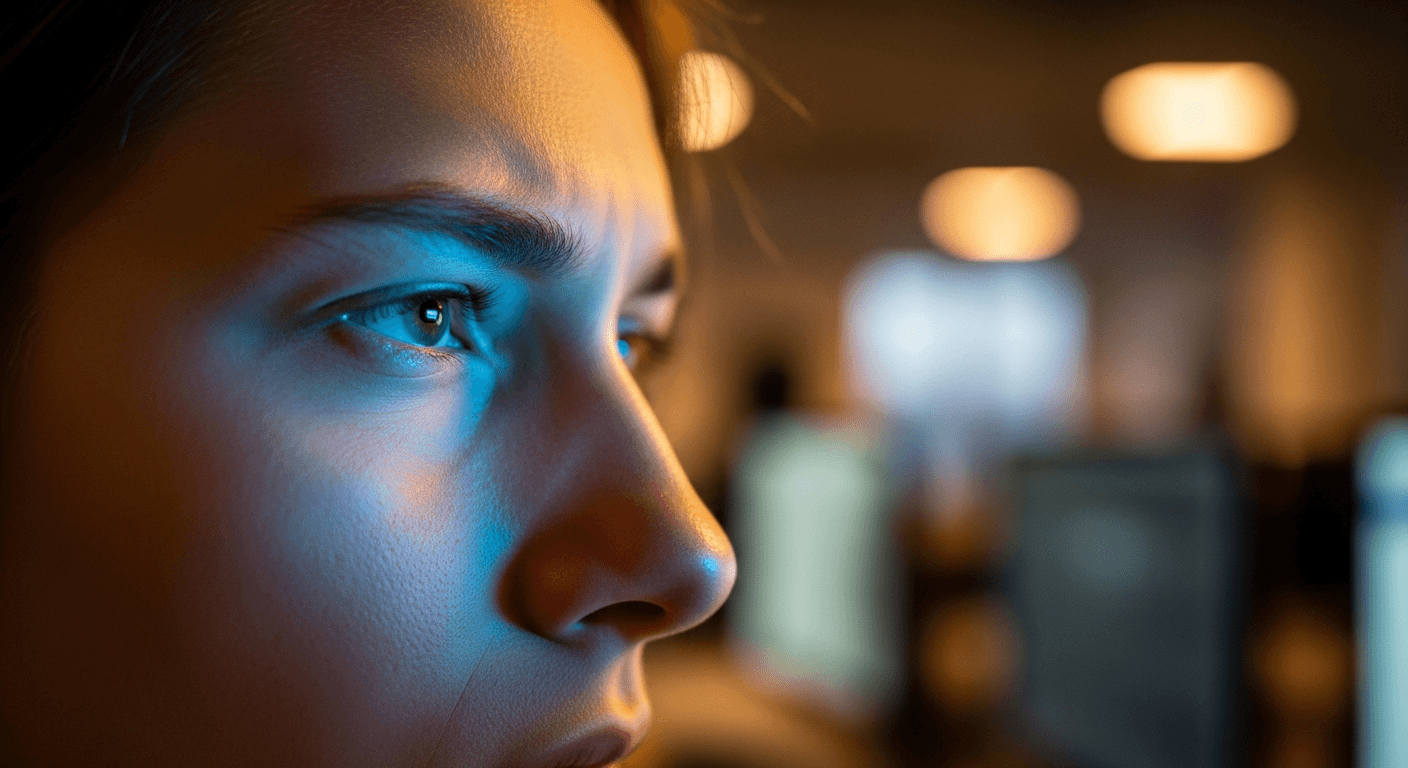
If you manage people, facilities, or workplace health budgets, here's a number worth sitting with: poor workstation design costs US employers an estimated $20 billion annually in workers' compensation claims tied to ergonomic injuries. That figure, drawn from the Ergonomics and Individual Wellness Report 2026 (UK, US, and Canada edition, published May 15, 2026), isn't dominated by back injuries or repetitive strain disorders the way it once was. A new category is climbing fast.
According to a June 26, 2026 industry analysis, Digital Eye Strain (DES) is now the fastest-growing workplace ergonomics concern of 2026. It's outpacing musculoskeletal complaints in growth rate, and the drivers are entirely predictable: longer screen hours, AI-assisted workflows that demand near-continuous visual attention, and the normalization of multi-screen setups across office, hybrid, and remote environments.
What Is Digital Eye Strain, and Why Is It Accelerating Now?
Digital Eye Strain refers to a cluster of visual and physical symptoms that develop after prolonged screen use. These include eye fatigue, dryness, blurred vision, headaches, and neck discomfort linked specifically to screen posture and focal demands. It's not a new condition. What's new is the speed at which it's spreading through the workforce.
The June 2026 report identifies three structural shifts fueling the acceleration. First, AI-assisted workflows have extended the amount of time workers spend in concentrated, screen-locked attention. When an AI tool handles research, drafting, or data aggregation, the human operator's role often becomes one of review, approval, and refinement. That work requires sustained close-range focus, often without the natural task breaks that physical work or non-screen collaboration once provided.
Second, multi-screen setups are now standard rather than exceptional. Many knowledge workers operate across two or three displays simultaneously. Each screen transition involves focal adjustment, brightness adaptation, and postural realignment. Over an eight-hour day, that cumulative demand is significant.
Third, younger workers are reporting higher symptom rates. The same June 2026 analysis found that employees under 35 are experiencing DES symptoms at disproportionate levels, likely because they're more deeply integrated into AI-enhanced digital workflows and more likely to be working across multiple platforms and devices at once.
This Is Not Just a Comfort Issue
The framing of eye strain as a minor inconvenience, something employees manage with eye drops or a weekend rest, is one of the more costly misconceptions in occupational health right now.
The June 2026 report draws a direct line between visual fatigue and increased employee error rates. When the visual system is fatigued, cognitive processing slows. Attention narrows. Workers miss details they would otherwise catch. That has obvious implications for productivity and output quality, but it also creates measurable risk in domains like data handling, compliance review, and cybersecurity.
An employee working through significant eye fatigue is more likely to misread a suspicious link, approve an anomalous transaction, or overlook a flag in a security alert. In environments where human oversight of AI-generated outputs is a core job function, that's not a marginal concern. It's a systemic vulnerability.
This connects directly to a broader pattern in workplace health: physical strain doesn't stay in a silo. As explored in the growing evidence around employee wellness ROI, the downstream costs of unaddressed physical discomfort consistently exceed the upfront cost of prevention.
The $20 Billion Workstation Problem
The May 2026 ergonomics report puts a precise and uncomfortable number on the status quo. Ergonomic injuries broadly, including musculoskeletal disorders, repetitive strain conditions, and now visually-driven complaints, account for approximately $20 billion per year in US workers' compensation costs.
That figure reflects claims that have already been filed. It doesn't capture the productivity drag that precedes a formal claim: the weeks or months of reduced output, increased errors, and presenteeism that typically precede a worker reaching the threshold of a compensable injury.
The same report offers a more optimistic data point. Ergonomically optimized workstations, meaning setups designed with appropriate monitor placement, lighting calibration, screen distance, and visual rest protocols, can deliver up to 25% productivity gains. That's not a marginal improvement. For a mid-sized employer with 500 knowledge workers, a 25% productivity gain across the workforce represents a return that dwarfs the capital investment required to achieve it.
For HR and facilities leaders building a business case, the math is unusually clean. You're not arguing for a wellness benefit. You're arguing against a documented liability.
What a Visual Ergonomics Intervention Actually Looks Like
Addressing DES at scale doesn't require a complete office redesign. It does require moving beyond the assumption that screen work is inherently benign as long as chairs and desks are properly configured.
A functional visual ergonomics program typically covers several areas:
- Monitor positioning: Screens should sit at or slightly below eye level, at a distance of roughly 20 to 28 inches from the face. For multi-screen setups, primary monitors should be centered, with secondary displays positioned to minimize extreme lateral head rotation.
- Lighting calibration: Overhead fluorescent lighting that creates glare on screens is a primary DES driver. Indirect or adjustable lighting that reduces contrast between screen brightness and ambient light significantly reduces symptom onset.
- The 20-20-20 protocol: Every 20 minutes, look at something 20 feet away for at least 20 seconds. This is a simple, cost-zero intervention that's consistently supported by occupational vision research. The challenge is building it into workflow culture, not just distributing a poster.
- Screen settings and blue light management: Display brightness should be calibrated to match ambient light rather than defaulting to maximum output. Blue light filtering, either through software settings or optical lenses, can reduce cumulative exposure over a full workday.
- Workstation assessments that include visual components: Most standard ergonomic assessments focus on posture, seating, and keyboard placement. Visual ergonomics requires its own checklist: screen angle, reflections, font size defaults, and whether employees are working in environments with significant natural light variation throughout the day.
The Remote and Hybrid Dimension
One complication HR leaders frequently underestimate is that DES risk doesn't stop at the office door. Remote and hybrid workers are operating in home environments where lighting, screen setup, and visual rest habits are almost entirely unmanaged.
As the emerging evidence on remote work health costs makes clear, the physical and psychological toll of unstructured remote environments is real and measurable. Visual ergonomics is part of that picture. A worker sitting at a kitchen table with a laptop screen six inches below eye level, in a room lit by a window directly behind the screen, is accumulating DES risk at a rate that no office intervention can offset.
Extending visual ergonomics guidance, equipment stipends, and self-assessment tools to remote workers isn't a perk. It's a logical extension of the same liability management framework that applies to the physical office.
Sleep, Recovery, and the Fatigue Feedback Loop
There's a compounding factor that rarely makes it into ergonomics conversations: sleep quality. Visual fatigue and cognitive fatigue from screen overexposure are meaningfully worsened by poor sleep, and the relationship runs in both directions. Excessive blue light exposure in the evening suppresses melatonin production, degrading sleep quality, which then reduces the visual system's overnight recovery capacity.
Workers who are chronically underslept arrive at their screens already depleted. The threshold for DES symptom onset drops, and the error-rate implications discussed earlier become more severe. What 2026 science is showing about sleep and recovery reinforces that sleep isn't a lifestyle variable separate from occupational health. It's directly implicated in how well workers function across every sensory and cognitive system.
This is also where the physical wellness dimension intersects. Workers who exercise regularly show better autonomic regulation and faster visual system recovery. The connection between physical activity and cognitive resilience is well-supported, and it's part of why workplace structural design that supports movement has measurable effects on cognitive output, not just physical health metrics.
The Business Case Is Already Made
You don't need to make a philosophical argument for caring about employee vision. The financial structure is already in place. A $20 billion annual liability, a documented 25% productivity upside from optimized workstations, and a risk category that's actively accelerating because of technology decisions you've already made, which is AI adoption and multi-screen workflows, are all the case you need.
The question for HR and facilities leaders in 2026 isn't whether Digital Eye Strain is a real cost center. The June 2026 report settles that. The question is whether your organization is going to address it proactively, at a fraction of the remediation cost, or wait for the workers' compensation data to make the decision for you.
Visual ergonomics is no longer a niche concern for specialists. It's a core component of what it means to design work environments that don't quietly erode the health and performance of the people doing the work.