
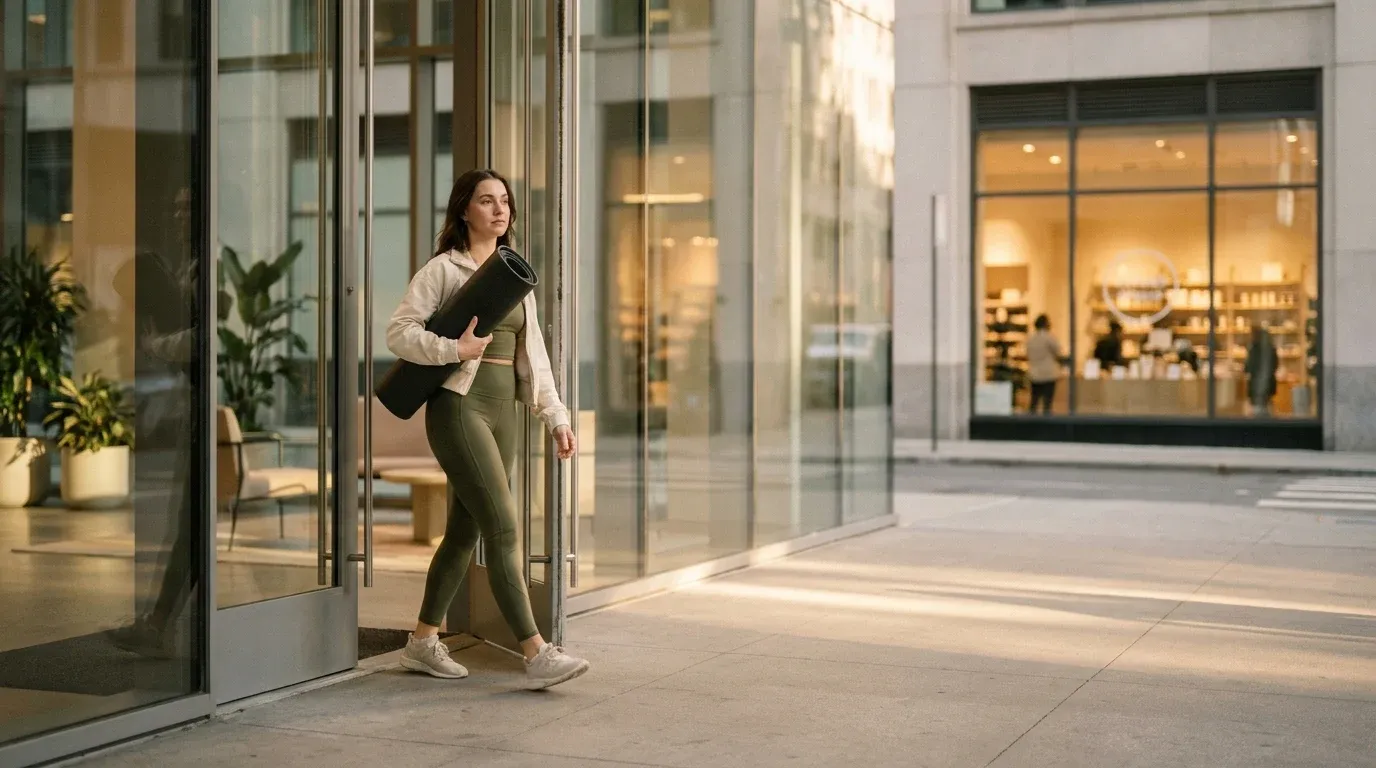
When Gen Z employees evaluate a job offer, they're not just reading the salary line. They're checking what's around the building. A report published November 3, 2026 found that Gen Z workers show a significantly stronger preference for office locations near gyms, Pilates studios, and wellness centers than their millennial counterparts. That's not a minor lifestyle footnote. It's a structural shift in how the next generation of workers defines a good place to work.
For HR teams and real estate decision-makers, this changes the return-to-office conversation entirely. The question is no longer just "how do we get people back?" It's "back to where, and surrounded by what?"
Proximity to Wellness Isn't a Bonus. It's a Baseline.
Gen Z has grown up with fitness culture embedded in social media, digital health tracking, and a broader awareness of mental health that previous generations didn't have at the same age. The result is a cohort that treats regular exercise and recovery not as a weekend hobby but as a non-negotiable part of their daily structure.
When that generation enters the workforce, they carry those expectations with them. A gym within walking distance of the office isn't a nice-to-have. It's closer to running water on the list of things they expect to exist near where they spend eight hours a day.
This reframes what "employer value proposition" actually means in 2026. Work-life balance has topped Gen Z's stated workplace priorities for several years running, and wellness access is now how that balance gets operationalized. Companies that locate offices in areas with no fitness infrastructure are signaling, whether they mean to or not, that they don't take that balance seriously.
If you're managing a dispersed or hybrid workforce, this matters even more. The office has to earn the commute. For Gen Z, a Pilates studio two blocks away helps justify that trip in a way that free coffee in the lobby simply doesn't.
What the Data on Engagement Actually Shows
An article published October 30, 2026 reported that companies offering fitness memberships and in-office yoga sessions are seeing measurable improvements in employee engagement. That's a real signal. But the same reporting flagged something important: those programs only work when the broader working environment supports them.
In other words, a subsidized gym membership doesn't fix a toxic management culture. A mindfulness app doesn't compensate for chronic understaffing. Wellness programs are amplifiers, not substitutes. When the underlying conditions are good, structured wellness benefits push engagement higher. When those conditions are poor, the programs land as performative gestures that employees see through immediately.
Gen Z, specifically, is attuned to this gap. They're more likely than older cohorts to describe wellness perks as hollow if they're offered alongside unsustainable workloads or inflexible scheduling. The benefit has to be coherent with the actual experience of working there.
This is worth keeping in mind as HR teams build out their wellness stacks. A corporate fitness allowance matters. Access to a coach can shift someone's trajectory. Understanding what a first coaching session actually involves helps employees self-select into support that works for them, rather than leaving unused benefits on the table.
The Real Cost of Ignoring This
Employee disengagement is expensive. Conservative estimates from workforce research consistently place the cost of a disengaged employee at 30 to 40 percent of their annual salary, when you factor in productivity loss, absenteeism, and eventual turnover. For a mid-level role paying $75,000 a year, that's somewhere between $22,000 and $30,000 in soft costs, per person, per year.
Workplace stress amplifies the problem. Chronic stress affects sleep, decision-making, physical health, and interpersonal dynamics at work. The physiological effects of prolonged stress are real and cumulative, and they show up in sick days, reduced output, and eventual burnout before HR even gets a resignation letter.
When companies think about real estate decisions, they typically model commute times, square footage costs, and transit access. Wellness proximity rarely appears in that spreadsheet. But if the evidence suggests that physical access to fitness and recovery infrastructure reduces disengagement, reduces sick days, and increases retention among the fastest-growing segment of the workforce, then it belongs in that model.
This is the lever that most HR strategies haven't pulled yet. Location is a retention tool. It's just not been framed that way.
Hybrid Policy and the Wellness Infrastructure Gap
The hybrid work debate has largely been fought on the terrain of productivity and collaboration. Gen Z is adding a third dimension: physical environment quality, defined in part by what surrounds the office, not just what's inside it.
This creates a practical problem for companies with legacy real estate. Offices in suburban office parks or car-dependent zones don't have the same access to walkable wellness infrastructure as urban locations. That gap becomes a structural disadvantage in recruiting Gen Z talent, particularly in competitive sectors like tech, media, and financial services.
Some companies are responding by negotiating corporate gym memberships with nearby facilities, subsidizing commuter wellness passes, or building fitness amenities directly into office footprints. Others are integrating movement into the workday itself, recognizing that not everyone can get a full training session in before or after work. Research on how desk workers can increase daily movement without leaving their workstation offers a practical starting point for teams that want to address the gap without major capital investment.
But these are workarounds. The more direct solution, for companies with flexibility in their real estate decisions, is to weight wellness proximity explicitly when choosing or renewing office locations.
The Loneliness Variable
There's another dimension here that HR teams often miss. Gen Z's preference for office locations near wellness infrastructure isn't purely about fitness. It's also about community and social density.
Gyms, studios, and wellness centers are inherently social environments. They create low-stakes connection points outside of formal work settings. For a generation that has struggled with the isolation effects of remote work, research shows remote work has contributed to measurable loneliness among young employees, access to those spaces near the office fills a real social need.
When you're 24 and new to a city, your social infrastructure often doesn't exist yet. The gym near the office can become a genuine community anchor, in a way that a Slack channel never will. Companies that locate near those environments are, perhaps inadvertently, supporting the social wellbeing of their youngest employees in a way that shows up as loyalty over time.
What HR Teams Can Do Right Now
You don't need to relocate your headquarters to respond to this shift. There are practical steps that move the needle without requiring a real estate overhaul.
- Audit your current wellness benefits for usability. A gym stipend that requires three forms of approval to access is not a gym stipend. Friction kills adoption. Simplify the process.
- Map the wellness ecosystem around your office. Know what's within a 10-minute walk. If the answer is very little, that's useful data for your next lease negotiation.
- Build movement into the workday explicitly. Encourage walking meetings, flexible scheduling around lunchtime workouts, and clear norms around starting slightly later or finishing slightly earlier to accommodate fitness routines.
- Include wellness proximity in job postings when it's a genuine differentiator. If your office is near a dense wellness corridor, say so. Gen Z candidates are looking for exactly that signal.
- Invest in education, not just access. Access to a gym is only as useful as an employee's ability to use it effectively. Resources on training intensity and how to structure gym sessions help employees actually benefit from the access you're providing.
The Bigger Picture
Gen Z's preference for wellness-adjacent offices is a leading indicator of a broader shift in what workers expect the relationship between employer and employee to look like. It's not just about the job anymore. It's about the conditions of life that the job makes possible.
That shift has profound implications for how companies think about return-to-office mandates, real estate portfolios, and benefits design. The organizations that are going to win Gen Z talent over the next decade are the ones that treat physical and mental health infrastructure as a core part of the employment offer, not a discretionary perk to be added when budgets allow.
The November 2026 data makes clear that this cohort is already making location decisions with their feet. The question for HR is whether the office you're asking them to come back to is worth the trip.