

Sedentary Work and Workplace Interventions: What the Lancet Review Says
If you manage people, design benefits programs, or advise organizations on workforce health, the 2025 umbrella review published in The Lancet Public Health is the clearest signal yet that workplace sedentary behavior is solvable. Not theoretically. Measurably, and with specific numbers attached to specific interventions.
Here's the context first, because the scale of the problem still surprises people.
The Scale of the Problem
Sedentary jobs have increased by 83% over the past 50 years. Today, roughly 80% of all jobs in the US qualify as sedentary or low-activity roles. That's not a trend. That's a structural shift in how work happens, and the health consequences track alongside it.
Prolonged sedentary behavior is now classified as an independent risk factor for cardiovascular disease, metabolic syndrome, and all-cause mortality. That classification matters because it means sitting time carries risk even when someone meets general physical activity guidelines. Thirty minutes at the gym before work doesn't fully offset eight hours in a chair. The research is consistent on this point.
For HR teams and wellness managers, that finding reframes the problem. You're not looking for ways to help employees who don't exercise. You're looking at a workplace design issue that affects virtually your entire workforce.
What the Lancet Umbrella Review Actually Found
The 2025 review synthesized existing meta-analyses on workplace sedentary behavior interventions, which gives it more statistical weight than a single study. The results are specific enough to build a budget case around.
Sit-stand desks were the most effective single intervention studied. Here's what the data showed for full-day sedentary time reduction:
- At 3 months: 68.7 minutes per day reduction
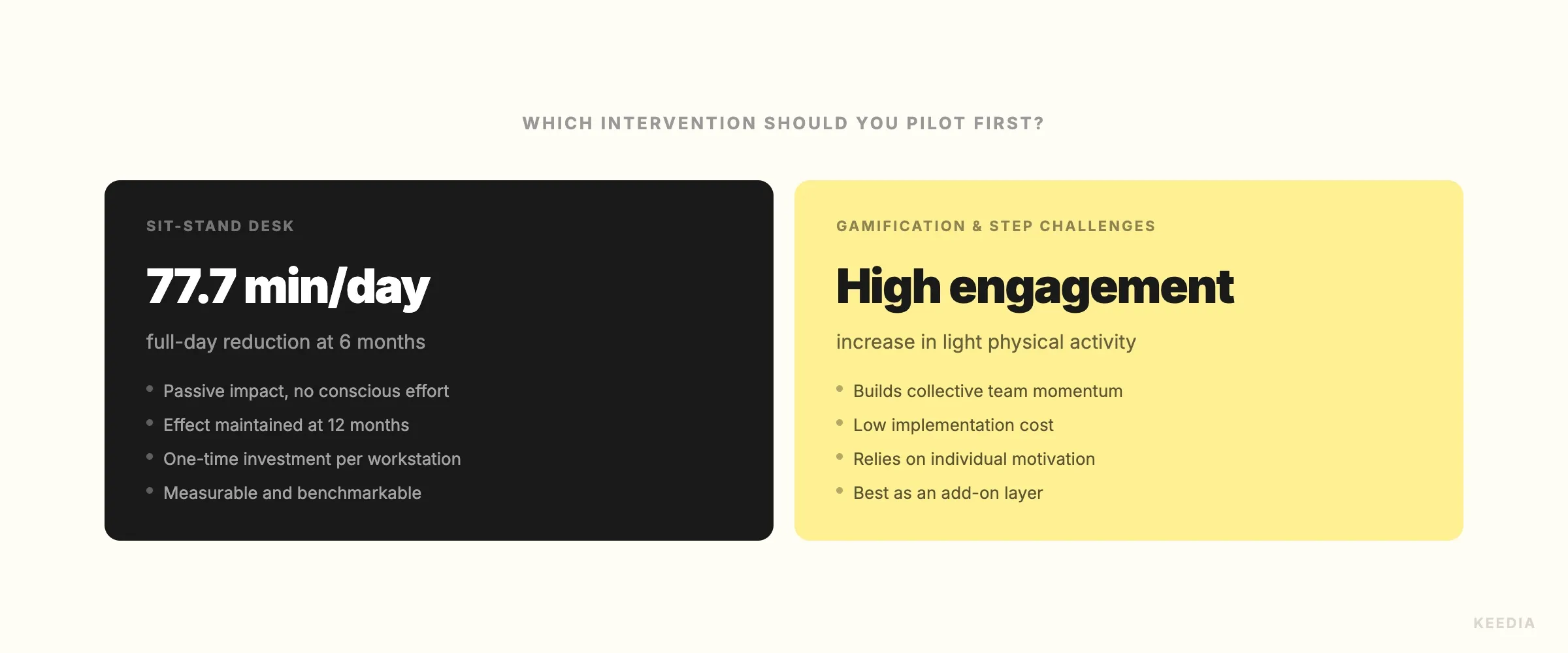
- At 6 months: 77.7 minutes per day reduction
- At 12 months: 62.1 minutes per day reduction
Those numbers hold up over time, which answers one of the common objections to environmental interventions. Employees don't just use the desk for two weeks and revert. The 12-month figure is lower than the 6-month peak, but 62 minutes per day less sitting after a full year is a meaningful, sustained outcome.
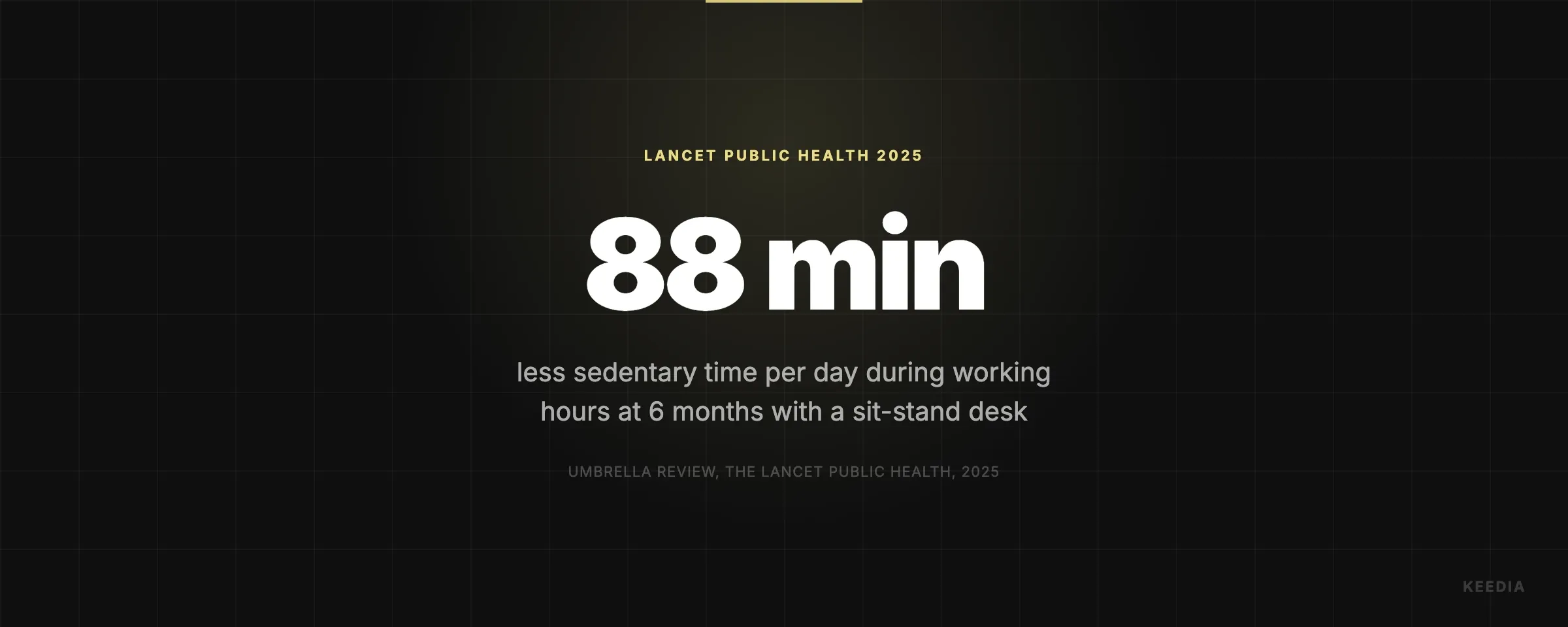
The working-hours numbers are even more compelling. During core business hours specifically, sit-stand desks reduced sedentary behavior by 80.8 minutes per day at 3 months and 88.0 minutes per day at 6 months. The intervention is delivering its impact exactly when your employees are at their desks, which is when the exposure accumulates.
Gamification and Step Challenges: The Engagement Layer
Sit-stand desks address environment. Gamified interventions and structured step challenges address behavior and culture. The Lancet review found both categories effective for reducing sedentary time and increasing light physical activity during the workday.
Gamified approaches work partly because they introduce social accountability without requiring anyone to disclose health information. A step challenge leaderboard is low-stakes and voluntary in a way that a mandatory wellness screening is not. The competitive or cooperative structure creates movement without the interventionist friction that tends to tank participation rates.
Structured step challenges also fit naturally with existing digital infrastructure. If your organization already uses a platform for employee benefits or engagement, adding a movement challenge doesn't require a separate procurement cycle. That lowers the implementation cost considerably.
For a deeper look at how wellness programs translate into measurable performance outcomes, Wellhub 2026: The Data Proving Workplace Wellness Actually Impacts Performance offers a useful data-level breakdown of what engagement actually produces at the organizational level.
The Cost-Benefit Math
A quality sit-stand desk runs between $400 and $1,200 per unit depending on configuration. Electric models with memory presets sit at the higher end. For a team of 50, a full rollout might cost $25,000 to $50,000 before installation.
That sounds significant until you run it against the productivity and health cost numbers. Sedentary behavior is associated with increased rates of musculoskeletal complaints, which are one of the leading drivers of absenteeism and short-term disability claims. Studies consistently estimate that musculoskeletal conditions cost US employers between $13 billion and $20 billion annually in lost productivity. At the team level, even modest reductions in sick days and presenteeism start to close the gap on equipment costs within 12 to 18 months.
Gamified step programs and movement break software are cheaper to deploy. Many platforms price at $3 to $10 per employee per month at scale, meaning a 100-person program costs $3,600 to $12,000 per year. The Lancet data suggests these interventions work, but they work differently. They're better at sustaining behavior change than creating it from scratch.
The combination approach, where you change the environment first and add behavioral programming on top, gives you the best return on both investments.
A Tiered Implementation Framework
The research supports a sequenced approach. Here's how to structure it:
Tier 1: Environmental changes. Start with sit-stand desks for the highest-exposure roles, which typically means those spending more than six hours per day seated. This creates passive impact. Employees don't need to remember to do anything differently. The desk changes the default. The Lancet data suggests you'll see meaningful reductions within three months with no further intervention required.
Tier 2: Gamified engagement. Layer in step challenges, movement challenges, or light activity tracking once the physical infrastructure is in place. This adds motivation and social structure to behavior that the environment has already made easier. Participation rates for voluntary wellness challenges tend to improve when employees have already experienced the physical changes of sitting less.
Tier 3: Structured movement breaks. Calendar-integrated movement reminders, team walking meetings, or scheduled break protocols shift the culture rather than just the individual behavior. This layer takes longer to embed but is the most durable. When movement breaks become a norm rather than a personal choice, the intervention becomes self-sustaining.
If budget forces you to pick one tier to start, the environmental layer has the strongest evidence base and the most passive mechanism. You're not asking employees to change habits. You're changing the conditions in which habits form.
What Doesn't Work
The review also gives you a way to allocate away from low-return interventions. Education-only programs, which include posters, email campaigns, and one-off lunch-and-learn sessions about the risks of sitting, don't show meaningful impact on actual sedentary time. Awareness doesn't move behavior reliably. This is consistent with decades of health behavior research.
Similarly, interventions that rely entirely on individual motivation without structural support tend to fade at the three-month mark. If your current program is built around asking employees to remember to stand up, you're working against the default. The data suggests that changing the default is what produces durable results.
It's also worth noting that sedentary behavior reduction doesn't replace the need for broader cardiovascular fitness. Sitting less is not the same as exercising more. Employees who use sit-stand desks and hit step targets are still likely to benefit from structured aerobic training. Research on how to improve VO2max through research-backed protocols shows what actual cardiorespiratory gains require, which goes beyond light activity increases during the workday.
The Wider Health Context
Sedentary behavior interacts with other health variables in ways that compound risk. Sleep quality, for example, affects metabolic function and inflammation in ways that overlap with the pathways activated by prolonged sitting. Research on how poor sleep cuts strength by 12% according to a 2025 meta-analysis illustrates how interconnected these inputs are. A workforce that sits for eight hours and sleeps poorly is carrying a compounded physiological load that no single wellness intervention fully addresses.
That doesn't mean you wait for a comprehensive solution. The Lancet data is specific: sit-stand desks work, they work within 90 days, and they sustain impact at 12 months. That's a rare combination of speed and durability in workplace health research.
If you're interested in how broader structural changes to work itself affect health outcomes, the 12-month trial data on the 4-day work week and physical health offers a complementary perspective on what happens when you reduce the total volume of sedentary work exposure rather than just interrupting it.
The Bottom Line for HR and Wellness Teams
The 2025 Lancet umbrella review gives you a defensible evidence base for a capital expenditure request on sit-stand desks, a rationale for gamified movement programs, and a clear framework for sequencing implementation. The numbers are specific. The time horizons are realistic. The mechanism is simple: reduce the amount of time your employees spend sitting by changing the conditions under which they work.
Start with the environment. Add engagement. Build the culture. The research tells you what to expect at each stage, which makes the case for doing it in the first place considerably easier to make.