
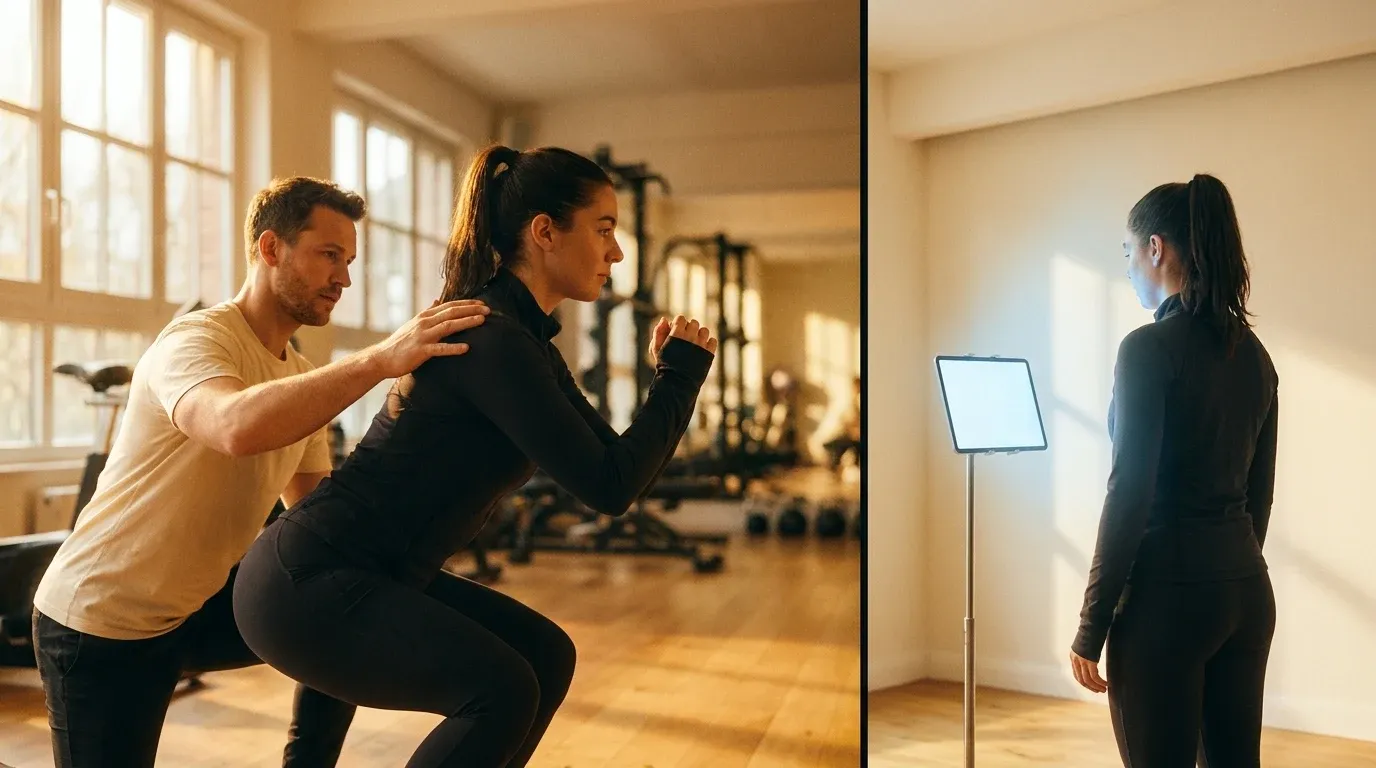
The fitness industry doesn't look the way it did five years ago. In 2026, you can hire a fully AI-driven coaching platform that builds your program, tracks your lifts, monitors your recovery, and messages you at 6 a.m. You can also still walk into a gym and work with a human being who's spent years learning how bodies move and how minds resist change. Both options have real merit. The problem is that most people choose one without knowing what they actually need from either.
This piece is here to help you make a smarter call, not sell you on a trend.
What AI Trainers Actually Do Well
Let's be direct: AI coaching platforms have gotten genuinely good at certain things. The strongest tools in 2026 can generate periodized training programs, auto-regulate volume based on your logged performance, track progressive overload across months, and send timely reminders without any human involvement. For consistency and structure, that's hard to beat.
AI doesn't get sick, doesn't cancel sessions, and doesn't have a bad day that bleeds into your workout. If you're someone who needs a clear plan and tends to follow it once it's in front of you, an AI platform can provide that at a fraction of the cost of a human coach. Subscription-based AI coaching typically runs between $20 and $60 per month, compared to $150 to $400 per month for a remote human coach, or $60 to $150 per individual in-person session in major US cities.
AI tools also excel at data aggregation. Your wearable feeds in sleep quality scores, heart rate variability, and step counts. The platform synthesizes that and adjusts your training load accordingly. That kind of 24/7 feedback loop was simply unavailable to most people a decade ago.
Where it breaks down is in the space between data and meaning. A platform can flag that your sleep score dropped. It can't ask you what's going on in your life and then decide, based on your answer, whether to push you harder or pull back entirely.
Where Human Coaches Still Win
Human coaches do something no algorithm currently replicates well: they read you. Not just your numbers, but your body language, your tone, the way you avoid eye contact when you say you've been eating well. That information shapes real coaching decisions in ways that a form input never will.
Accountability is the other major differentiator. Research consistently shows that social accountability, specifically having a person who expects something from you, produces stronger adherence to exercise programs than self-monitoring alone. When you know your coach is going to ask why you skipped Tuesday, you're less likely to skip Tuesday.
Human trainers also handle the messy middle of any fitness journey. Progress stalls, injuries happen, life gets complicated, motivation evaporates. A good coach has seen all of it and can recalibrate your program and your mindset at the same time. That combination of programming adjustment and emotional support is genuinely hard to automate. If you're not sure whether you're at a point where you need that kind of support, 11 Signs You Actually Need a Personal Trainer is a useful starting point before you commit to either option.
There's also the movement quality piece. AI platforms can review form through video analysis, and the technology has improved significantly. But catching a subtle hip shift under fatigue, or noticing that your shoulder is creeping up because of an old injury you mentioned once in an intake form, still requires a trained human eye in most cases. Why Movement Science Makes You a Better Coach outlines why deep biomechanical knowledge remains one of the clearest advantages a human professional brings to the table.
The Hybrid Model: Why It Makes Sense in 2026
The most effective setup for many clients right now isn't a binary choice. It's a hybrid model that uses AI for what it's genuinely good at and preserves human coaching for what it can't replace.
Here's what that looks like in practice. Your AI platform handles daily tracking, sleep and recovery data, session logging, and volume management across your training week. You check in with a human coach once or twice a month, either remotely or in person, for programming reviews, goal-setting conversations, and mindset work. The AI keeps you consistent. The human keeps you on the right path.
This structure also tends to be more affordable. A monthly remote coaching check-in plus an AI subscription can cost significantly less than weekly in-person sessions, while covering more ground than either option alone. Many platforms are now designed explicitly for this kind of collaboration, giving coaches a dashboard view of client data collected by AI tools.
Recovery is one area where the hybrid model shines. If your AI tool is pulling in wearable data and flagging elevated resting heart rate or poor sleep quality, your human coach can use that information in your next check-in to decide whether your current training load is appropriate. That conversation has more context and leads to better decisions. For a clearer sense of what your wearable data can and can't tell you, 5 Simple Recovery Habits That Actually Work covers the foundational habits that support whatever your tracker is measuring.
How to Figure Out What You Actually Need
Before you spend money on any coaching format, it helps to be honest about your situation. The right tool depends heavily on where you are in your fitness journey and what's actually getting in your way.
Ask yourself these questions:
- Are you a self-starter who just needs a structured plan? AI coaching is likely sufficient, at least for now.
- Have you hit a plateau you can't explain or work around? A human coach can troubleshoot in ways an algorithm can't.
- Do you struggle with consistency and find that accountability drives your behavior? A human relationship will outperform any notification system.
- Are you dealing with pain, injury history, or a medical condition that affects training? You need a qualified human professional, full stop.
- Are you training for a specific performance goal, like a race, competition, or sport? Nuanced periodization and real-time adjustments from a human coach will almost certainly get you further.
- Is your main barrier budget? A strong AI platform combined with occasional human check-ins may be your best value.
Your answers should point you toward a format before you start comparing products. Most people who end up frustrated with AI coaching weren't failed by the technology. They just needed something the technology was never designed to provide.
The Hype Problem
It would be easy to read the current AI fitness marketing and conclude that human trainers are becoming obsolete. That's not what the evidence suggests. What's actually happening is a segmentation of services, where AI handles the high-volume, low-complexity end of coaching, and human professionals move toward the work that requires judgment, relationship, and adaptability.
That shift benefits clients who pay attention. The people best positioned to take advantage of both worlds are the ones who understand what each format is designed to do and build their support system accordingly. The people who get burned are the ones who expect an app to replace a conversation they actually need to have with a real person.
Cognitive load matters here too. If you're already overwhelmed, constantly managing another app and interpreting its recommendations adds friction. Research published in 2024 found that decision fatigue and mental overload are significant barriers to exercise adherence, particularly among adults managing high-stress work environments. Endless Scrolling Hurts Your Memory. Exercise Fights Back. touches on why protecting your mental bandwidth isn't separate from your fitness strategy. It's central to it.
Making the Call
Here's the practical summary. AI coaching is a legitimate option if you're self-motivated, you have clear goals, you're not dealing with injury or complex health history, and you want structure at a lower cost. It's not a shortcut to better results. It's a tool that works well when you already know how to use it.
Human coaching is worth the investment when you need more than a plan. When you need someone who can look at the full picture of your life, not just your data, and help you figure out why you're not moving forward and what to do about it.
The hybrid model is where most clients in 2026 will find the best return on their time and money. AI for volume and consistency. Human for strategy and support. Neither is going away, and that's actually a good thing for anyone who takes their health seriously.
Start by knowing what you need. The format follows from that, not the other way around.