
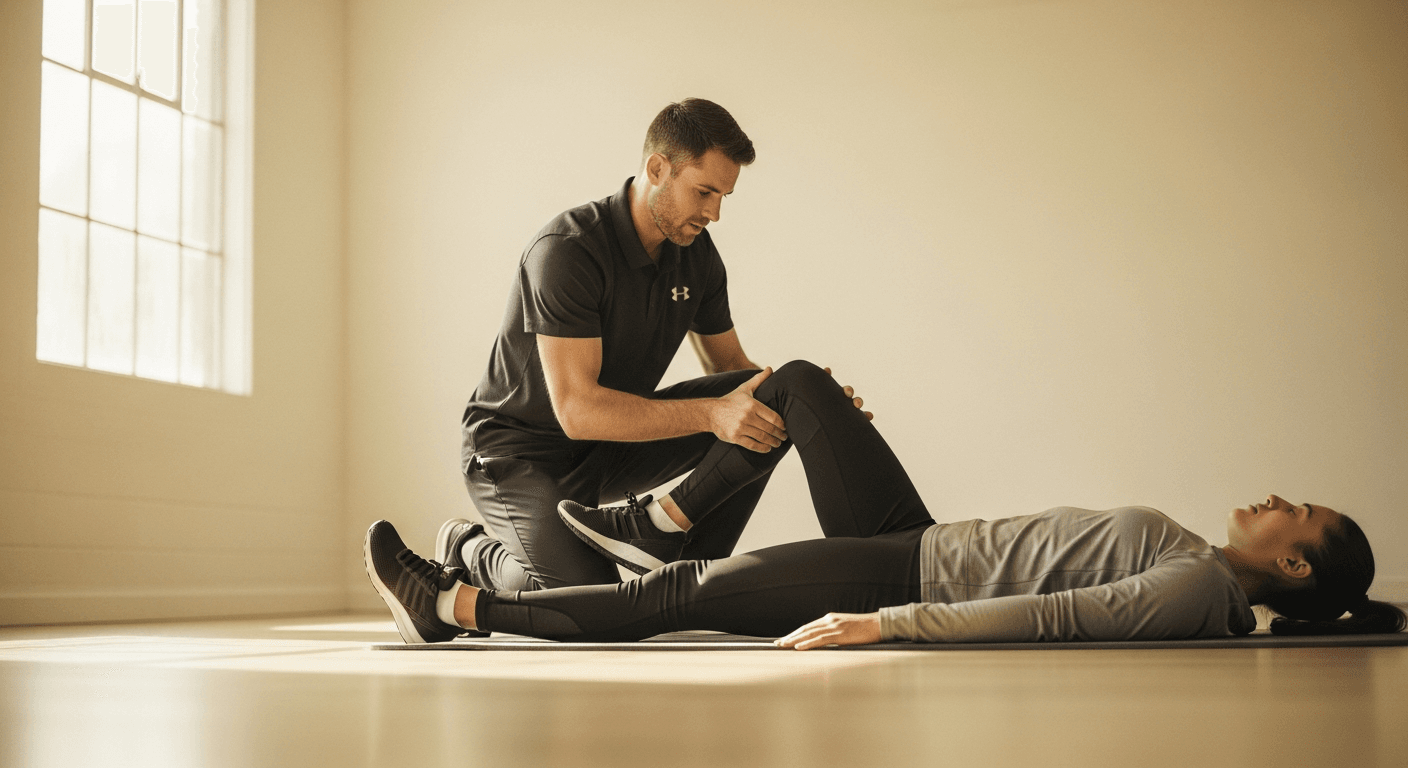
Most coaches program the same way they were trained: sets, reps, rest periods, and a generic warmup lifted from a certification manual. It works well enough for motivated clients who stay injury-free. But when someone's progress stalls, a knee starts acting up, or a client quietly stops booking sessions, that generic approach has nothing left to offer.
Movement science changes that. It gives you a systematic way to look at how a body actually moves, find the compensations hiding underneath, and design sessions that address root causes instead of symptoms. The result isn't just better client outcomes. It's a fundamentally different coaching identity.
What Coaches Miss Without a Movement Framework
The human body is remarkably good at masking dysfunction. A client can squat, deadlift, and lunge for months while quietly compensating around a restricted hip, an inhibited glute, or a ribcage that won't rotate properly. To the untrained eye, the movement looks fine. Under load, over time, those compensations compound.
A movement science framework teaches you to see what's actually happening. Functional movement screening, gait analysis, and joint-by-joint assessment tools give coaches a structured lens for identifying dysfunctional mechanics before they express as injury. Research consistently shows that observable movement asymmetries and mobility restrictions are strong predictors of musculoskeletal injury. Catching them early is the most underused injury prevention tool in coaching.
This matters more than ever as the coaching market grows increasingly competitive. The industry is expanding rapidly, with projections pointing to significant global revenue growth through 2026. If you want to understand what that context means for your practice, Coaching Is a $5.34B Industry: What the Numbers Mean for You breaks down the opportunity. Differentiating on outcomes, not just on effort or personality, is where coaches build lasting practices.
Analyzing Movement Patterns: The Skill That Changes Everything
Movement analysis isn't about memorizing anatomy. It's about training your eye to notice how joints interact across a movement chain. When a client's knee caves during a squat, that's not just a knee problem. It could trace back to a weak glute medius, limited ankle dorsiflexion, or poor hip external rotation. Understanding which is the actual driver changes your entire prescription.
There are practical frameworks coaches can apply without a physical therapy license. The joint-by-joint concept, popularized in performance coaching, identifies which joints are designed for mobility and which for stability. When a mobility joint becomes stiff, the adjacent stability joint compensates by moving too much. That's how lower back pain shows up in people with immobile hips, and how shoulder injuries develop from thoracic spines that don't rotate.
Start with a simple movement screen at intake. Observe a bodyweight squat, a single-leg balance, a hip hinge, and an overhead reach. You're not diagnosing. You're collecting information. Note where movement breaks down, where compensation patterns appear, and which restrictions are limiting range. That information should drive everything you program next.
Replacing Generic Warmups With Targeted Preparation
The standard five-minute cardio warmup followed by a few dynamic stretches isn't wrong. It's just not very useful for clients with specific restrictions. Movement science lets you replace that routine with something that actually prepares the body for what's coming, and starts correcting dysfunction at the same time.
A targeted preparation sequence has three layers. First, mobility work that addresses the specific restrictions identified in your assessment. For a client with limited thoracic rotation, that means thoracic extension and rotation drills, not a generic foam roll of the IT band. Second, activation work that wakes up inhibited muscles before you load them. If a client's glutes aren't firing properly, a heavy Romanian deadlift won't fix it. A targeted glute activation sequence before the session will.
Third, alignment and positional work that grooves the movement patterns you're about to train. A few reps of a goblet squat with tempo, focusing on knee tracking and hip position, primes the nervous system far more effectively than random movement prep. This kind of precision is exactly what separates clients who benefit most from working with a trained coach versus following a generic app or template.
Done consistently, this approach compounds. Mobility improves session to session. Inhibited muscles start activating reliably. Compensation patterns diminish. Clients feel better, move better, and notice the difference. That's not just good coaching. That's retention.
Building Sessions Around Root Causes, Not Symptoms
Once you can identify dysfunctional mechanics and design targeted prep, your programming logic changes. You're no longer just selecting exercises based on muscle groups or energy systems. You're building sessions that address the underlying patterns driving your client's limitations and risks.
This might mean deprioritizing a client's favorite exercise because it reinforces a compensation they need to address first. It might mean spending three weeks on unilateral work and positional stability before reintroducing bilateral loading. It requires having honest conversations and backing up your decisions with clear explanations. Clients who understand the reasoning almost always comply. And when they see the results, their trust in you becomes something a generic trainer can't easily replicate.
Movement-informed programming also integrates naturally with recovery. Clients dealing with chronic stiffness, poor sleep quality, or high stress loads often show predictable movement deficits. Understanding that connection helps you adjust session intensity and volume in real time rather than just following a prescribed plan. Recovery practices that address the whole system become a natural part of the conversation you have with clients, not an afterthought.
How Movement Science Raises Your Market Value
Here's the practical reality. Two coaches can have identical certifications, similar personalities, and comparable pricing. The one who understands movement will consistently produce better outcomes. And in a market where clients are increasingly informed and results-focused, outcomes are what justify premium pricing and generate referrals.
Coaches applying movement science can reasonably position their services at $150 to $250 per session for in-person work, with online programs starting around $300 to $500 per month, depending on the depth of assessment and customization included. That's meaningfully above the market average for general personal training. The positioning works because the offer is different. You're not selling workouts. You're selling a systematic approach to improving how someone moves, feels, and performs.
This also connects to how the coaching industry is evolving around technology and hybrid delivery. Online coaching platforms now make it possible to conduct movement assessments remotely via video, build personalized corrective protocols, and deliver them through structured programming tools. If you're navigating that shift, Hybrid Coaching Is the Baseline Now: How to Reposition outlines how to adapt your model without losing the depth that makes your work valuable.
The coaches who struggle with retention are often the ones whose clients plateau or get hurt. Movement science directly attacks both problems. A client who's progressing, staying healthy, and visibly moving better has no reason to leave. And a client who's referred to you specifically because you "actually figured out why my hip hurt" is already presold on your expertise.
Making the Transition: Where to Start
You don't need to overhaul your entire practice overnight. The transition into movement-informed coaching is incremental, and even small shifts produce noticeable results.
- Add a movement screen to your intake process. Even a basic five-movement assessment gives you more useful information than a health history questionnaire alone. Document what you see and reference it when explaining your programming decisions.
- Replace one generic warmup per week with a targeted preparation sequence. Pick one client with a known restriction. Design a specific mobility and activation sequence around that restriction. Track how their main lifts feel afterward.
- Study one joint per month. Go deep on hip mechanics, then thoracic mobility, then ankle function. Understanding each joint's role in the chain builds a mental model you'll apply across every client.
- Communicate your reasoning out loud. When you make a programming decision based on what you observed in their movement, explain it. That transparency builds trust and signals expertise without requiring you to oversell yourself.
- Invest in continuing education. Functional movement, corrective exercise, and applied anatomy courses vary widely in quality, but the investment pays off quickly when it translates into better client results and higher retention.
The gap between coaches who apply movement science and those who don't is widening. As clients become more educated about their bodies, and as the market continues to stratify between commodity fitness instruction and genuine performance coaching, that gap becomes a competitive advantage for those on the right side of it.
Understanding how the body moves isn't a niche specialization. It's the foundation of doing this job well. The coaches building durable, high-value practices in 2025 and beyond aren't just programming harder. They're programming smarter, and they're starting with movement.