

The problem isn't where you think it is
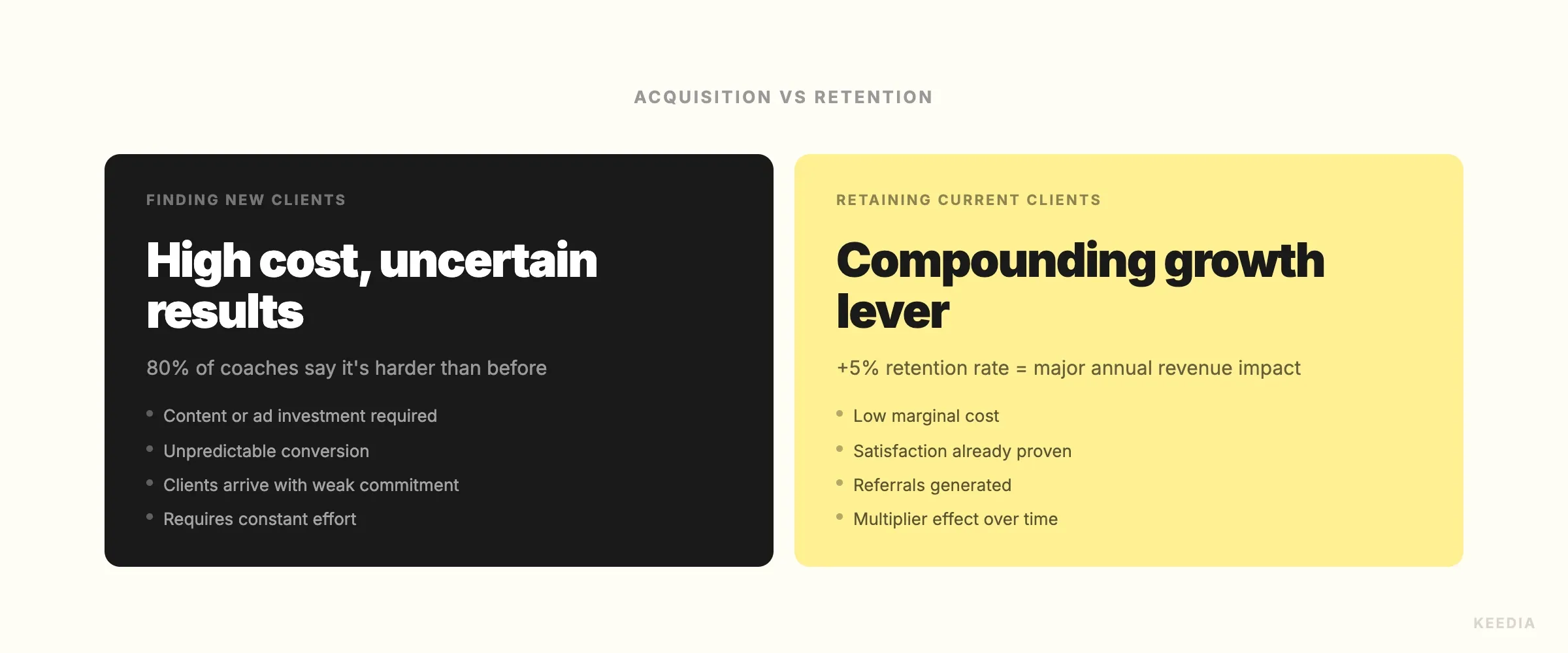
Four in five coaches say finding new clients has gotten harder or plateaued compared to previous years. Most of them look for the solution in the same direction: more social media content, a better Instagram bio, a promotional offer to attract new prospects.
That's the wrong answer to the right problem. Because the problem isn't acquiring clients — it's keeping them.
The 2026 personal training industry report (Trainerize/TrueCoach) identifies retention as the most underused growth lever for independent coaches. A coach who moves from 70% to 75% annual retention sees a significant revenue increase without adding a single new client. A coach who pours all their energy into acquisition without working on retention ends up on a treadmill: always running, never getting ahead.
The 3 moments where coaches lose the most clients
Retention isn't lost randomly. It's lost at specific, predictable moments in a client's journey. Here they are.
Weeks 2-4: the motivation dip. The client arrived with high enthusiasm. The first sessions were exciting. Then the novelty wore off, the soreness hit, and visible results aren't there yet. This is where the less committed clients start finding reasons to cancel.
What you can do: implement a structured check-in at the end of week 3. Not a performance review — a conversation about what's working, what's hard, and an explicit reminder of why the client started. That conversation, when it happens, meaningfully reduces dropout rates in the weeks that follow.
Week 12: the first visible plateau. Twelve weeks in, the initial newbie gains are behind them. Progress starts slowing visibly. If the coach doesn't frame this period in advance — if the client arrives at the month-three session without being prepared for how progress was going to change — they may interpret the plateau as failure and decide to stop.
What you can do: prime this moment at the month-one review. "In 6-8 weeks, you're going to enter a phase where progress looks slower but is actually going deeper. That's normal, and it's where we'll shift our approach." A client who has that information won't be surprised when it happens.
Month 6+: the habit without the relationship. The client has built their fitness habit. They show up regularly. But if the coaching relationship hasn't evolved — if every session looks like the one before without visible progression in the coaching approach — the client may start wondering if they still need a coach. "I know the exercises now."
What you can do: actively reintroduce complexity and progression at the 6-month mark. New programming block, new 3-month goal, new baseline test. The client needs to feel the coaching is advancing, not plateauing.
Time-bound vs. outcome-bound delivery
One of the most striking observations in the 2026 industry report: coaches who shift from time-bound delivery ("you get X sessions per month") to outcome-bound delivery ("here's what we're working toward, here's why, here's where you'll be in 90 days") retain clients significantly longer.
It's not a psychological surprise. Humans commit to outcomes, not processes. A client who buys "4 sessions per month" has bought time. A client who enrolls in "a 12-week program to run my first half marathon" has bought a transformation.
What this changes in practice
The shift isn't in what you do during sessions — it's in how you talk about what you do between sessions. A few simple adjustments:
- At contract signing: clearly articulate the 90-day goal, not just the sessions included.
- Every 4 weeks: a brief 10-minute review to recalibrate the goal and show progress markers.
- At 6 months: actively propose a new programming block — don't wait for the client to ask.
Retention isn't accidental. It's the result of small, recurring decisions at each stage of the client journey. Coaches who formalize those decisions — particularly through a structured weekly check-in system — consistently outperform those who rely on intuition alone.