
If you're coaching clients over 60, you already know that "just lift more" or "just do more cardio" isn't good enough. The research keeps tightening around a harder truth: older adults who train only one physical quality decline faster in the others, and that imbalance is exactly what leads to falls, functional loss, and early exits from active life.
New guidance from sports medicine and gerontology researchers is converging on a cleaner framework. Effective senior fitness programs don't optimize for one variable. They develop five overlapping physical abilities at once. Here's what those abilities are, why each one matters, and how to use this framework as both a coaching tool and a client education tool.
The Five Abilities That Define Functional Fitness After 60
The framework isn't arbitrary. Each of these five abilities maps directly to the activities older adults need to perform safely and independently. Remove any one of them from a program and you create a gap that the other four can't fully cover.
- Strength: The capacity to produce force against resistance. It underpins almost every physical task, from getting up off the floor to carrying groceries. Research consistently shows that muscle mass and strength begin declining around age 30, with the rate accelerating after 60 if not actively countered through resistance training.
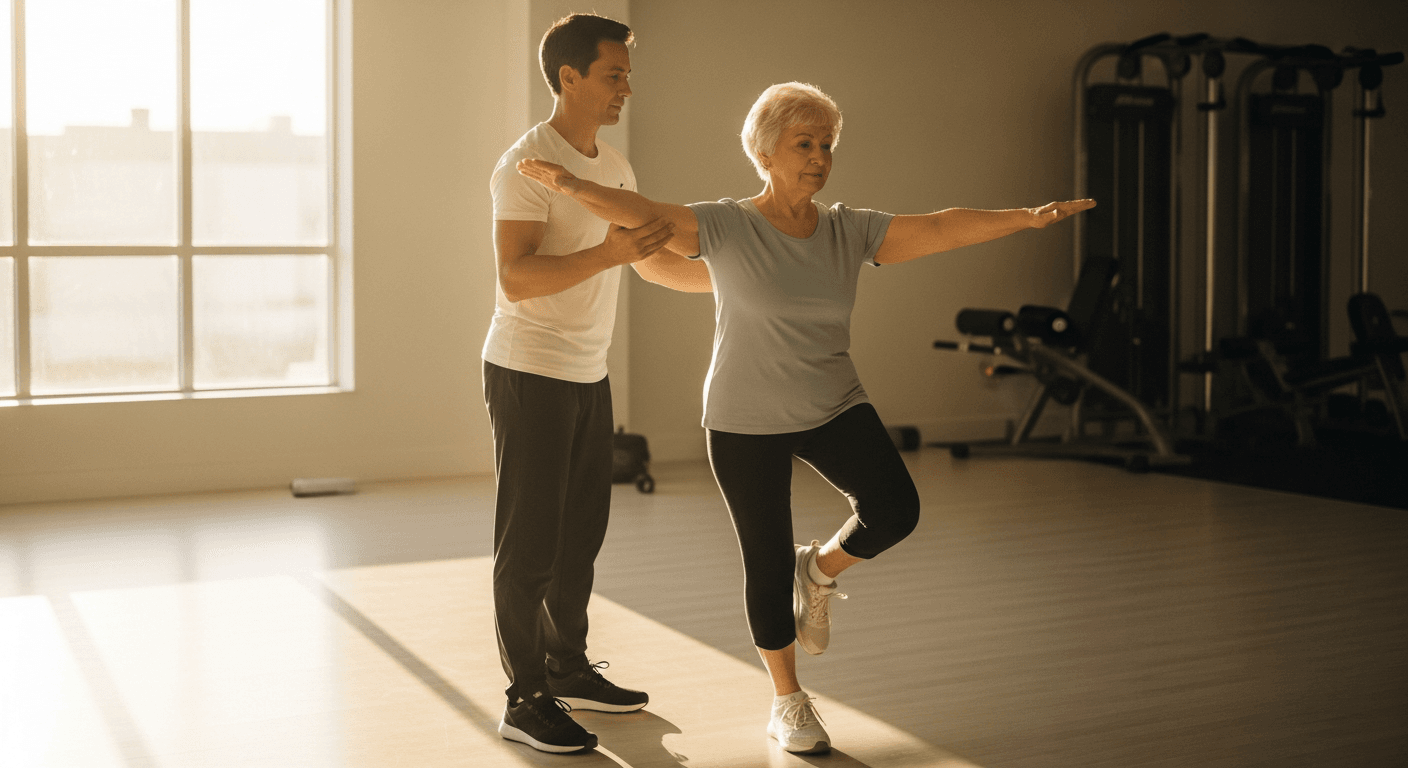
- Balance: The ability to control the body's position, both statically and dynamically. Balance is the most direct predictor of fall risk. Adults over 65 account for the majority of fall-related hospitalizations globally, and poor balance is the single most modifiable factor in that equation.
- Power: Force produced at speed. This is distinct from strength and often undertrained. Power is what allows a person to catch themselves mid-stumble, step off a curb without incident, or react quickly in a crowd. Studies show that power declines faster with age than raw strength does, making it a priority, not an afterthought.
- Mobility: The active range of motion through joints, combined with the strength to control that range. Stiff hips and shoulders don't just limit exercise performance. They change gait mechanics, increase compensation patterns, and quietly raise injury risk across every other movement category.
- Endurance: The cardiovascular and muscular capacity to sustain effort over time. Endurance supports heart health, metabolic function, energy levels, and the ability to stay active throughout a full day. Research on combining resistance training and cardiovascular work shows that pairing these modalities extends healthy lifespan more effectively than either approach alone.
Why Training Only One Quality Creates Dangerous Gaps
A client who lifts weights three days a week but never works on balance or power is stronger, but not safer. Strength without reactive capacity means the body can produce force but can't deploy it fast enough to prevent a fall. That's a critical distinction most general fitness programs never address.
The same problem runs the other direction. A client who does group cardio classes five days a week may have decent endurance, but if their hip mobility is limited and their lower body power is undertrained, every step on uneven ground is a calculated risk. Cardio alone doesn't build the neuromuscular reactivity that protects joints and stabilizes movement.
This is why the five-ability model is more useful than the traditional strength-versus-cardio binary. It gives you a diagnostic lens. When a client over 60 describes a near-fall, a recurring ache, or fatigue that hits earlier than expected, you can map that symptom directly to one of the five abilities and adjust programming accordingly. That's a sharper clinical conversation than a general "let's add more volume."
How Recovery Changes the Equation for Older Clients
Programming for seniors isn't just about what goes into each session. It's about what happens in the 24 to 48 hours after. Older adults experience slower protein synthesis rates, reduced hormonal recovery responses, and a longer window of elevated inflammation following high-intensity effort. Ignoring this doesn't make your programming more rigorous. It makes it less effective.
The practical implication is session frequency and sequencing. High-demand sessions targeting strength and power need more spacing than you might apply with a 35-year-old client. Mobility and light endurance work can fill those recovery windows without creating additional systemic load. Building the week around recovery, rather than treating recovery as what happens when you're not training, is the distinguishing feature of smart senior programming.
This matters particularly because recovery has become a central pillar of modern fitness culture, and for older clients the stakes are higher than for any other demographic. Poor recovery doesn't just slow progress. It accelerates the functional decline you're trying to prevent.
Sleep is a non-negotiable part of this picture. Tissue repair, motor learning, and hormonal rebalancing all depend on adequate sleep quality, not just duration. If your clients aren't sleeping well, their adaptation to training is compromised regardless of how well-designed the program is. New research on how sleep facilitates neurological repair reinforces why coaches working with older adults should ask about sleep as a standard intake question, not an afterthought.
Building a Program Around All Five Abilities
You don't need five separate training blocks to cover five abilities. The most efficient senior programs layer multiple qualities into single sessions through smart exercise selection.
A single-leg Romanian deadlift, for example, trains strength and balance simultaneously. A medicine ball chest pass from a split stance adds power to what might otherwise be a static strength drill. A farmer's carry with a slight surface challenge combines endurance, strength, and balance in one movement. The goal isn't complexity for its own sake. It's selecting exercises that earn multiple training adaptations per unit of time, which matters more for older clients whose recovery capacity is finite.
A practical weekly structure might look like this:
- Two to three sessions per week focused on integrated strength, power, and balance work, using compound movements at moderate to high effort.
- One to two sessions per week of lower-intensity endurance training, walking, cycling, swimming, or light rowing, keeping heart rate in a sustainable aerobic zone.
- Daily or near-daily mobility work that takes 10 to 15 minutes and targets the hips, thoracic spine, and ankles. This doesn't require a full training session and can be assigned as homework.
Progression follows the same five-ability logic. You're not just adding load over time. You're tracking improvement across all five dimensions and adjusting emphasis when one ability falls behind. If a client's strength scores are climbing but their balance assessments are stagnant, that's your signal to rebalance the program before the gap becomes a liability.
Using This Framework as a Client Education and Retention Tool
Here's where this framework becomes a coaching asset beyond program design. Most clients over 60 have had some form of fitness instruction before. Many have been told to lift weights or walk more without understanding why, and without any structure to evaluate whether what they're doing is actually working.
When you present the five-ability model at intake, you're doing something different. You're giving clients a vocabulary for their own fitness. You're showing them that your program is addressing five distinct physical needs, not just a generic "get stronger" objective. That transparency builds trust faster than any credential on your wall.
It also gives you a retention mechanism. Progress across five measurable dimensions means clients can see improvement in multiple areas simultaneously, even when one quality is slower to respond. A client whose squat weight hasn't budged in three weeks can still recognize that their single-leg balance hold has gone from 8 seconds to 22 seconds. That visible, multi-dimensional progress keeps clients engaged through plateaus that might otherwise feel discouraging.
If you're designing programs at scale or working with a larger senior client base, this kind of structured framework also pairs well with systematic program design tools. Using AI to support program design can help you apply a five-ability structure consistently across a roster of clients with varying ability levels, without sacrificing the personalization that older clients specifically require.
The Standard Every Senior Fitness Program Should Meet
The five-ability framework isn't a proprietary method or a branded system. It's a practical synthesis of what exercise science tells us older adults actually need to maintain independence, reduce injury risk, and keep training productively into their 70s, 80s, and beyond.
For coaches, it's a program design standard. Does your current structure for older clients address strength, balance, power, mobility, and endurance? If any of those five are missing, that's where decline is likely to start.
For clients, it's a smarter way to evaluate their own training. If a program only asks you to lift heavier or run longer, it's leaving critical gaps. A complete program trains all five abilities, sequences recovery intelligently, and gives you visible progress across dimensions that actually predict how well you'll function in daily life.
That's not a higher standard. That's the correct one.