
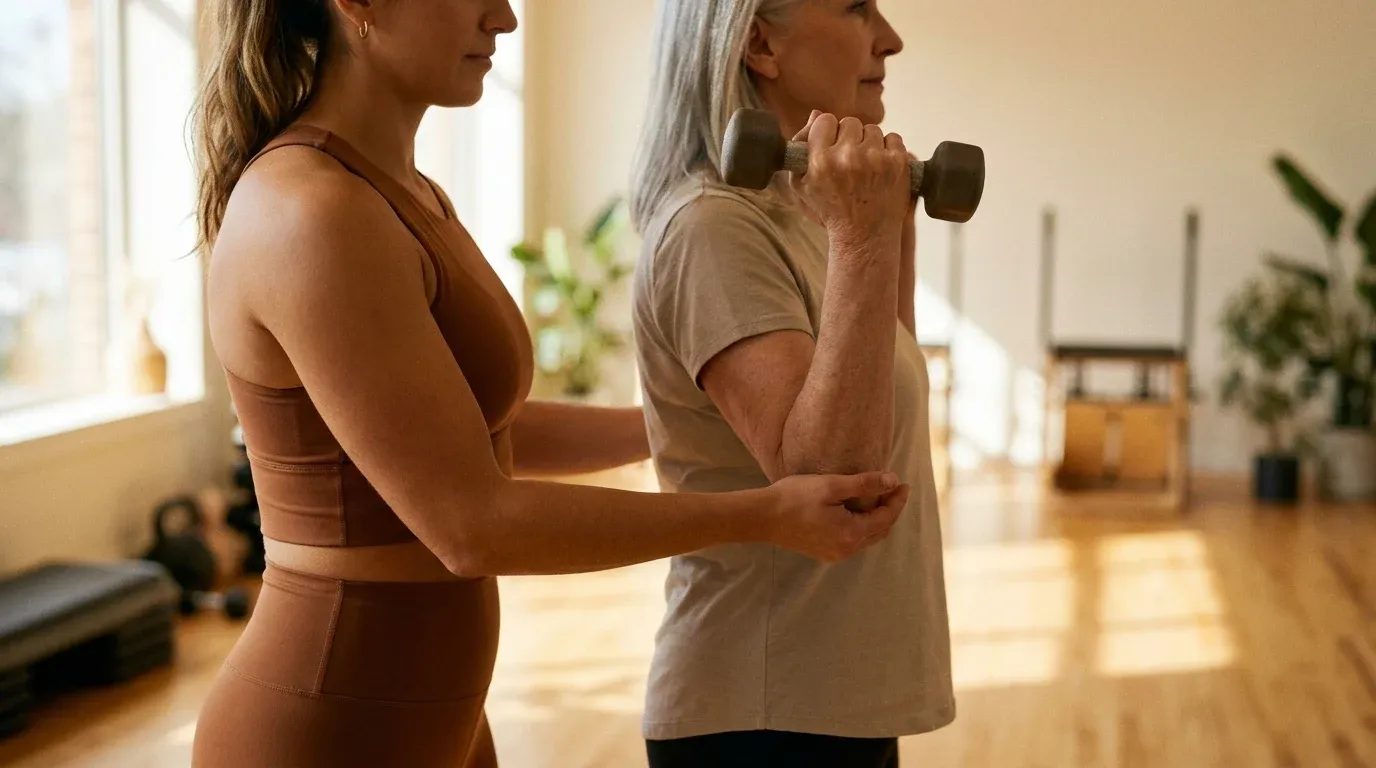
Most adults over 50 who walk into a coaching session carry the same assumption: to get stronger, you need to lift heavier. It's a belief shaped by decades of fitness culture, and it's one of the first things worth addressing. For this demographic, the goal isn't to outlift a 30-year-old. It's to move better, protect muscle mass, and build a training habit that actually sticks.
The good news for coaches is that a well-designed dumbbell protocol can accomplish all of that in under 30 minutes, without a rack, without a spotter, and without intimidating a client who hasn't trained in years.
Why Dumbbells Are the Right Starting Point
Dumbbells offer something barbells and machines don't: unilateral loading with natural range of motion. Each side works independently, which means strength imbalances get addressed early rather than masked. For beginners over 50, that matters. Asymmetries in strength and mobility are a major contributor to fall risk, which is one of the leading causes of injury-related hospitalization in adults over 65.
Dumbbells also reduce the technical learning curve. Your client doesn't need to learn how to brace for a barbell squat on day one. They pick up a dumbbell, follow a cue, and move. That lower barrier to entry translates directly into adherence, which is the variable that actually drives long-term results.
If you've worked with this age group before, you've probably already seen how quickly motivation drops when programming feels too complex or too foreign. The internal drive that keeps clients consistent has to be cultivated carefully at the start. Powered by You: Why Internal Drive Is the Only One That Lasts outlines why coaching decisions in the early weeks have an outsized effect on whether clients stay in the program at all.
Reframing Progressive Overload for Older Beginners
Progressive overload is non-negotiable. Without it, adaptation stalls. But overload doesn't mean heavier weight, and this distinction is especially important when you're coaching adults over 50.
Joint health, connective tissue recovery, and hormonal changes all affect how quickly this demographic can absorb increased load. Research consistently shows that time under tension, rep volume, and rest period manipulation are equally valid drivers of hypertrophy and strength adaptation in older adults. You don't need to add weight every session. You need to add demand in a way the body can recover from.
Practical progressions for this population include:
- Adding reps before adding weight. Move from 10 to 15 reps at the same load before increasing resistance.
- Slowing the eccentric phase. A 3-second lowering phase on a goblet squat turns a beginner movement into a meaningful strength stimulus.
- Reducing rest intervals. Shortening rest from 90 seconds to 60 seconds increases metabolic demand without touching the load.
- Adding a pause at end range. Holding a position at the bottom of a Romanian deadlift builds strength and mobility simultaneously.
This approach also sidesteps one of the most common errors coaches make when working with clients trying to build momentum. Pushing load increases too fast, too early, is a pattern worth examining closely. 5 Coaching Mistakes That Wreck Weight Loss Results covers several programming errors that quietly undermine client progress, many of which apply directly to strength coaching for older beginners.
The 5-Move Protocol
This circuit is designed to hit all major muscle groups, include a mobility component in each movement, and be completable in 25 to 30 minutes including warm-up. It works as a standalone full-body session or as the foundation of a 2-to-3-day weekly training block.
1. Goblet Squat
Hold one dumbbell vertically at chest height. Feet shoulder-width apart, toes slightly out. Squat to comfortable depth, keeping the torso upright and elbows inside the knees at the bottom. This move builds quad and glute strength while reinforcing hip mobility and ankle dorsiflexion. It's one of the best self-correcting movements for beginners because poor form is immediately uncomfortable.
Starting point: 3 sets of 10 reps. Progress by adding reps before adding load.
2. Dumbbell Romanian Deadlift
Holding a dumbbell in each hand, hinge at the hips with a soft knee bend. Lower the dumbbells along the thighs until you feel a hamstring stretch, then drive through the hips to return. This builds posterior chain strength and directly targets the hip mobility deficits that are near-universal in adults over 50 who've spent years sitting. Strong hamstrings and glutes are also your client's best protection against lower back pain.
Starting point: 3 sets of 10 reps. Add a 2-second pause at the bottom as a progression before increasing weight.
3. Single-Arm Dumbbell Row
With one hand and knee supported on a bench, row a single dumbbell toward the hip with the elbow driving back. This builds mid-back and lat strength, corrects the forward-rounded posture that develops after years of desk work, and trains unilateral control. Upper back strength is directly linked to shoulder health and spinal stability, two areas that decline quickly without targeted training.
Starting point: 3 sets of 10 reps per side. Progress by slowing the lowering phase to 3 seconds.
4. Dumbbell Overhead Press (Seated or Standing)
Press both dumbbells from shoulder height to full extension overhead. Seated reduces spinal loading for clients with lower back sensitivity. Standing adds a core stability demand. This builds shoulder strength and overhead mobility, which adults over 50 often lose gradually without realizing it. Reduced shoulder range of motion affects everything from carrying groceries to getting dressed.
Starting point: 3 sets of 10 reps. Use seated variation first, transition to standing as core stability improves.
5. Dumbbell Goblet Reverse Lunge
Holding one dumbbell at the chest, step one foot back into a lunge, lower the back knee toward the floor, then return to standing. The reverse lunge is far more joint-friendly than a forward lunge for beginners because it reduces shear force on the knee. It also trains single-leg stability, hip flexor length, and glute activation in one movement. For adults over 50, single-leg strength and balance are critical fall-prevention tools.
Starting point: 3 sets of 8 reps per leg. Add reps before adding load. Progress to a walking lunge when balance and strength allow.
Building Mobility Into Every Session
One of the highest-value things you can offer clients over 50 is a session structure that doesn't treat strength and mobility as separate concerns. Adults in this age group face two accelerating physical risks: muscle loss (sarcopenia begins in earnest after 50 at roughly 1 to 2 percent per year) and reduced joint mobility. Addressing both in a single session dramatically increases the efficiency of your coaching, and it's a strong differentiator if you're building a practice around this demographic.
Each of the five movements above was chosen specifically because it combines strength stimulus with mobility work. The goblet squat opens the hips. The Romanian deadlift lengthens the hamstrings under load. The reverse lunge stretches the hip flexors while building single-leg stability. You're not adding a mobility block at the end of the session. The mobility is built into the training itself.
This integrated approach pairs well with modalities like yoga for clients who want to supplement their strength work. Research shows that yoga improves metabolic health even without weight loss, making it a credible addition to a well-rounded over-50 program rather than just a flexibility afterthought.
How to Structure the Session
A practical session structure for beginners might look like this:
- Warm-up (5 minutes): Bodyweight hip circles, cat-cow, band pull-aparts or arm circles, and a slow bodyweight squat to assess range of motion.
- Circuit (20 minutes): Move through all five exercises with 60 to 90 seconds of rest between movements. Two to three full rounds depending on the client's current fitness level.
- Cool-down (5 minutes): Hip flexor stretch, hamstring stretch, and thoracic rotation. Keep it simple and tied directly to what was trained.
Keep the total session time to 30 minutes for the first four to six weeks. Extending duration before the client has built a consistent habit is a common programming mistake. Shorter, repeatable sessions build more long-term strength than longer sessions that lead to soreness, skipped workouts, and dropout.
Recovery quality matters here too. Adults over 50 often experience disrupted sleep, which directly affects muscle protein synthesis and training adaptation. If your clients are reporting poor sleep, it's worth understanding what's happening physiologically. Sleep stages matter more than total sleep time, and addressing sleep quality can be one of the fastest ways to improve training outcomes for this group without changing the program at all.
What This Protocol Means for Your Coaching Practice
A structured, repeatable dumbbell protocol for adults over 50 isn't just good programming. It's a scalable coaching asset. Once you've refined the progression system, you can deliver it in one-on-one sessions, semi-private formats, or small group settings. The group model in particular is worth considering if you're working with multiple clients in this demographic. Group Coaching Revenue Model: Why Coaches Underestimate It makes a strong case for why this format is underutilized, especially when the programming is already standardized.
The over-50 market is growing, underleveraged in most coaching practices, and highly motivated when given a program that respects both their goals and their physiology. A five-move dumbbell circuit that fits in 30 minutes, builds strength without intimidation, and addresses mobility in the same session is exactly the kind of clear, results-oriented offer that earns referrals and long-term retention.
Start simple. Progress systematically. Let the results do the convincing.