
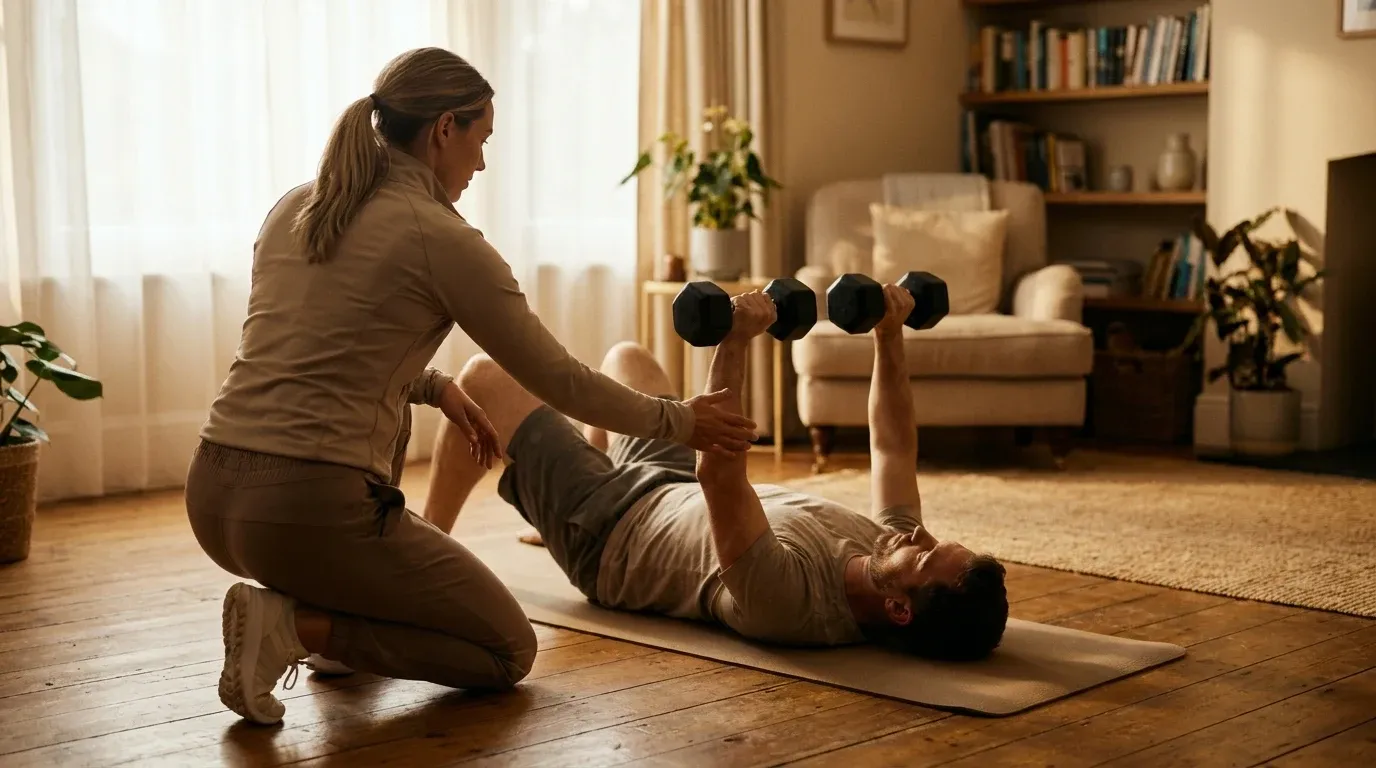
The image of personal training has changed. It's no longer just fluorescent-lit gym floors, mirrored walls, and cable machines. In 2026, a growing share of coached sessions happen in living rooms, garages, and back gardens. That shift isn't a workaround. It's a deliberate choice backed by real evidence, and it's reshaping how coaches and clients think about results.
If you've been weighing up home-based coaching against studio or gym training, here's what the research and current industry data actually say.
Hybrid Coaching Is Now the Default, Not the Exception
The fitness industry's pivot to hybrid coaching, accelerated by the pandemic years, has stabilized into something more permanent. A 2024 survey by the International Health, Racquet and Sportsclub Association found that over 60% of personal trainers now deliver sessions across at least two formats. In-person gym sessions, home visits, and remote video coaching are treated as interchangeable tools depending on the week, the client, and the goal.
That normalization matters. Home training no longer carries the stigma of being a second-best option for people who can't afford a real gym. It's a mainstream delivery format used by elite coaches and everyday clients alike. When you choose a home personal trainer in 2026, you're not settling. You're selecting a format that fits your life.
Before committing to any coaching arrangement, it's worth reading through the questions that actually matter in a personal training consultation, whether sessions happen at home or elsewhere.
Gym Anxiety Is a Real Barrier, and Home Training Eliminates It
Exercise psychology research consistently identifies gym-related anxiety as a primary reason beginners and returning exercisers drop out. The formal term is "exercise intimidation," and it's not a personality flaw. It's a documented, measurable response to unfamiliar social environments, perceived judgment, and uncertainty about how to use equipment correctly.
A 2023 study published in the Journal of Health Psychology found that gym-anxious participants who trained at home reported significantly higher session adherence over a 12-week period compared to those placed in group gym environments. The environment, not the motivation, was the primary variable.
For anyone returning to exercise after an injury, illness, or long break, this matters enormously. When your environment feels safe and familiar, you show up consistently. Consistency is the single biggest predictor of long-term results, ahead of program sophistication or equipment quality. A coach who trains you at home removes the environmental friction entirely before the first session even begins.
Your Coach Can See How You Actually Move
One underappreciated advantage of home-based training is the quality of movement assessment it allows. In a gym, your coach watches you perform exercises in a controlled, neutral setting. At home, they see how you actually live.
They notice the kitchen counter you brace against when you bend down. They see the chair you sit in for eight hours a day. They observe the staircase you navigate every morning and the way your lower back rounds when you pick something up from the floor. That information is genuinely useful for programming.
A trainer who can assess your movement in your real environment will write a more precise program than one who only sees you in a gym. Postural compensations, mobility restrictions, and daily movement habits become visible in context rather than in isolation. This is particularly valuable for older adults and anyone managing chronic pain or past injuries, where lifestyle-integrated movement matters as much as formal exercise.
Equipment Constraints Are a Feature, Not a Bug
Most people's home setups are modest. A few resistance bands, a pair of dumbbells, maybe a pull-up bar or a kettlebell. That's enough. In fact, for longevity-focused training, it may be ideal.
Bodyweight and functional training, which home constraints naturally push coaches toward, has one of the strongest evidence bases in the exercise science literature for long-term musculoskeletal health. A comprehensive 2022 review in Sports Medicine found that bodyweight resistance training produced comparable strength and hypertrophy outcomes to machine-based training in untrained and moderately trained populations, with lower injury incidence across the study period.
Functional programming also tends to prioritize movement patterns over isolated muscles. Push, pull, hinge, squat, carry, and rotate. These patterns transfer directly to daily life, which is exactly what matters if your goal is staying capable and pain-free as you age. For a deeper look at how pull movements specifically tend to get deprioritized even by experienced lifters, this breakdown of pull movements and push-pull imbalances is worth your time.
A skilled home trainer doesn't see a spare bedroom with two kettlebells as a limitation. They see an opportunity to build a program that's sustainable, technically sound, and directly matched to your body and goals.
Recovery Gets the Attention It Deserves
One practical side effect of home training is that recovery conversations happen more naturally. In a gym, a session ends and you leave. At home, a coach can integrate recovery practices directly into your session structure, cool-down breathing, mobility work, and sleep hygiene discussions become part of the coaching relationship rather than afterthoughts.
The science on recovery is clear: training adaptation happens between sessions, not during them. Understanding when active recovery outperforms complete rest is the kind of nuanced guidance that a home coach, working within your actual schedule and environment, is well-placed to deliver.
Home coaching also creates space to address the factors that undermine recovery but rarely come up in gym settings. Stress load, sleep quality, and nutrition timing all affect how your body responds to training. A coach who trains you at home sees the full picture of your life, not just the 45 minutes you're performing.
The Real Cost Comparison
The assumption that home coaching is automatically cheaper than gym-based training is worth examining carefully. Rates for an experienced in-home personal trainer in major US cities typically run between $80 and $150 per session, similar to mid-tier studio coaching rates. So the session cost itself may not differ dramatically.
What does change is the total cost of your fitness setup. Consider what gym-based training actually costs when you account for everything:
- Gym membership fees: $50 to $200 per month for facilities where you'd realistically want to train with a coach
- Commute time: For urban clients, 30 to 60 minutes of round-trip travel per session adds up to 2 to 4 hours per week. That's time with a real opportunity cost.
- Incidental spending: Post-gym smoothies, parking, and transit costs are small individually but consistent over months
- Missed sessions: Logistical friction (traffic, timing, fatigue after a long commute) is one of the most common reasons people skip paid sessions
When you account for these factors honestly, home coaching frequently comes out at comparable or lower total cost, particularly for clients in cities with high commute times or expensive gym memberships. And skipping fewer sessions means you extract more value from every dollar you spend.
It's also worth noting that a modest home equipment setup, a set of adjustable dumbbells, a resistance band kit, and a pull-up bar, can be purchased for $200 to $400 total and lasts years. That's a one-time investment that eliminates the recurring membership cost entirely.
When Home Coaching Is the Better Choice
Home-based training isn't universally superior. If your goal requires specialized equipment like a full power rack, a rowing machine, or a competition platform, a gym is the right environment. Athletes training for specific sport performance may also benefit from facility access.
But for the majority of people, those building foundational fitness, managing weight, recovering from injury, or simply trying to stay healthy and capable across decades, home coaching delivers everything that matters. The research supports it. The economics support it. And the removal of environmental barriers means you're far more likely to actually do it consistently.
Consistency built over months and years in a comfortable environment where a knowledgeable coach sees your real life and writes programs accordingly. That's not a compromise. That's a smart setup.
If you're starting or restarting a training routine and want a structured framework to build from, this guide to rebuilding a training routine from scratch applies equally well to home-based training, regardless of what time of year you're reading it.