
Walk into almost any commercial gym and you'll see the same pattern playing out across a dozen benches and curl stations. Chest on Monday. Biceps on Wednesday. Shoulders on Friday. Maybe some triceps thrown in for variety. The back, the glutes, the hamstrings, the hips. those get a token set or two, if they get anything at all.
This is bro training in its purest form. And if you've been self-programming for more than six months, there's a reasonable chance you're doing some version of it right now.
A good coach spots this in session one. Here's what they do about it, and why it matters more than any new exercise you could add to your current routine.
The Mirror Muscle Problem
The term "bro training" isn't an insult. It's a clinical description of a programming pattern defined by the overemphasis of muscles you can see in the mirror: the chest, biceps, and anterior deltoids. These are the muscles that respond visually, that look good in a fitted t-shirt, and that most people associate with being in shape.
The problem isn't training these muscles. It's training them disproportionately while systematically neglecting everything on the opposite side of the body.
When you train the chest and anterior shoulders repeatedly without balancing that volume with upper back and posterior shoulder work, you create a pulling imbalance at the shoulder joint. The pecs and front deltoids shorten and tighten. The rhomboids, lower traps, and rotator cuff muscles weaken from underuse. Over time, your shoulders start rounding forward. Your thoracic spine stiffens into flexion. The head drifts forward to compensate.
This isn't aesthetic. It's structural. And it sets up a predictable injury pathway: rotator cuff impingement, biceps tendon irritation, anterior shoulder pain, and eventually labral issues that sideline people for months.
Research consistently shows that upper crossed syndrome, a posture pattern characterized by tight chest and neck flexors paired with weak deep neck flexors and mid-back muscles, is directly associated with shoulder pain and reduced overhead function. It's also one of the most common presentations coaches see in self-trained clients who've been lifting for two to five years.
What's Being Left Out
The neglected side of a typical bro program isn't just the upper back. It's everything below the waist, and most of what's behind you.
Hamstrings. Glutes. Hip external rotators. The erectors. The thoracic extensors. These muscles don't just matter for aesthetics. They're the primary drivers of athletic performance, spinal stability, and long-term joint health. Weak glutes and hamstrings shift load onto the lumbar spine during daily activities like bending, lifting, and sitting for extended periods. That's a compounding liability.
Lower body neglect also has measurable consequences for bone density. Compound lower body movements, particularly those involving axial loading through the spine, are among the most effective stimuli for bone remodeling in adults. Isolation work on a preacher curl machine simply doesn't generate the mechanical forces needed to drive that adaptation. This becomes increasingly important as you age, and it's part of a broader picture of how strength training protects your physiology over decades. The cellular mechanisms involved in that protection are well-documented, including how exercise supports processes like the cellular recycling system that slows biological aging.
What a Barbell Actually Does for You
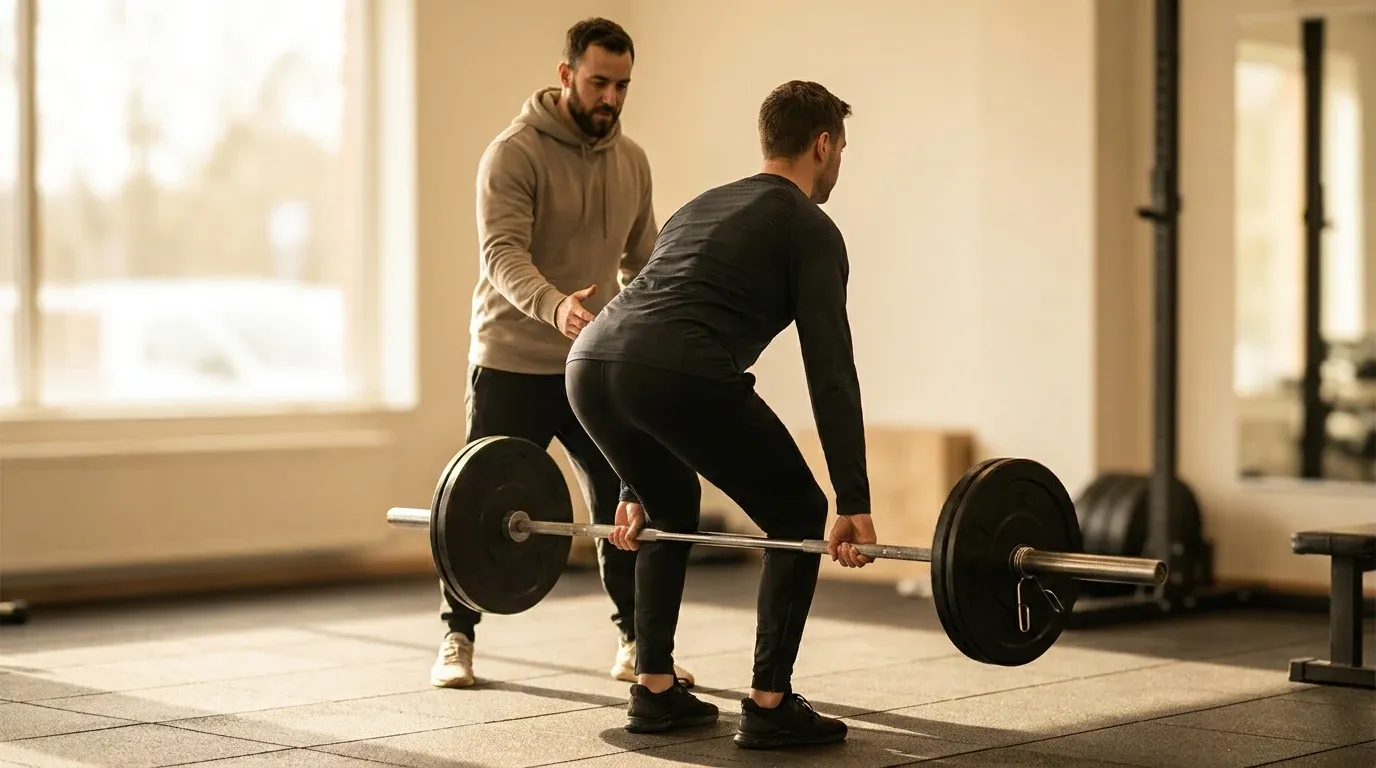
One of the first tools a good coach introduces to a bro-trained client isn't a new isolation exercise. It's a loaded barbell used for compound, multi-joint movements.
Squats, deadlifts, Romanian deadlifts, rows, rack pulls, hip thrusts. These movements recruit large muscle groups across multiple planes, require the posterior chain to stabilize and produce force simultaneously, and generate the kind of mechanical loading that isolation work cannot replicate.
A barbell back squat, for example, loads the spine axially, challenges hip and ankle mobility under tension, recruits the glutes, hamstrings, quads, and erectors in a coordinated pattern, and builds the proprioceptive demand that machine work bypasses entirely. The nervous system adaptation involved in learning compound movements is substantial. Your strength gains in the early weeks of introducing these lifts come almost entirely from neural efficiency, not hypertrophy. Understanding why your nervous system drives strength before muscle does helps explain why clients feel dramatically stronger within weeks of switching to compound-dominant programming.
There's also a meaningful difference in how these movements affect bone density compared to resistance band or machine-based alternatives. Research comparing resistance bands and free weights confirms that while bands have genuine utility, the axial loading provided by a barbell is particularly effective for skeletal adaptation, making it a difficult tool to replace when bone health is a priority.
How a Coach Reads Your Program in Session One
When a competent coach takes on a new self-trained client, the first thing they're doing isn't assessing how much you can bench. They're building a picture of what you've been doing, and more importantly, what you haven't.
The intake process typically involves reviewing your current program, asking about which movements feel comfortable versus which ones feel unstable or painful, and running a basic movement screen. A single-leg squat, a hip hinge, a wall shoulder reach. These quick assessments reveal compensations and asymmetries that a training history of bench press and curls tends to produce reliably.
Common findings in bro-trained clients include:
- Forward head posture and rounded shoulders from chronic anterior dominance
- Poor hip hinge mechanics from never training the pattern under load
- Weak glute activation with the hamstrings or lower back compensating on any posterior chain movement
- Limited thoracic extension making overhead positions unstable or painful
- Asymmetrical grip or shoulder height indicating side-to-side imbalances
A good coach doesn't add volume to what you're already doing. They rebalance the foundation first. That means temporarily reducing chest and biceps frequency, introducing posterior chain work at a volume the client can actually handle, and building the movement patterns that were missing before increasing total training load.
This is a critical distinction. The instinct for many clients is to keep their existing program and just add in the missing pieces. But if you're already training four or five days a week with a chest-heavy split, adding two posterior chain sessions on top of that doesn't create balance. It creates overtraining. Recovery needs to be protected during the rebalancing phase, and recovery management is an area where many self-trained clients also have significant gaps. Some approaches people rely on are actually counterproductive, which is worth examining separately: common recovery strategies that undermine your training progress are more prevalent than most people realize.
What Balanced Programming Actually Looks Like
A balanced program isn't necessarily symmetric in terms of exercise count. It's balanced in terms of the forces being applied to the body and the muscles being developed relative to each other.
A general framework a coach might use to correct a bro training pattern looks something like this:
- Pull-to-push ratio of at least 2:1 in the upper body. For every pressing movement, two pulling movements. This directly counters the anterior dominance pattern.
- Posterior chain priority in lower body programming. Deadlifts, Romanian deadlifts, glute bridges, or hip thrusts before quad-dominant work like leg press or lunges.
- Compound movements as the foundation of each session, with isolation work used selectively to address specific weaknesses, not as the primary driver of volume.
- Mobility and thoracic work integrated into warm-ups, not treated as optional. Tight thoracic extension is a direct byproduct of too much chest pressing, and it limits performance on virtually every upper body movement.
It's also worth noting that mobility deficits don't resolve quickly. Structural changes to posture and movement quality take months of consistent work, not weeks. If you're over 40, this process is both more important and requires more patience. A targeted daily mobility routine accelerates the process significantly and should be part of any rebalancing plan for clients in that age range.
Why You Shouldn't Wait Until It Hurts
One of the most consistent things coaches hear from bro-trained clients is some version of: "I only came in because my shoulder started bothering me."
The imbalance existed long before the pain. The pain is just where the imbalance finally exceeded the threshold your tissue could absorb. By that point, you're not just rebalancing a program. You're managing an injury while trying to train around it, which is slower, more frustrating, and more expensive.
Coaching intervention before pain appears is categorically more effective than intervention after it. A good coach isn't waiting for you to break down. They're identifying where the breakdown is going to happen and removing that risk before it materializes.
If you've been self-programming for more than a year with a chest-and-arms emphasis, you don't need to wait until something hurts to get an assessment. The pattern is predictable enough that a single session with a qualified coach will almost certainly reveal something you hadn't accounted for. That's not a criticism of your effort. It's just what systematic programming blind spots look like when someone examines them from the outside.
Getting ahead of that curve is the whole point of working with a coach. Fix the foundation first. The mirror muscles will still be there once the rest of your body catches up.