
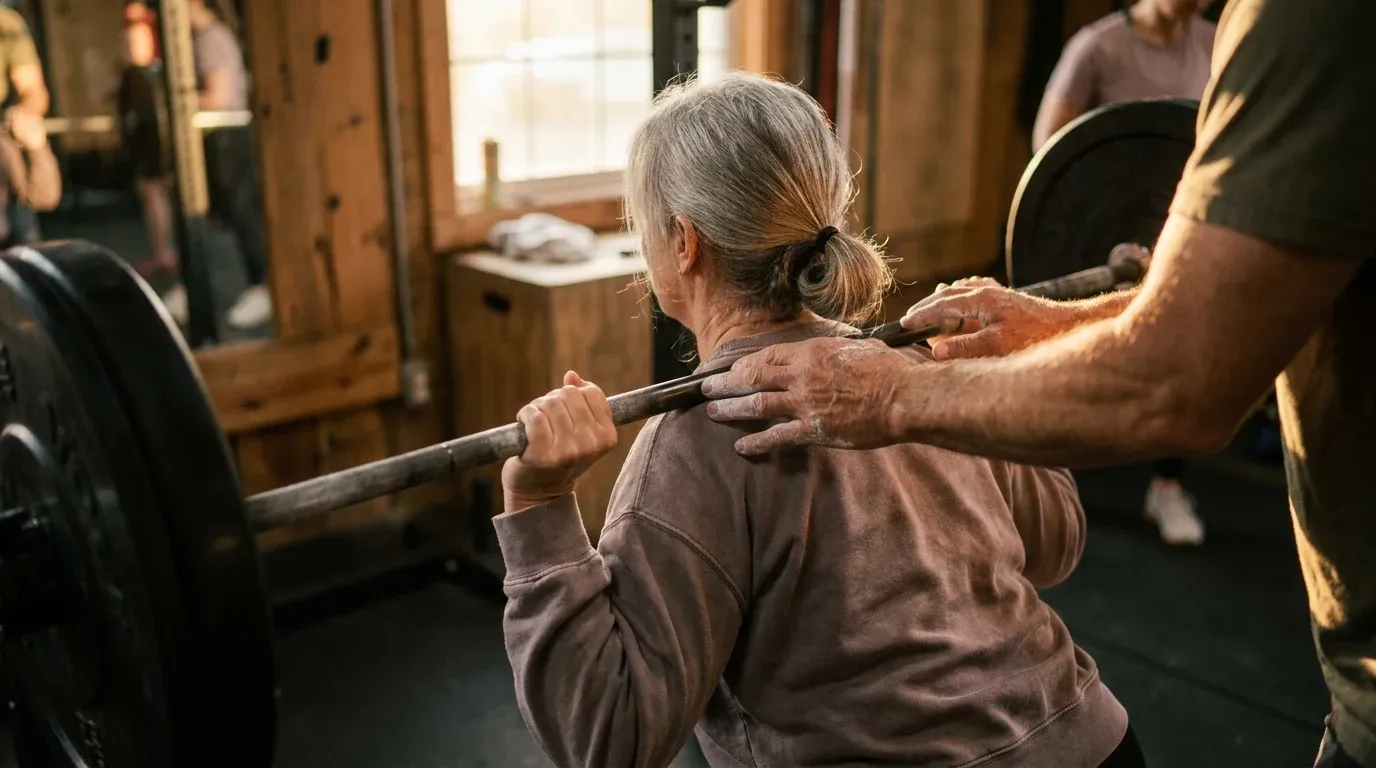
Clients over 50 are flooding personal training studios, and the numbers back it up. The over-50 demographic now represents one of the fastest-growing segments in the personal training market, which has surpassed $48 billion globally. Yet most coaches are still running these clients through programming designed for 28-year-olds. That's a problem with real consequences: overuse injuries, stalled progress, and dropout rates that hurt your retention numbers and your clients' health.
This guide gives you a practical framework built around what the science actually shows. It covers how to onboard older clients safely, which movement patterns deliver the highest functional return, and why recovery spacing isn't a scheduling preference. It's a core programming variable.
Why Standard Programs Fail Older Clients
The physiology of aging creates specific training constraints that most cookie-cutter programs don't account for. After 50, testosterone and growth hormone levels decline measurably, satellite cell activity slows, and connective tissue becomes less elastic. These aren't reasons to avoid hard training. They're reasons to structure it differently.
The most common mistake is treating older clients like deconditioned young adults. They're not. They often have decades of accumulated movement patterns, joint wear, and compensations baked in. Loading those patterns aggressively from week one doesn't build strength. It builds a case for physical therapy.
Research consistently shows that older adults respond well to resistance training when volume and intensity are managed carefully. The adaptations are real. The timeline is just longer, and the consequences of programming errors are steeper.
The 48-to-72-Hour Recovery Window
Session spacing is the most underestimated programming decision you'll make with clients over 50. While a 30-year-old might recover from a hard lower-body session in 36 to 48 hours, an older adult typically needs 48 to 72 hours before that same tissue is ready to be loaded again with meaningful intensity.
This isn't about being conservative for its own sake. It's about understanding that muscle protein synthesis rates and inflammatory clearance both slow with age. Stacking intense sessions too close together doesn't increase the training stimulus. It accumulates fatigue without the adaptation payoff.
A practical framework for most over-50 clients looks like this:
- 3 resistance training sessions per week, separated by at least 48 hours, with one longer recovery gap over the weekend
- Active recovery days using light walking, mobility work, or low-intensity cycling to maintain blood flow without adding systemic stress
- Session duration capped at 45 to 60 minutes of actual training time, not including warm-up and cool-down
Supporting recovery also extends beyond what happens in the gym. Sleep quality has a direct impact on muscular repair, and coaches should be asking about it during check-ins. Research spanning a decade links consistent sleep habits to reduced physiological stress, which matters a great deal when your clients are trying to recover from hard training sessions on top of demanding work lives.
Nutrition timing and protein quality also play into recovery speed. Getting adequate leucine-rich protein within a few hours of training supports muscle protein synthesis in a demographic where anabolic sensitivity is already reduced. Understanding protein quality scores like DIAAS helps you give clients practical guidance rather than just telling them to "eat more protein."
Mobility-First Onboarding: Building Confidence Before Loading
The first four to six weeks with a new over-50 client should prioritize movement quality over load. That's not about being overly cautious. It's about setting up every subsequent training block to land correctly.
A mobility-first onboarding phase accomplishes several things at once. It surfaces movement restrictions you'd otherwise discover painfully mid-session. It gives the client a series of early wins, which matters more than most coaches acknowledge. And it builds the neuromuscular patterns that compound movements will later depend on.
Here's what a structured onboarding phase looks like in practice:
- Weeks 1-2: Movement screening, hip and thoracic mobility work, light cardio conditioning (walking, cycling), bodyweight patterns only
- Weeks 3-4: Introduce goblet squats, hip hinges with a dowel, horizontal rows with bands or light cables. Focus on range of motion before adding resistance.
- Weeks 5-6: Begin loading compound movements at low intensity. Introduce the concept of progressive overload. Establish baseline numbers.
The light cardio component in those early weeks isn't filler. It improves cardiovascular baseline, helps with body composition, and has been shown to reduce systemic inflammation. It also keeps clients engaged while you're doing the less visible work of fixing movement quality.
Compound Movements as the Foundation
When programming for older adults, compound movements aren't just a preference. They're the most efficient use of limited training volume. Squats, deadlifts, Romanian deadlifts, hip thrusts, rows, and pressing patterns all recruit multiple muscle groups simultaneously, which means you're building functional strength across several movement systems in a single exercise.
Isolation work has its place, but it's supplementary. A client who trains three times a week for 45 minutes doesn't have the volume budget to spend significant time on bicep curls and leg extensions. They need movements that transfer directly to getting off the floor, carrying groceries, maintaining balance, and preserving bone density.
The compound movements that consistently deliver the highest return for over-50 clients include:
- Goblet squat and barbell back squat progressions: Quad and glute strength, hip mobility, balance
- Romanian deadlift and conventional deadlift: Posterior chain development, hip hinge mechanics, spinal erector strength
- Seated or bent-over row variations: Upper back strength, postural improvement, shoulder health
- Trap bar deadlift: A lower-back-friendly alternative with high full-body stimulus
- Push-up progressions and dumbbell press: Horizontal pushing patterns that preserve shoulder integrity
One point worth making explicitly: exercise selection should be modified, not avoided. A client with hip arthritis doesn't stop squatting. You find the variation that keeps them in a pain-free range and loads the pattern appropriately. The goal is always to keep them training.
Progressive Overload Is the Variable That Matters Most
Here's where a lot of coaches go wrong with older clients. They assume that because recovery is slower and injury risk is higher, the training needs to stay light indefinitely. That logic feels safe but it leads to plateau and disengagement. Clients don't pay for consistency. They pay for progress.
Progressive overload is the primary driver of long-term strength gains in any population, and over-50 clients are no different. The difference is how you apply it. In younger adults, progressive overload often means adding weight to the bar regularly. In older adults, the progression variables are broader and more nuanced:
- Load progression: Increasing weight in small increments (2.5 to 5 lbs) over weeks, not days
- Volume progression: Adding a set or additional rep range before adding load
- Tempo manipulation: Slowing the eccentric phase to increase time under tension without adding external load
- Range of motion progression: Gradually deepening a squat or hinge pattern as mobility improves
- Exercise complexity: Moving from a goblet squat to a front squat as the client builds capacity
Tracking these progressions is non-negotiable. Without data, you're guessing. With data, you can show clients exactly how far they've come, which is one of the strongest retention tools you have. The growth of one-on-one coaching formats reflects exactly this. Clients are paying for personalized attention and accountability, and documented progress is central to that value proposition.
The Bigger Picture: Recovery as a Lifestyle Variable
Strength gains don't happen in the gym. They happen in the 48 to 72 hours afterward. For over-50 clients, that recovery window is influenced by everything outside the training session: sleep quality, stress levels, nutrition adequacy, and systemic inflammation.
Coaches who treat recovery as purely a programming concern are missing half the picture. Checking in on sleep, hydration, and nutrition between sessions isn't overstepping. It's thorough coaching. Gut health, for example, directly affects how well clients absorb nutrients and manage inflammation. Emerging research on the gut microbiome and training recovery is giving coaches another evidence-based angle for those lifestyle conversations.
You don't need to become a registered dietitian. You need to ask the right questions and refer out when appropriate. A client who trains consistently, sleeps well, eats enough quality protein, and manages stress is going to outperform someone with a perfect program who ignores those factors. Every time.
Building a Practice Around This Demographic
Specializing in over-50 clients isn't a niche limitation. It's a business advantage. This demographic tends to have more disposable income, stronger commitment to appointments, and higher lifetime value per client than younger segments.
That means your programming quality directly reflects your reputation. A client who avoids injury, builds consistent strength, and feels better at 58 than they did at 52 is your most powerful marketing asset. They refer friends. They stay for years. They push back less on rate increases.
Getting the programming right isn't complicated. Space sessions to match recovery capacity, start with mobility and movement quality, anchor your program in compound movements, and drive progress through measured overload rather than intensity spikes. That's the blueprint. Apply it consistently and the results follow.