
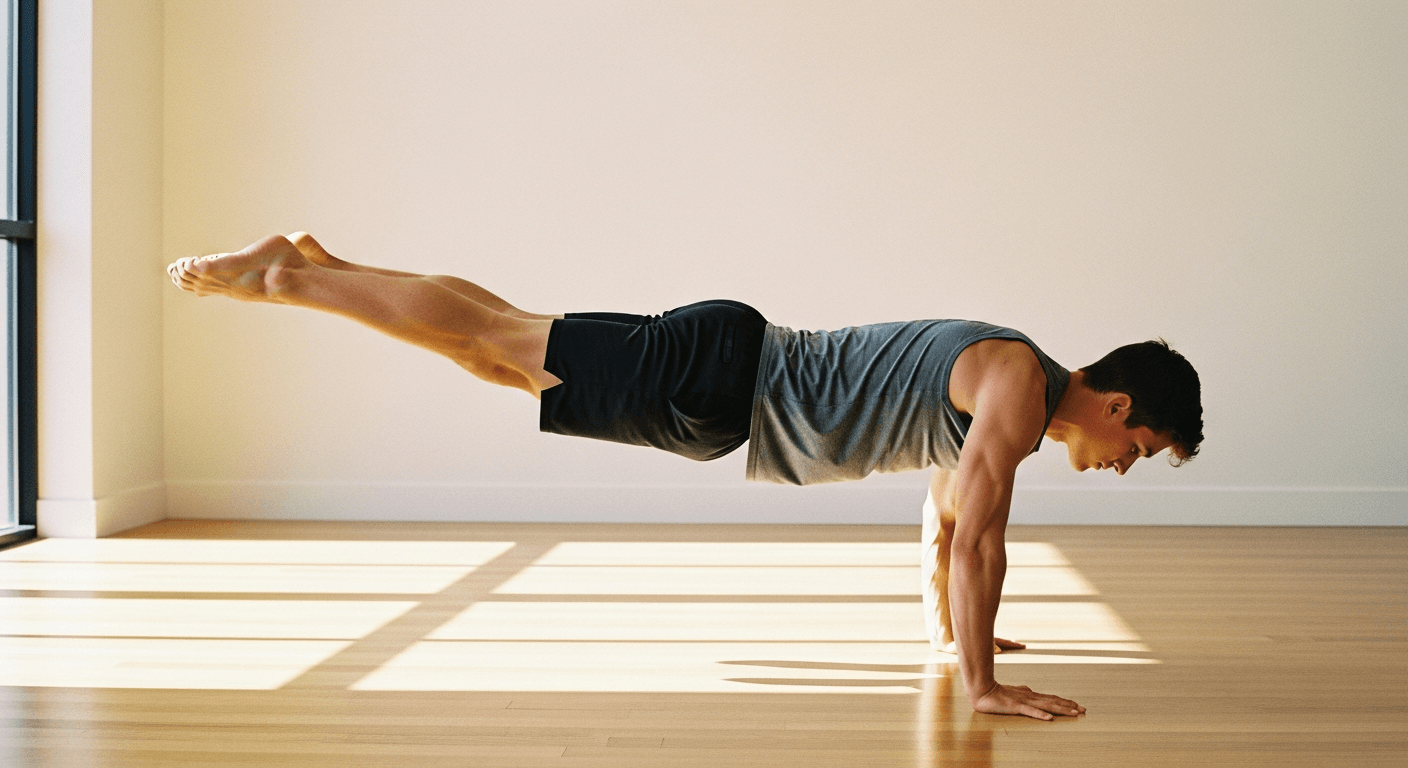
It's one of the most searched fitness questions online. And in 2026, science has a definitive answer: yes, bodyweight training can produce real hypertrophy, provided you apply the same principle that governs every form of resistance training: progressive overload.
Key Takeaways
- ACSM 2026: equipment type doesn't significantly change long-term muscle-building outcomes
- Progressive overload is the key variable, not dumbbells or barbells
- Lower body muscles are harder to overload without equipment
- Resistance bands fill most of the gaps in pure bodyweight training
What Science Says in 2026
The 2026 ACSM Position Stand, built on 137 systematic reviews across 30,000+ participants, concludes that equipment type (dumbbells, barbells, machines, bands, bodyweight) doesn't significantly impact long-term muscle gains.
What matters is that the muscle is exposed to sufficient effort, close to its maximum capacity, and that this effort increases progressively over time. The source of resistance is secondary.
Why It Works: The Logic of Overload
Your muscle doesn't know if it's pushing a barbell or doing a push-up. What it perceives is mechanical tension and metabolic stress. If that stress is high enough and increases over time, the muscle adapts and grows.
The real question isn't "weights or bodyweight" but "am I increasing the difficulty consistently?"
If you can do 30 push-ups easily and you keep doing 30 push-ups every week, the muscle gets zero growth signal. But if you progress from standard push-ups to weighted push-ups to feet-elevated push-ups to one-arm push-ups, you're creating real progressive overload.
The Real Limits of Bodyweight Training
To be honest: bodyweight does have real limits for some muscle groups:
- Quads and hamstrings: Bodyweight squats and lunges hit a ceiling fast. Progressing to pistol squats helps but is technically demanding.
- Back: Without a pull-up bar, options are limited. With a bar or rings, pull-ups and inverted rows cover the gap well.
- Shoulders: Pike push-ups and handstand push-ups work but require significant practice to reach adequate loading.
For most people, a hybrid program combining bodyweight movements with resistance bands for equivalent muscle growth (roughly $30-50 of investment) covers nearly every muscle group without needing a gym.
How to Build an Effective No-Gym Program
- Chest and triceps: push-up progressions (standard, feet-elevated, weighted, archer, one-arm)
- Back and biceps: pull-ups, inverted rows on a table or with bands
- Shoulders: pike push-ups, band lateral raises
- Legs: weighted squats with a backpack, Bulgarian split squats, glute bridges with added resistance
- Core: progressive planks, hollow body holds, dragon flag progressions
Apply the 2026 ACSM principles: target 10+ sets per muscle per week, stay 1-3 reps short of failure, and increase difficulty consistently. The equipment adapts to your situation. The principles don't change.