
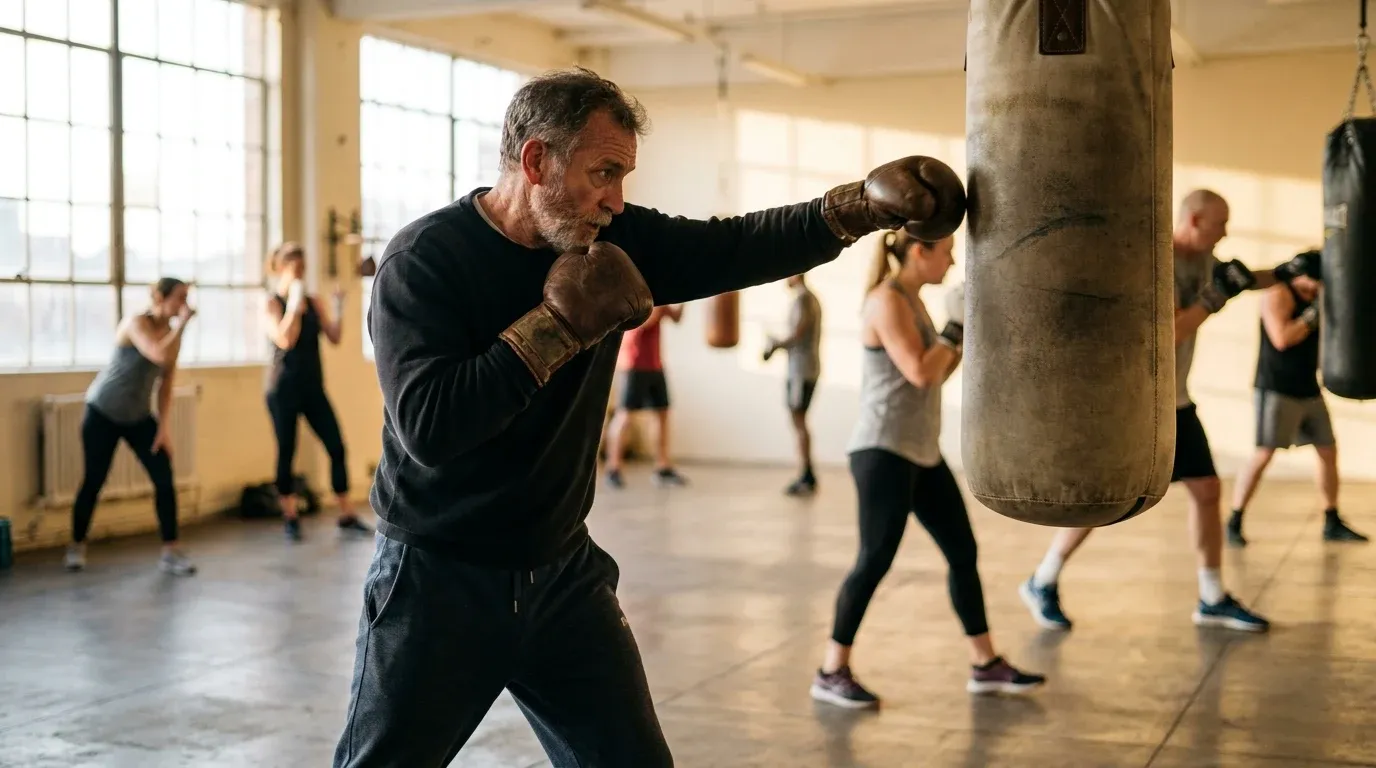
If you've been told that boxing is a young person's sport, the latest research disagrees. A study published in September 2026 found that adults over 50 who participated in group boxing programs outperformed their peers in traditional gym settings across nearly every measurable health marker. The results weren't marginal. They were consistent, meaningful, and they raise a serious question: why aren't more older adults throwing punches?
The short answer is perception. Boxing carries an image problem for this demographic. People picture split lips and sparring partners, not balance drills and cognitive challenges. But the modern fitness boxing landscape looks nothing like that. It's mitts, movement, rhythm, and community. And it turns out that combination may be exactly what the body over 50 needs most.
What the Research Actually Found
The September 2026 research examined adults over 50 enrolled in structured boxing programs compared to those following conventional exercise protocols, including standard resistance training and group fitness classes. The boxing participants showed superior adherence rates throughout the study period. They showed up more consistently, dropped out less frequently, and reported higher motivation to continue.
That alone would be worth noting. But the physical results went further. Researchers documented consistent improvements across a wide range of outcomes: physical-functional status, muscle strength, psychoemotional health, walk distance, balance, and cognitive function. Those aren't peripheral benefits. They're the exact markers that predict independence, fall prevention, and quality of life as people age.
The psychoemotional gains are worth pausing on. Mood, stress resilience, and sense of purpose all improved more significantly in the boxing cohorts. At a time when 24 minutes of music measurably cuts anxiety, it's worth appreciating how much the sensory and emotional demands of boxing training might compound those kinds of benefits in a single session.
The Dose Problem: Once a Week Is Not Enough
Here's where a lot of well-meaning programs fall short. The research made one thing clear: frequency matters enormously, and once-weekly sessions did not produce meaningful physiological change in adults over 50.
This isn't surprising to exercise physiologists, but it runs counter to how many community programs are structured. A single weekly boxing class might feel like enough effort. It might even feel hard. But the stimulus is insufficient to drive adaptation in this age group. The threshold for meaningful change appears to require at least two sessions per week, with three being more consistently associated with the documented gains in strength and balance.
Think of it like hydration. One good drink of water doesn't keep you hydrated across a week. The benefits require regularity. This is something to discuss honestly with any instructor or trainer you work with before committing to a program. If you want real results, the structure has to support the dose.
If you're evaluating coaching options to find the right program format and accountability structure, choosing the right type of coach for your goal can make a significant difference in how consistently you actually train.
Why Boxing Works Better Than Standard Gym Programs
Traditional gym programs have real value. Resistance training, in particular, remains one of the most evidence-backed interventions for healthy aging. But adherence is where most protocols fail older adults. People stop going. The reasons vary but they cluster around boredom, lack of social connection, and programs that feel disconnected from anything resembling fun.
Boxing addresses all three simultaneously.
Coordination demand. Every boxing movement requires neurological engagement. Learning a jab-cross-hook combination activates different motor pathways than a leg press or a lat pulldown. That constant coordination challenge appears to be one driver of the cognitive function improvements seen in the research. The brain is learning alongside the body.
Variable intensity. A boxing session naturally oscillates between high-effort bursts and active recovery. That variability, similar in principle to interval training, creates a broader cardiovascular stimulus than steady-state exercise at a fixed pace. It also makes sessions feel less monotonous, which keeps people coming back.
Social engagement. Group formats matter more than many exercise prescriptions acknowledge. Working with partners, responding to a coach's cues in real time, and sharing a physical challenge with others creates a sense of belonging that gym machines simply can't replicate. Research consistently shows social exercise increases adherence, and boxing's structure is inherently social.
This combination of cognitive load, cardiovascular variety, and community may explain why boxing cohorts outperformed traditional gym participants not just in physical metrics but in psychological ones. It's harder to quit something you genuinely enjoy and feel connected to.
The Balance and Fall Prevention Angle
Balance improvements deserve specific attention because falls are one of the most serious health threats adults over 50 face. A fall can trigger a cascade of consequences: fractures, reduced mobility, loss of independence, and significant declines in overall health. Conventional exercise often addresses balance through isolated drills that, while effective, lack the unpredictability of real-world movement.
Boxing training challenges balance in a more dynamic way. Shifting weight between a jab and a cross, moving laterally around a bag, rotating the torso while maintaining a stable base. these actions require constant proprioceptive adjustment. The research documented meaningful improvements in balance among regular boxing participants, which translates directly into fall risk reduction.
Combined with the strength gains recorded in the study, this creates a compounding protective effect. Stronger legs and a better-trained balance system together form a more resilient foundation for daily life.
How to Start Smartly
Starting boxing after 50 doesn't require any prior experience. Most group fitness boxing programs are designed specifically for beginners, and many explicitly welcome older adults. That said, a few principles will help you get results rather than just go through the motions.
- Commit to frequency from the start. Based on the research, plan for at least two sessions per week. Three is better. One session weekly may feel productive but won't drive meaningful adaptation.
- Find a group format. The adherence advantage in the research came specifically from group boxing, not solo bag work. The social structure is part of the mechanism, not just a preference.
- Progress intentionally. The coordination demands should increase over time. If you're doing the same combination at the same intensity after eight weeks, you're not progressing. Talk to your coach about advancing the complexity.
- Support recovery seriously. Training stimulus only produces results if recovery is adequate. Sleep quality, nutrition timing, and stress management all influence your ability to adapt. If you want a structured approach to rebuilding around a new program, the September Strength Reset offers a useful framework for structuring that kind of recommitment.
- Don't ignore supplementary evidence. When researching programs or supplements that promise to accelerate your results, apply critical thinking. Funding bias in supplement research is a real and documented issue, and the fitness industry targeting older adults is particularly susceptible to it.
What This Means If You're Already Active
If you're currently running, lifting, or attending fitness classes, boxing doesn't have to replace what you're doing. It can complement it. Adding two boxing sessions per week to an existing routine would likely deliver the coordination and balance benefits without disrupting cardiovascular or strength work you've already built.
Recovery becomes the variable to manage. If you're adding training volume, pay attention to how your body responds in the first four to six weeks. Soreness in unfamiliar movement patterns is normal. Fatigue that compounds week over week is a signal to adjust.
The research is also a reminder that the type of exercise matters as much as the fact of exercise. Doing something consistently is better than doing nothing, but doing the right thing consistently is better still. For adults over 50, boxing's multi-system demands appear to hit more of the right targets simultaneously than most single-modality programs.
The Bottom Line
Boxing after 50 isn't a novelty or a trend. It's a well-supported exercise modality with documented advantages in adherence, strength, balance, cognitive function, and emotional wellbeing for older adults. The September 2026 research adds to a growing body of evidence that the coordination demands and social structure of boxing training are genuinely superior to conventional gym programs for this population.
The caveat is real: frequency is non-negotiable. Once a week won't move the needle. But if you can commit to two or three sessions per week in a group format, the evidence suggests you're looking at one of the most effective things you can do for your health past 50. That's not a small claim. The research backs it up.