
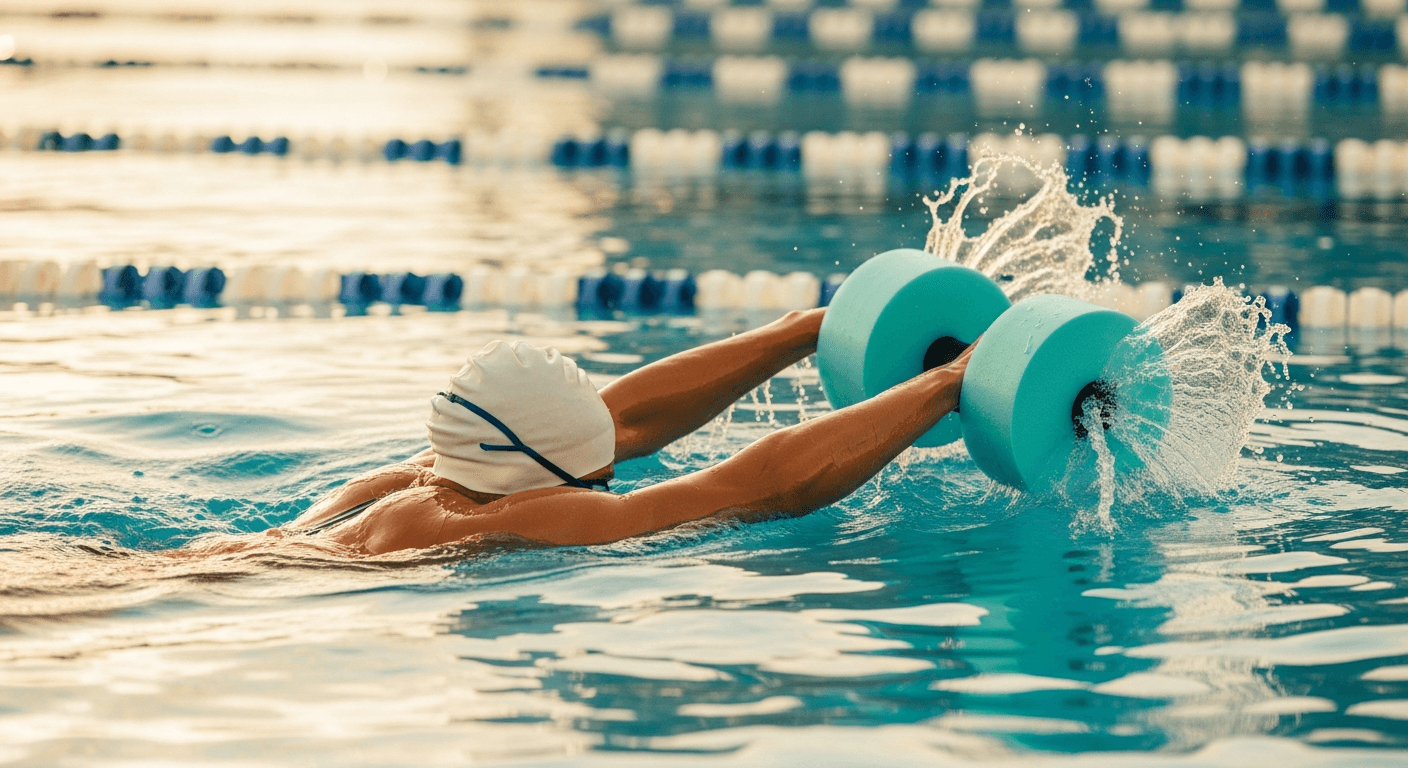
Aqua fitness is having a moment. What was once dismissed as light exercise for older adults is now showing up in boutique studios, athletic recovery centers, and training programs for competitive athletes. In 2026, aqua gym is being rebranded, upgraded with resistance equipment, and positioned as a serious training alternative. But serious marketing doesn't always equal serious results. So let's cut through it: can aqua training actually replace the weight room?
The honest answer is no. But that framing misses the real point. Aqua gym isn't trying to be the weight room. When you understand what it actually does well, and where it falls short, it becomes a genuinely useful tool rather than a fad you're supposed to feel excited about.
What Aqua Gym Actually Does to Your Body
Water creates resistance in every direction you move. That's not a marketing claim. It's physics. The drag force you work against in a pool scales with the speed and surface area of your movement, meaning the harder you push, the harder the water pushes back. Research consistently shows that water provides up to 12 times more resistance than air at equivalent movement speeds.
That resistance translates into real muscular effort. During aqua gym sessions, your stabilizer muscles, core, and lower body are continuously engaged just to maintain position and control. Your cardiovascular system works hard, your muscles fatigue, and your heart rate climbs. Studies measuring oxygen consumption during aqua jogging and water-based circuit training show results comparable to moderate-intensity land-based cardio sessions.
What you gain from a well-structured aqua gym class is genuine cardiovascular conditioning, muscular endurance, and improved neuromuscular coordination. Those are meaningful fitness outcomes, and they shouldn't be dismissed.
The Joint Stress Difference Is Real and Significant
Here's where aqua training earns its strongest argument. Buoyancy reduces effective body weight in water by roughly 80 to 90 percent depending on immersion depth. That means a 180-pound person working out chest-deep in a pool is experiencing approximately 20 to 36 pounds of gravitational load on their joints. Compare that to the same person performing a weighted squat or running on asphalt.
For athletes managing knee injuries, hip impingement, or lower back issues, this difference is not trivial. It's the reason physical therapists have used hydrotherapy for decades. It's also why aqua training is increasingly relevant to recreational gym-goers who are accumulating years of wear from high-impact training and need a smarter way to stay active during recovery windows.
If you're building a real recovery routine in 2026, aqua training fits naturally alongside other low-impact modalities. It lets you maintain conditioning without further stressing damaged or overtaxed tissue. That's a legitimate performance advantage, not a compromise.
Where Aqua Gym Can't Compete: Progressive Overload
Strength training works because of a fundamental principle: progressive overload. You add weight, increase reps, reduce rest, or change tempo to continuously challenge your muscles beyond their current capacity. Over time, that stimulus drives hypertrophy, increases maximum force production, and builds the kind of strength that translates to athletic performance and long-term health.
Aqua gym has a ceiling problem here. You can increase resistance by moving faster, using foam dumbbells or resistance gloves, or changing the surface area you're pushing against. But you cannot replicate the precise, measurable, and incrementally scalable overload that a barbell or cable machine provides. The resistance in water is also velocity-dependent, meaning if you slow down, the resistance drops. That makes consistent progressive loading difficult to control and nearly impossible to track with accuracy.
Research on muscle hypertrophy from aquatic training shows modest gains in untrained individuals but limited results in those who are already conditioned. For someone who has never trained, almost anything produces adaptation. But if you're a regular gym-goer with years of training behind you, aqua gym won't move the needle on muscle mass in any meaningful way.
This also matters for protein utilization. If you're following the updated 2025-2030 guidelines targeting 1.2 to 1.6 grams of protein per kilogram of body weight, you need sufficient mechanical muscle stimulus to actually put that protein to work for hypertrophy. Aqua training alone doesn't consistently provide that stimulus at the level required for meaningful muscle building.
Who Benefits Most From Aqua Training in 2026
The question isn't whether aqua gym is "good." It clearly is. The better question is who benefits most, and in what context.
- Athletes in heavy training blocks. Adding one aqua session per week as active recovery allows continued cardiovascular work while reducing cumulative joint load. You stay fit without digging the recovery hole deeper.
- People returning from injury. Low impact, full-body engagement, and natural resistance make aqua gym an excellent bridge between rehabilitation and return to full training.
- Older adults maintaining fitness. For those over 60 managing arthritis, joint replacement, or chronic pain, aqua training can be the primary modality without the risks associated with heavy lifting or high-impact cardio.
- Recreational gym-goers with high weekly volume. If you're training five or six days a week, replacing one land session with aqua work can sustain conditioning while giving connective tissue more time to recover.
- Endurance athletes in off-season or taper phases. Aqua running and pool circuits maintain aerobic capacity without the mechanical stress of road or track training.
What all these use cases share is a supporting role, not a lead one. Aqua training works best when it's part of a balanced program rather than the whole program.
How Aqua Gym Fits Into a Modern Training Stack
In 2026, the most effective training programs are built around recovery as a core variable, not an afterthought. Research increasingly shows that the quality of your adaptation depends as much on how well you recover as on how hard you train. In that context, aqua gym slots in cleanly.
Consider a practical weekly structure. You lift three days. You do one long aerobic session. You add one aqua gym session as active recovery. That fifth session keeps your cardiovascular base intact, your movement quality high, and your injury risk lower. You're not replacing anything. You're rounding out a program that already does what strength training does best.
Pair that with smart nutrition. Protein timing for muscle recovery matters more on your heavy lifting days, but maintaining consistent intake across the week, including lighter days, supports the continuous protein synthesis that drives adaptation over time.
You might also look at complementary recovery tools. The 2026 research on massage therapy for recovery points to genuine benefits for reducing delayed onset muscle soreness and improving tissue mobility between training sessions. Combined with aqua training on recovery days, you're building a real system, not just stacking random activities.
The Cost and Access Reality
One practical consideration that rarely gets addressed honestly: aqua gym requires pool access. In the US, a gym membership with pool access typically runs $50 to $120 per month depending on the facility. Dedicated aqua fitness classes at boutique studios can cost $25 to $45 per session. That's a meaningful addition to a standard gym budget, especially if you're already paying $40 to $80 per month for a weight training facility.
For most people, the economics push toward using aqua gym strategically, once or twice a week, rather than as a daily training environment. Which, conveniently, is exactly how it's most effective anyway.
The Bottom Line
Aqua gym is a legitimate training tool with real, documented benefits for cardiovascular conditioning, muscular endurance, and joint health. It's not a gimmick, and dismissing it as easy exercise misses what it actually delivers at the physiological level.
But it's not the weight room, and it doesn't pretend to be. You can't build maximum strength in water. You can't apply the kind of progressive overload that drives serious hypertrophy. And for anyone who's been lifting consistently, the muscular stimulus simply won't match what a barbell provides.
The smartest approach in 2026 is to stop asking whether aqua gym can replace the weight room and start asking where it fits in your program. For recovery, injury management, joint protection, and aerobic maintenance, it fits very well. If you're also tracking broader fitness markers, it's worth noting that what the revived Presidential Fitness Test actually measures includes endurance and mobility components where aqua training has direct carryover value.
Use aqua gym for what it's genuinely good at. Keep lifting for what lifting is genuinely good at. That's not a compromise. That's just a well-built program.