
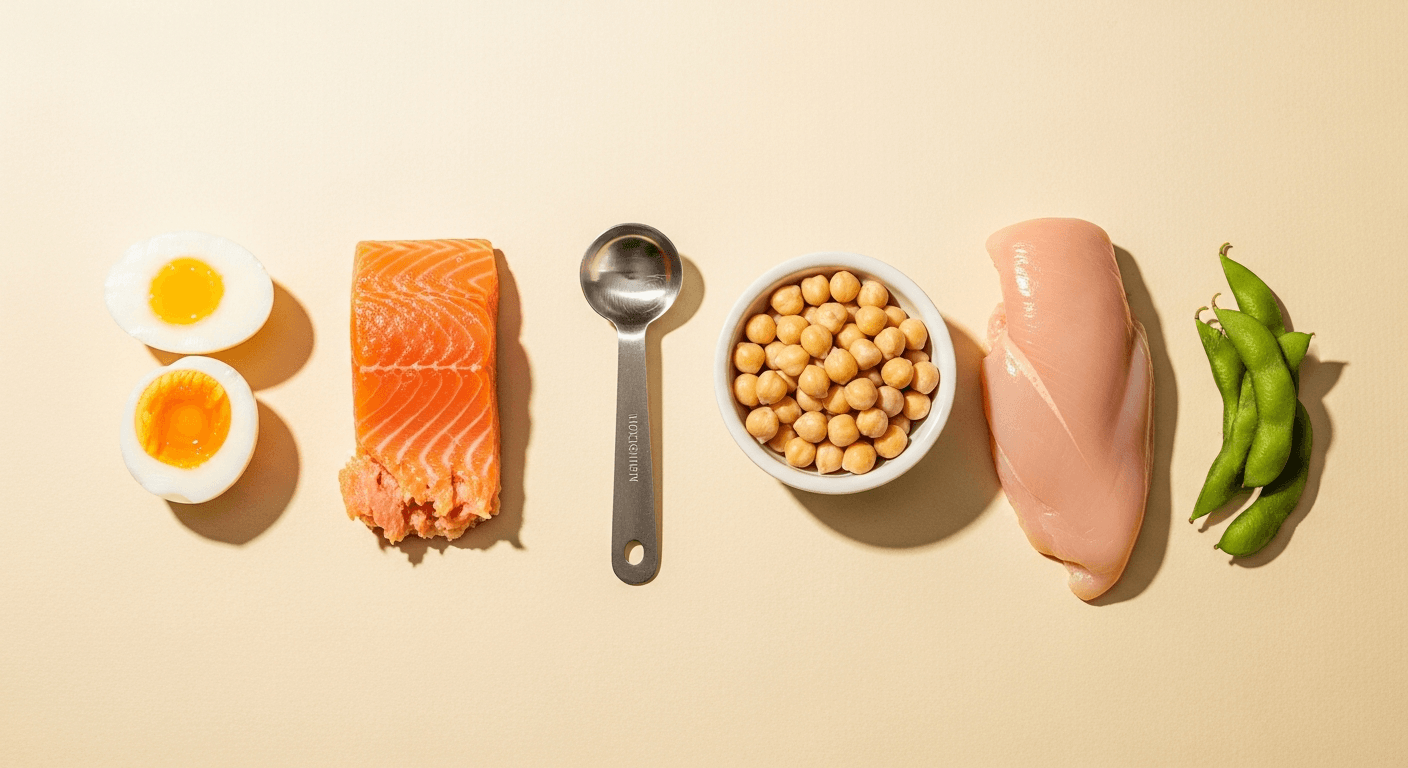
For decades, the recommended protein intake for adults sat at 0.8 grams per kilogram of body weight. That number, baked into US nutrition guidelines since 1980, lives in nutrition textbooks, food labels, and the standard advice patients hear from their doctor.
That benchmark just changed.
The 2025-2030 Dietary Guidelines for Americans now recommend a daily intake of 1.2 to 1.6 grams of protein per kilogram of body weight for adults. Almost double the old standard.
And it's not a marginal tweak. It's a fundamental rethink of what protein actually does in the body.
Why the Old 0.8 g/kg Number No Longer Holds Up
The original RDA of 0.8 g/kg was set to answer a specific question. What's the minimum amount of protein needed to prevent muscle loss in a healthy sedentary adult? The answer was 0.8 g/kg.
The problem is that nutrition science stopped framing the question that way over 15 years ago. More recent research shows that the amount needed to merely maintain muscle is very different from the amount needed to optimize strength, body composition, recovery, immune function, and the prevention of age-related sarcopenia.
The 2025-2030 committee updated the target accordingly. The 1.2 to 1.6 g/kg range corresponds to the levels where the majority of beneficial adaptations actually occur. That includes optimal muscle protein synthesis, improved satiety, metabolic stability, and lean mass preservation during a calorie deficit.
The Groups Most Likely to Underconsume
The report explicitly flags three subgroups at high risk of falling short. Adolescent females, young women, and older adults.
These populations share a common pattern. Lower total daily caloric intake combined with food choices that are less protein-dense. For a 25-year-old woman eating around 1,800 kcal per day on a moderately varied diet, hitting 1.2 g/kg requires conscious effort at each meal. Hitting 1.6 g/kg becomes almost impossible without active planning.
For older adults, the issue is even more critical. Muscle protein synthesis becomes progressively resistant with age, a phenomenon called anabolic resistance. For a meal to trigger the same anabolic signal it would have at 30, a 65-year-old needs a higher protein dose. That's the anabolic blunting effect, and it's why protein recommendations for adults over 65 sit at the upper end of the new range or above.
The Protein-Inflammation Link Science Just Quantified
A 2026 study added another data point that changes how to read the new guidelines. In certain genetic profiles, higher protein intake correlated with up to a 30 percent reduction in inflammatory biomarkers.
Chronic low-grade inflammation is one of the most strongly implicated factors in metabolic aging, cardiovascular disease, and muscle mass loss. If protein intake can modulate this baseline level, the 1.2 to 1.6 g/kg range isn't just a strength and lean mass target anymore. It's potentially a long-term metabolic health strategy.
The nuance matters. The effect is most pronounced in subgroups genetically predisposed to higher inflammation. Not everyone benefits in the same proportion. But the directional effect lines up with a growing body of literature that repositions protein as a pillar of overall health, not just physical performance.
How to Hit 1.2 to 1.6 g/kg Without Reengineering Every Meal
For an adult weighing 70 kilograms (about 154 pounds), the lower target is 84 grams per day. The upper target is 112 grams per day. Practically, that means aiming for roughly 25 to 35 grams of protein per main meal, plus a protein-focused snack if needed.
Here are useful reference points:
- A 3.5-ounce serving of cooked chicken, turkey, or lean beef delivers about 28 to 32 grams of protein
- A 5-ounce serving of full-fat Greek yogurt delivers about 15 grams
- One whole egg delivers 6 to 7 grams
- 1 ounce of hard cheese delivers about 8 to 10 grams
- A 5-ounce serving of firm tofu delivers about 18 grams
- A 30-gram scoop of protein powder delivers 22 to 25 grams
The simplest framework is to build each meal around an identified protein source rather than treating it as a side. A lunch built around a 5-ounce salmon fillet already covers 30 grams of the 84-gram target. A Greek yogurt and almond snack mid-afternoon adds another 18.
What This Means for Supplements
Protein powder and meal replacement sales grew 13 percent in unit volume and 12.4 percent in dollars year over year in 2025, hitting 8.6 billion dollars in the US alone. That isn't a fad effect. It's a logical response to recommendations that ask for a daily intake many people can't reach through food alone.
That said, supplements don't replace the food strategy. They complete it when life context gets in the way of three protein-rich meals. For a working professional who skips lunch three times a week, a properly dosed shake is a practical tool. For someone who can plan three real meals, whole foods remain more efficient on cost, satiety, and overall diet quality.
The Number to Keep
The 0.8 g/kg RDA isn't the reference to apply anymore. The new scientific baseline sits between 1.2 and 1.6 g/kg for most adults, with the upper range being more relevant for active populations and older adults. The practical translation is conscious meal structure around an identified protein source matched to the eater's profile.
The point isn't athletic performance. It's metabolic health, sarcopenia prevention, and chronic inflammation management. Protein just changed categories in nutrition. It's no longer one nutrient among others. It's a long-term health lever.