

Cardio and Strength Together: What the Science Actually Says
If you've ever been told to keep your cardio away from your lifting because it'll kill your gains, you've been given outdated advice. The fear of "concurrent training interference" has circulated in gyms for decades. But the actual evidence. The numbers. Tell a different story.
A major updated meta-analysis pooling data from 43 studies put hard figures on what happens when you combine aerobic and resistance training. The results challenge almost everything the fitness world has repeated as gospel.
The Interference Effect: What It Is and What It Isn't
The interference effect refers to the idea that aerobic training undermines the adaptations you'd normally get from strength training alone. The theory has been around since the 1980s and became embedded in training culture long before the evidence base was deep enough to test it properly.
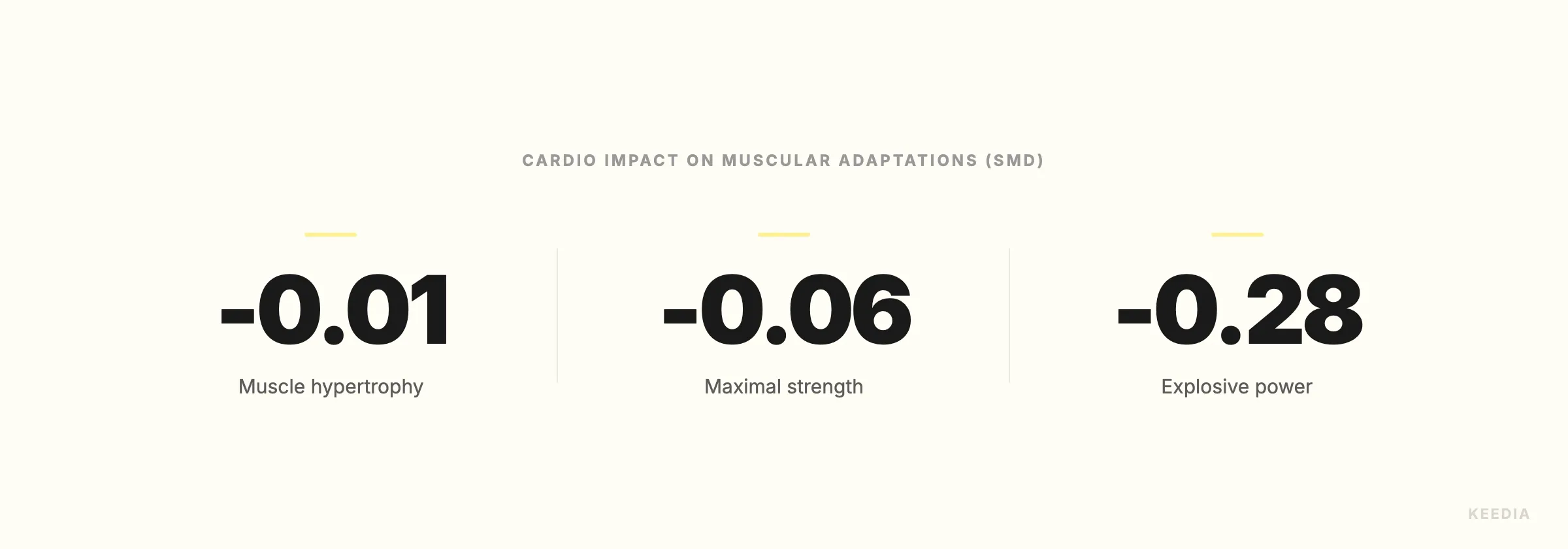
Here's what the updated data actually shows. When comparing concurrent training to strength training alone, the standardized mean difference (SMD) for muscle hypertrophy is -0.01. That's not a typo. The effect is essentially zero. Concurrent training produces virtually identical muscle growth to lifting alone.
For maximal strength, the SMD is -0.06. Again, negligible. If you're a recreational lifter, an intermediate, or even an advanced athlete who isn't competing in pure powerlifting, this difference is not going to matter to your real-world performance or your physique.
The conclusion is clear: adding aerobic training to your program does not meaningfully compromise hypertrophy or maximal strength. The interference effect, as most people understand it, doesn't exist at those levels.
The One Exception: Explosive Strength
There is a legitimate concern buried in the data, and it's specific. Explosive strength does take a hit when cardio and lifting are combined. The SMD here is -0.28, which is a small-to-moderate effect. If you're a sprinter, a jumper, a combat athlete, or a team sport player where power output is your primary currency, this matters.
But here's the critical nuance: this interference effect only appears when cardio and lifting are performed in the same session. Separate your sessions by three or more hours, and the effect disappears. Your nervous system has time to recover. The acute fatigue from aerobic work no longer bleeds into your power output during lifting.
For most people training in gyms, this is a straightforward fix. If explosive performance is a priority, don't do a 40-minute run and then immediately hit heavy jump squats. Either train them on separate days, or leave a minimum three-hour gap between sessions.
Not All Cardio Is Equal: Running vs. Cycling
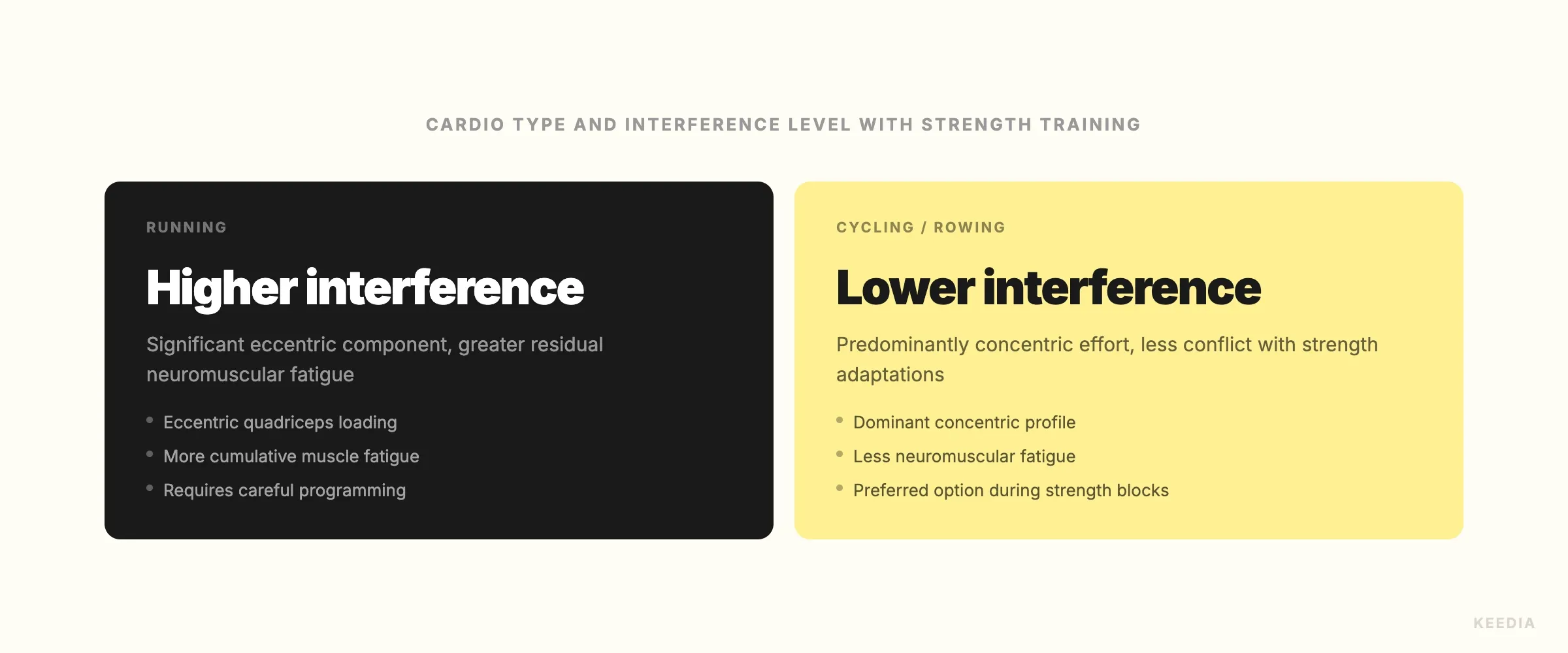
The type of aerobic work you choose matters more than most coaches acknowledge. The research shows a clear pattern: running combined with lifting produces more interference than cycling combined with lifting.
The likely mechanism is mechanical. Running creates significant eccentric loading through the lower body. That eccentric stress generates muscle damage and residual fatigue that overlaps with the demands of resistance training. Cycling, by contrast, is concentric-dominant. It taxes the cardiovascular system without imposing the same structural load on the musculature.
If you're programming concurrent training for a client or for yourself, and the goal is to minimize any potential interference while maximizing aerobic adaptation, cycling. Rowing. Swimming. These are lower-risk choices than running when combined with a lifting block.
This doesn't mean you should stop running. If running is your preferred mode, or if you're training for an event, that specificity is more important than marginal interference management. But for general fitness programming, it's a variable worth controlling.
Why Concurrent Training Is Actually the Better Choice for Most People
Looking beyond the interference question entirely, the case for concurrent training is compelling. The total health outcomes from combining aerobic and resistance training exceed those from either modality alone. Cardiovascular risk reduction. Metabolic health. Body composition. Bone density. Cognitive function. Mental health markers. Concurrent training hits all of them.
Neither a pure strength athlete nor a pure endurance athlete is optimizing for overall health. Most people are not competing at an elite level where specialization demands that trade-off. For the vast majority of the population, doing both is the physiologically superior option.
This is also relevant for anyone managing body composition alongside a medical or pharmaceutical protocol. If you're looking at how resistance training protects lean mass in various contexts, GLP-1 and Muscle Loss: What Training Can — and Can't — Fix covers that intersection in detail.
How to Structure Cardio and Strength in the Same Program
The science gives you a clear framework. Here's how to apply it practically.
- Separate sessions when possible. Train strength in the morning and aerobics in the evening, or on alternate days. A three-hour minimum gap between sessions eliminates the acute interference effect on explosive strength.
- If training in a single session, lift first. Neuromuscular demand is higher for strength work. Pre-fatiguing your nervous system with cardio before lifting is the worst sequencing choice if performance is your goal.
- Choose low-interference cardio modes. Cycling, rowing, and swimming impose less structural fatigue on the musculature than running, especially for the lower body. Use them when minimizing interference is a priority.
- Keep aerobic volume appropriate to your goal. More cardio is not always better. If hypertrophy or strength is the primary outcome, excessive aerobic volume will create caloric and recovery deficits that eventually do interfere with progress.
- Align your periodization. Don't attempt to peak your aerobic capacity and your strength simultaneously. Block periodization allows you to emphasize one quality while maintaining the other. For a deeper breakdown of how to structure this, periodization for natural athletes: block, undulating or linear? lays out the options clearly.
The 80/20 Rule for Aerobic Training Within a Concurrent Block
If you're including meaningful aerobic work alongside lifting, the intensity distribution of that aerobic work matters. The research on endurance athletes consistently supports an 80/20 split: approximately 80% of aerobic volume at low intensity (Zone 2), and 20% at high intensity (HIIT or threshold work).
Zone 2 training drives mitochondrial adaptations, improves fat oxidation, and builds the aerobic base without generating excessive fatigue. It's recoverable. You can run significant Zone 2 volume alongside a strength block without it crushing your lifting performance, provided total weekly load is managed sensibly.
If you're not sure where your Zone 2 actually sits without access to a lab, Zone 2 Without a Lab: Find Your Zone Accurately gives you practical field-based methods to identify it.
The 20% high-intensity component drives VO2max adaptation. It's more stressful and requires more recovery, so it needs to be scheduled carefully relative to your hardest lifting sessions. Stacking a high-intensity interval session the day before your heaviest compound lifts is a poor choice. Place it on the same day if you must, or on a lighter training day.
For a full breakdown of protocols designed specifically to push VO2max, how to improve your VO2max: the research-backed protocols covers the evidence in detail.
Recovery Is the Variable That Changes Everything
The numbers in the meta-analysis assume adequate recovery. An SMD of -0.01 for hypertrophy assumes you're sleeping, eating, and managing stress at a level that allows adaptation to occur. If your recovery is compromised, the equation shifts.
Sleep quality is particularly relevant for anyone running a concurrent training program. The demand on the body is higher. Recovery windows are tighter. Magnesium and Sleep for Athletes: Which Form, What Dose, What Results covers one of the more evidence-supported interventions for improving sleep quality in athletes under high training load.
Don't overlook deload cycles either. Concurrent training accumulates fatigue faster than single-modality training. Periodic planned reductions in volume and intensity are not optional for long-term progress. They're structural. The evidence on how to time and design them is worth reviewing if you haven't already.
The Bottom Line
The data is consistent and clear. Concurrent training does not kill gains. Hypertrophy and maximal strength are effectively unaffected when aerobic training is intelligently combined with lifting. Explosive power is the one area where interference is real, and it's fully manageable with session sequencing.
The health argument for doing both is stronger than the argument for specializing in one, for most people. The interference effect was never as universal as the gym mythology suggested. Train smart, sequence your sessions with intention, and stop choosing between cardio and strength as if it's a binary.
It isn't.