
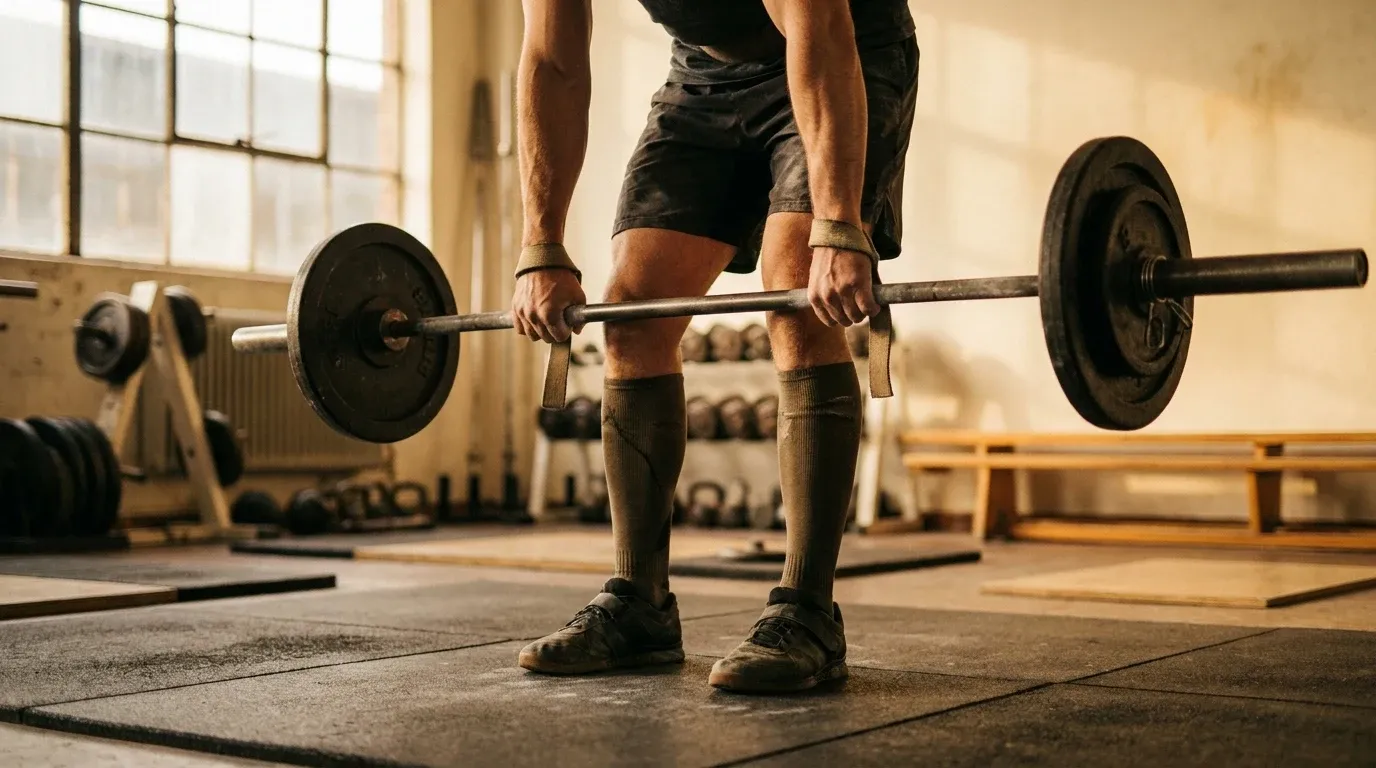
Strength training's connection to longevity isn't a fringe theory anymore. The research has moved from niche sports science journals into mainstream clinical guidelines, and the core finding is consistent: people who lift regularly live longer, with better functional capacity, than those who don't. But not all lifts are created equal when it comes to that outcome.
If you're training with one eye on the long game, movement selection matters more than most programs acknowledge. Here's what the evidence points to, and why these four compound lifts earn a permanent place in your routine.
Why Compound Movements Drive Longevity Adaptations
The physiological argument for compound lifts isn't complicated. When you recruit large amounts of muscle mass simultaneously, you trigger hormonal and metabolic responses that isolation exercises simply can't replicate at the same scale. Testosterone, growth hormone, and IGF-1 all rise more significantly after multi-joint movements, and these hormones are directly tied to muscle retention, bone density, and metabolic health across decades.
Muscle tissue itself functions as a metabolic organ. It improves insulin sensitivity, regulates glucose disposal, and supports immune function. Maintaining it as you age is one of the strongest predictors of functional independence and reduced disease risk. Compound lifts are the most efficient tools for building and preserving that tissue.
The time efficiency argument is equally compelling. A 2022 analysis published in the British Journal of Sports Medicine found that approximately two hours of muscle-strengthening activity per week was associated with a 13% reduction in all-cause mortality risk. That's a meaningful return. When your training window is limited, choosing movements that work the most muscle in the fewest sets isn't a shortcut. It's strategy.
1. The Squat: Loading the Foundation of Human Movement
The squat is the most fundamental lower-body pattern in existence. Sitting down, standing up, climbing stairs, getting off the floor. These are all squat-pattern movements, and your ability to perform them with control and strength determines a significant portion of your functional independence as you age.
From a longevity standpoint, the squat matters because it loads the largest muscles in your body simultaneously. The quadriceps, hamstrings, glutes, and spinal erectors all work together under load, driving systemic hormonal responses and demanding high levels of neuromuscular coordination. Research consistently links lower-body strength to reduced fall risk and lower cardiovascular mortality in older adults.
You don't need to back-squat heavy to get the benefit. Goblet squats, front squats, and box squats all preserve the movement pattern and can be progressed systematically. The key variable isn't the specific variation. It's that you're squatting, loading it progressively, and doing it consistently over years.
- Primary muscles: Quadriceps, glutes, hamstrings, spinal erectors
- Functional carry-over: Rising from seated positions, stair climbing, fall prevention
- Longevity marker: Lower-body strength is inversely correlated with cardiovascular and all-cause mortality risk
2. The Deadlift: The Full-Chain Pull
No other lift loads the posterior chain as completely as the deadlift. From the lats and traps through the spinal erectors, glutes, and hamstrings, it demands that your entire back half work as a coordinated system under genuine load. That's rare in most training programs, and it's exactly why its absence creates long-term vulnerabilities.
Grip strength deserves specific mention here. Research has repeatedly identified grip strength as one of the strongest predictors of all-cause mortality, outperforming many conventional cardiovascular markers in longitudinal studies. The deadlift trains grip under maximal tension, in a way that carries over to real-world demands far more than forearm curls or grip trainers ever will.
Hip-hinge mechanics, which the deadlift develops directly, also underpin safe movement for daily tasks like lifting objects off the floor. Losing the ability to hinge without compensating through the lower back is a major contributor to injury risk and functional decline. Training the pattern keeps it available when you need it. For those who want to reinforce this further, hanging from a bar for 30 seconds is a simple accessory practice that builds grip and shoulder integrity between heavier sessions.
- Primary muscles: Posterior chain, lats, traps, forearms
- Functional carry-over: Lifting from the floor, loaded carries, postural integrity
- Longevity marker: Grip strength is among the most predictive physical markers of long-term survival
3. The Barbell Row: The Neglected Pull
Most recreational lifters have an imbalanced push-to-pull ratio. They bench press, they overhead press, and they largely neglect the horizontal pulling pattern that keeps shoulders healthy and posture intact. The barbell row corrects this, training the mid-back, rhomboids, rear deltoids, and biceps in a way that directly counteracts the forward-rounded posture most people accumulate from prolonged sitting.
Postural integrity isn't just aesthetic. Thoracic kyphosis, the exaggerated forward rounding of the upper back, is associated with reduced lung capacity, increased fall risk, and higher rates of vertebral fracture in older populations. Rows train the muscles that resist that pattern, keeping you upright and structurally sound across decades.
If you've been prioritizing pressing movements and underweighting pulls, this is worth reconsidering as a structural issue. Pull movements are consistently the most neglected lift in recreational programs, and the postural and functional cost accumulates quietly over years before it becomes obvious.
- Primary muscles: Latissimus dorsi, rhomboids, rear deltoids, biceps
- Functional carry-over: Pulling, carrying, postural support, spinal decompression
- Longevity marker: Upper-back strength protects against thoracic kyphosis and the functional decline it accelerates
4. The Overhead Press: Shoulder Health Above Your Head
The overhead press is the only one of these four lifts that loads the upper body through a vertical pressing pattern. That matters because reaching overhead, whether to place something on a shelf or to catch yourself during a fall, is a movement capacity that erodes quickly when it isn't trained.
Beyond shoulder strength, the overhead press demands core stability in a way that bench pressing doesn't. You're pressing a load directly over your center of mass with no bench to stabilize against. Your lumbar spine, glutes, and obliques all have to co-contract to keep you from collapsing under the load. That full-body demand makes it a more systemically taxing lift than it appears.
Rotator cuff integrity is also directly addressed here. Controlled overhead loading, with good mechanics and appropriate weight, strengthens the shoulder's stabilizing musculature and reduces injury risk over time. The overhead press done well is protective. Done poorly or avoided entirely, shoulder capacity tends to degrade quietly until something gives way under an unexpected load.
- Primary muscles: Deltoids, triceps, upper traps, rotator cuff stabilizers, core
- Functional carry-over: Overhead reach, fall response, carrying objects at shoulder height
- Longevity marker: Shoulder function and overhead capacity predict upper-body independence in aging populations
Progressive Overload: The Variable That Binds All Four
Performing these four lifts is the starting point. Making consistent, measurable progress on them over months and years is the mechanism that produces long-term adaptation. Progressive overload, adding load, volume, or density incrementally over time, is the single most evidence-supported driver of sustained muscle retention and strength development.
Muscle mass peaks in most people around their mid-thirties and declines at roughly 3-8% per decade without resistance training, accelerating significantly after sixty. Progressive overload on compound movements is the primary lever that counteracts that trajectory. You don't need to be adding weight every single session. You do need to be making measurable progress over every training block.
This is also where program structure becomes critical. If you're returning to training after time away, building your routine around these four movements with clear progression markers gives you the most direct path back to meaningful adaptation. Rebuilding your gym routine with a structured reset is one of the most effective ways to reestablish that progression baseline after a break.
How to Put This Into Practice
You don't need to train all four lifts in every session. A two or three day per week program built around these movements, with progressive loading tracked over time, is sufficient to capture the longevity benefits the research identifies. Consistency across years matters more than complexity within any given week.
If you're unsure whether your form on these movements is actually sound, that's worth addressing directly before adding load. Working with a qualified coach to assess your mechanics is a significantly better investment than years of training patterns that accumulate structural strain. Understanding which questions to ask in a personal training consultation helps you find someone who can actually evaluate movement quality rather than just count reps.
Strength training's longevity benefits are not incidental. They're dose-dependent, pattern-specific, and progressive. These four lifts give you the highest return on that investment. The rest is showing up consistently enough to let the adaptation compound.