
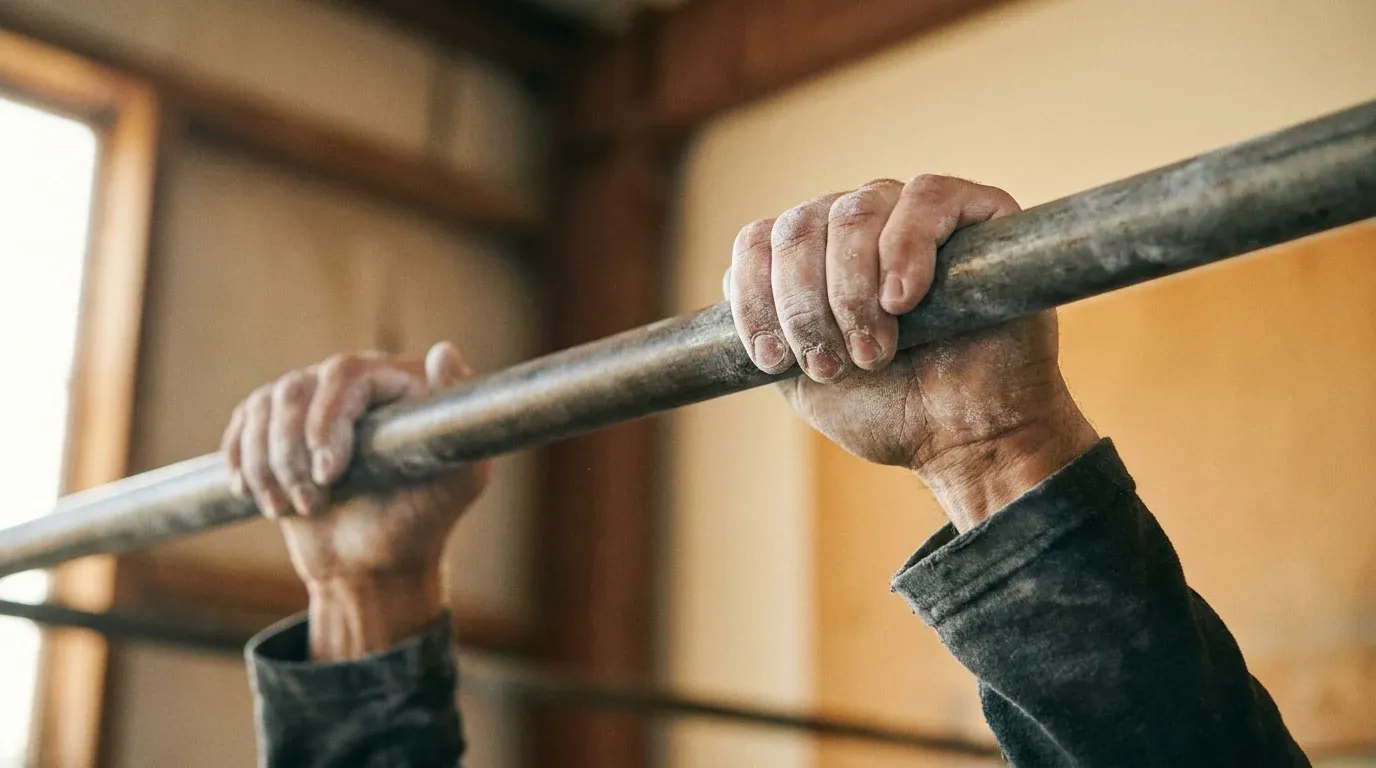
Hang from a Bar for 30 Seconds: What It Does to Your Body
It looks almost too simple to matter. You grab a pull-up bar, let your feet leave the ground, and just hang there. No reps, no tempo, no complex loading scheme. Yet research emerging from the climbing world is making a strong case that this single, humble movement delivers structural benefits that most gym programs are quietly missing.
Dead hangs. passive bodyweight suspension supported entirely by your grip. are earning serious attention from coaches and physio teams who have spent years watching climbers develop grip strength, shoulder resilience, and postural control that most lifters never achieve. And it turns out, you don't need to be a climber to collect those benefits.
What the Research on Climbers Is Actually Telling Us
Climbing athletes spend significant time supporting their full bodyweight through their hands, fingers, and wrists. Studies measuring grip strength, shoulder joint integrity, and connective tissue density in trained climbers consistently show values that outperform sport-matched controls. What makes these findings relevant beyond the climbing gym is that the adaptations appear tied to the hanging stimulus itself, not to the technical skill of climbing routes.
One key finding across multiple studies is that the tendons and ligaments of the hand, wrist, elbow, and shoulder girdle respond to sustained low-load tension, exactly what a dead hang produces. Connective tissue adapts more slowly than muscle, often requiring six to twelve weeks of consistent loading to show measurable change, but it does adapt. Regular hanging appears to be one of the most efficient ways to apply that stimulus without adding muscle fatigue or joint compression.
Scapular positioning is another consistent finding. Climbers show better resting scapular mechanics and lower rates of shoulder impingement than populations doing equivalent volumes of upper body pressing. The working theory is that hanging loads the shoulder in a distraction pattern, the opposite of compression, which helps remodel the tissue around the rotator cuff and keeps the subacromial space clear.
What 30 Seconds of Hanging Actually Does
Thirty seconds is not an arbitrary number. It sits in a range that's long enough to produce a meaningful tensile load on connective tissue without tipping into grip failure for most gym-goers. Think of it as the minimum effective dose.
During a dead hang, several things happen simultaneously:
- Grip strength recruitment: Every muscle involved in finger flexion and wrist stabilization is working under load. Over time, this builds the kind of functional grip strength that carries over to deadlifts, rows, and daily life.
- Shoulder decompression: Gravity gently pulls the humerus downward, creating space in the joint capsule. For anyone doing heavy pressing, this is a direct counterweight to the compression those movements create.
- Scapular engagement: Even in a passive hang, your scapulae are being loaded and positioned. An active hang, where you gently retract and depress them, trains the serratus anterior and lower trapezius with almost no recovery cost.
- Spinal elongation: The vertebral discs decompress slightly under traction. Many people report immediate relief from lower back tightness after a single set.
- Wrist and elbow tissue loading: The tendons at the wrist and elbow, often undertrained in standard lifting programs, receive direct stimulus that supports long-term joint health.
None of these effects require you to pull yourself up. The hang itself is the intervention.
Why This Matters for Pressing-Heavy Programs
Most standard gym programs are push-dominant. Bench press, overhead press, incline press, dips. These are the movements people prioritize, and they build real upper body strength. But they also create a mechanical environment that gradually increases shoulder impingement risk by tightening the anterior shoulder capsule and underloading the muscles that pull the scapula back and down.
The dead hang directly offsets this. If you're doing three or four pressing sessions per week with minimal pulling volume, adding two to three sets of hanging to your warm-up or cool-down is one of the fastest structural corrections you can make. It doesn't require extra gym time. It doesn't generate meaningful fatigue. And it begins rebalancing the shoulder without removing any of the pressing you enjoy.
For a deeper look at why pulling volume is chronically underprogrammed in most training plans, Pull Movements: The Most Neglected Lift in Your Program breaks down the mechanics and offers a practical approach to restoring balance.
Zero Equipment, Maximum Accessibility
Part of what makes the dead hang worth championing is how few barriers exist to doing it. A pull-up bar. Your bodyweight. That's it. You don't need a climbing gym membership, specialized equipment, or a coach to supervise the movement.
For gym-goers returning after a break, dead hangs offer a low-risk re-entry point for upper body training. If you're rebuilding your program after time off, incorporating hangs early is a smart way to start loading the connective tissue before ramping up heavier compound work. The September Reset: How to Rebuild Your Gym Routine guide covers exactly this kind of progressive reintroduction strategy.
For those with current shoulder sensitivity or early-stage impingement symptoms, always clear hanging with a physiotherapist before loading. But for the majority of gym-goers without active injury, dead hangs represent one of the safest movement patterns in the entire training toolkit.
How to Program Dead Hangs Without Overcomplicating It
Coaches who use dead hangs regularly tend to keep the programming simple, and that simplicity is part of the point. Here's a framework that works across most training contexts:
- Sets and duration: 2 to 3 sets of 20 to 45 seconds, depending on your current grip endurance. Start at the lower end and build over four to six weeks.
- Placement: Use as a warm-up opener before upper body sessions, or as a cool-down finisher at the end of any session. Both placements work. Warm-up use primes shoulder mechanics before loading; cool-down use serves a mild decompression function after heavy work.
- Grip variation: Alternate between overhand (pronated), underhand (supinated), and neutral grip hangs across sessions to distribute the stimulus across different forearm and shoulder positions.
- Progression: Once you can comfortably hold 45 seconds for three sets, add an active component. Gently pull your shoulder blades together and down while hanging, without bending your elbows. This is the transition to an active hang and raises the training demand significantly.
- Rest between sets: 60 to 90 seconds is sufficient. You're not accumulating systemic fatigue here.
If you're working with a personal trainer and they've never mentioned dead hangs or connective tissue loading, it's worth raising in your next session. Knowing which questions to ask your coach matters as much as the programming itself. Personal Training Consult: Questions That Actually Matter is a useful reference for those conversations.
Recovery, Fatigue, and Fitting It Into Your Week
One of the consistent advantages of dead hangs is how little recovery demand they place on the body. Unlike pulling exercises such as weighted rows or pull-ups, a passive hang doesn't create significant mechanical damage to muscle tissue. This means you can include hangs on days when you're managing fatigue from heavier sessions without meaningfully adding to your recovery burden.
For athletes managing a high training load, especially those stacking multiple sessions per week, understanding the difference between active recovery strategies and full rest is key to sustainable performance. Active Recovery vs Rest Days: What Science Says covers this tradeoff in detail, including how low-intensity movement like hanging fits into a broader recovery framework.
The connective tissue adaptations from dead hangs also compound quietly over time. After eight to twelve weeks of consistent practice, you'll likely notice better grip endurance on deadlifts and rows, reduced shoulder tightness after pressing sessions, and a baseline posture that's simply more upright. These aren't dramatic, session-to-session changes. They're structural improvements that accumulate in the background while you focus on the rest of your training.
The Bottom Line
Dead hangs are not a replacement for a well-designed program. They don't build the kind of primary strength that compound lifts produce, and they shouldn't be treated as a stand-alone intervention for serious shoulder pathology. What they are is a remarkably efficient, low-risk tool for building the structural foundation that makes everything else in your training work better.
Thirty seconds. Two or three sets. A pull-up bar. The research on climbers points clearly in one direction: regularly loading your bodyweight through your hands builds grip, protects your shoulders, and improves how your whole upper body sits at rest. That's a strong return on a very small time investment, and there's no reason it should stay exclusive to climbing athletes.
Add it to your warm-up this week and give it six weeks. The results will show up before you think they will.