
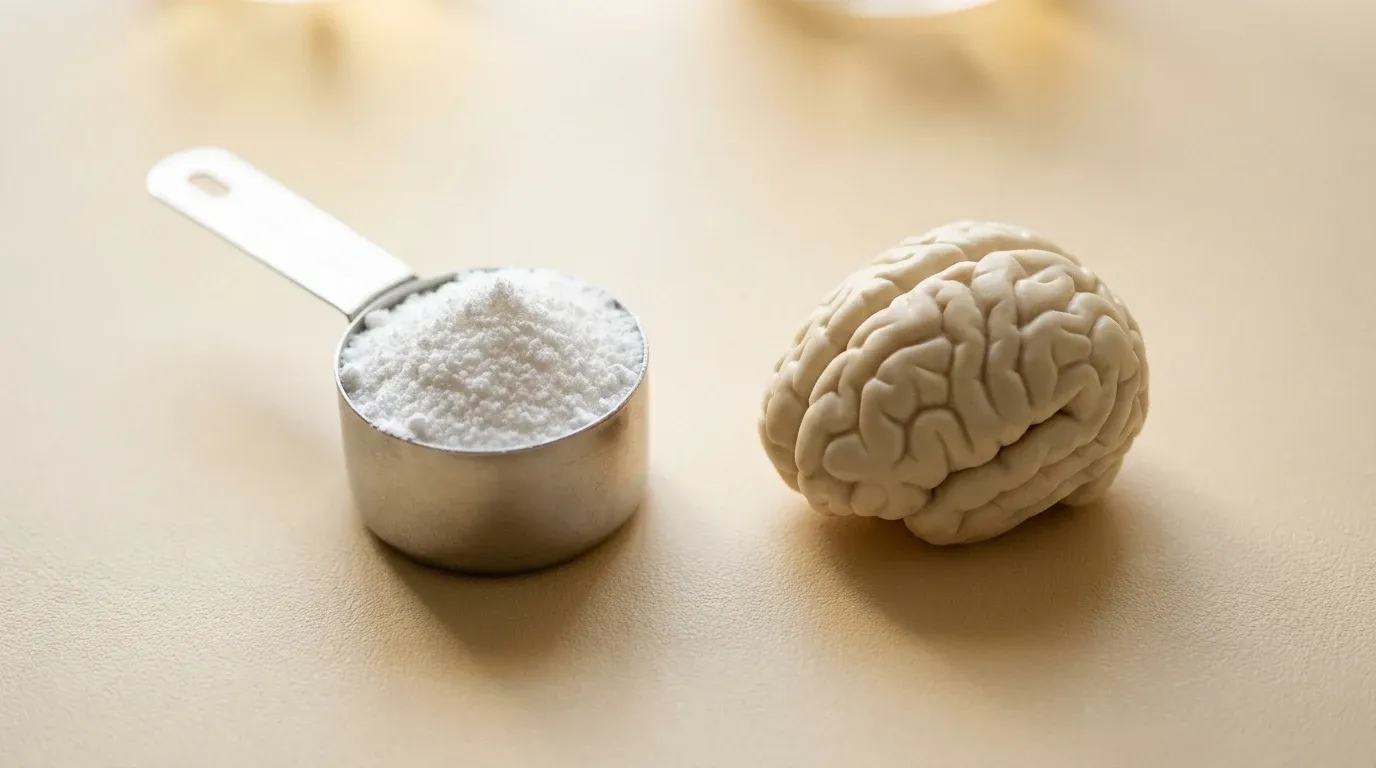
For decades, creatine has lived in a very specific corner of the fitness world. It's the white powder on the shelf next to whey protein, the supplement that serious lifters swear by and everyone else quietly avoids. The assumptions are familiar: it's for bulking, it makes you bloated, and it's not much use if you're not chasing a one-rep max.
New research is dismantling that picture. Scientists are now questioning whether creatine builds muscle directly at all, while simultaneously finding strong signals that it does something potentially more interesting. Here's what the evidence actually says.
Rethinking How Creatine Works in the Gym
The standard story goes like this: creatine increases phosphocreatine stores in your muscles, which helps you produce ATP (energy) faster during high-intensity effort. More energy means more reps. More reps mean more muscle. Simple, right?
Not quite. A growing body of research is separating two things that were long lumped together: strength and power output on one hand, and actual muscle hypertrophy on the other. A recent meta-analysis examining creatine's effects across resistance training studies found that its most consistent benefit is performance. It helps you do more work in a session. Whether that directly drives muscle growth. or whether it simply creates better training conditions that then drive growth. is a more complicated question.
The distinction matters. If creatine's primary role is energy availability rather than direct anabolic signaling, then the old framing of it as a "muscle builder" is imprecise at best. What it may actually do is let you train harder without hitting the wall as quickly, which creates the environment for adaptation. The muscle building is downstream of the effort, not a direct chemical effect.
This also reframes who should consider taking it. If you're doing any form of repeated high-intensity effort. sprint intervals, heavy compound lifts, circuit training. creatine's performance benefits apply to you whether or not you're trying to add mass.
The Brain Connection That Researchers Are Taking Seriously
Here's where things get genuinely interesting. Your brain accounts for roughly 20% of your body's total energy consumption, and it relies heavily on the same ATP-creatine system your muscles use. That's not a coincidence researchers have been ignoring.
Multiple studies over the past several years have looked at creatine supplementation and cognitive function, particularly under conditions of stress or sleep deprivation. The results are notable. One study found that participants who supplemented with creatine performed significantly better on tasks involving working memory and processing speed after sleep deprivation compared to those on placebo. Another line of research has explored creatine's potential role in reducing symptoms of depression and mental fatigue, with early trials showing promising but not yet conclusive results.
The cognitive angle is especially relevant for people who are training hard while managing demanding schedules. Overtraining Without Rest Is Quietly Wrecking Your Progress covers how chronic fatigue accumulates without proper recovery, and it's worth noting that mental fatigue and physical overreach often travel together. If creatine can buffer cognitive decline under stress, its value extends well beyond the weight room.
Researchers are also looking at creatine as a potential neuroprotective agent, with interest in conditions like Parkinson's disease and traumatic brain injury. The evidence here is still early. but it signals that this molecule has a broader biological role than sports nutrition has historically acknowledged.
Creatine and Aging: A Separate Conversation Worth Having
Muscle loss with age, known clinically as sarcopenia, begins earlier than most people expect. Research suggests measurable muscle decline can start in your thirties if you're not actively working against it. By your sixties and seventies, it's a primary driver of functional decline and fall risk.
Creatine research in older adults is producing some of its most compelling results. Several randomized controlled trials have found that older adults who combined creatine supplementation with resistance training preserved more lean mass and functional strength than those who trained without it. The effect sizes aren't enormous, but they're consistent across multiple studies and populations.
There's also emerging evidence that creatine may help maintain satellite cell activity, which is the mechanism your body uses to repair and grow muscle tissue. Satellite cell function declines with age, and anything that supports its activity has meaningful implications for longevity.
This is a very different conversation from the one happening in gym locker rooms. The question isn't whether creatine helps a 28-year-old add size for summer. It's whether a 60-year-old can preserve functional independence for longer. The same supplement, a radically different use case.
Understanding body composition rather than just body weight is essential context here. Body Composition vs BMI: Which Number Actually Matters? explains why the number on the scale tells you far less than most people assume, which connects directly to how you should interpret changes when you start supplementing with creatine.
The Water Weight Question, Answered Properly
This is the issue that stops a disproportionate number of people, particularly women and anyone focused on aesthetic goals, from ever trying creatine. Within the first one to two weeks of supplementation, body weight typically increases by one to three kilograms. People see that number, assume they've gained fat, and stop.
Here's what's actually happening. Creatine is osmotically active, meaning it draws water into the cells where it's stored. Those cells are your muscle cells. The water weight you're gaining is intracellular fluid in muscle tissue, not subcutaneous water retention or fat. It doesn't make you visually puffier in the way that excess sodium or alcohol-induced bloating does. In many cases, it actually makes muscles look slightly fuller.
That initial weight increase is not a side effect to push through. It's a sign the supplement is working. Phosphocreatine stores in your muscles are increasing, which is exactly what enables better performance.
For anyone tracking body composition seriously, the scale weight change is essentially noise. What matters is whether lean mass is being preserved or added, and whether performance metrics are improving. If you're already using tools to monitor how your body is responding to training, CGMs Are Now Over-the-Counter: What Lifters Should Know is worth reading as context for how wearable and metabolic tracking is evolving alongside supplementation choices.
Who Should Actually Consider Taking It
Creatine monohydrate is one of the most studied supplements in existence. Thousands of trials across four decades have produced a safety profile that is, by any reasonable standard, excellent. No credible evidence links long-term creatine use to kidney damage in healthy individuals, despite the persistent myth.
Based on current research, these are the groups with the clearest case for supplementation:
- People doing high-intensity training of any kind. strength, sprinting, team sports, HIIT. who want to improve output and reduce fatigue.
- Adults over 50 engaged in resistance training who want to maximize the muscle-preserving effect of their sessions.
- People in cognitively demanding roles who are also training hard and want to buffer mental fatigue.
- Vegetarians and vegans, who have naturally lower baseline creatine levels due to the absence of meat in their diet and tend to see stronger responses to supplementation.
Standard dosing is straightforward. Three to five grams of creatine monohydrate per day, taken consistently, is sufficient to saturate muscle stores over time. There's no strong reason to use a loading phase unless you want faster saturation. Timing doesn't matter much. taking it at a consistent point in your day is more important than taking it at a specific moment around training.
Cost is also not a barrier. A month's supply of basic creatine monohydrate from a reputable brand typically runs between $15 and $25. There's no meaningful evidence that more expensive forms (buffered creatine, creatine HCL, ethyl ester) outperform monohydrate in practical use. The upsell exists; the science supporting it largely doesn't.
What This Means for How You Think About Supplements
Creatine's evolving research profile is a useful reminder that the fitness industry's categorization of supplements often lags years behind the actual science. Something gets labeled "for bulking" and that label sticks regardless of what subsequent research finds.
It also reinforces a broader principle: most supplements work best when they're supporting an intelligent training and recovery structure, not substituting for one. If you're running a solid program and recovering properly, creatine has something meaningful to add. If your training is inconsistent or your sleep is wrecked, no supplement bridges that gap. Fall Strength Reset: Get Your Program Back on Track in 4 Weeks is a practical starting point if your consistency has slipped and you want to build a foundation worth supplementing.
The new research on creatine doesn't overturn everything you thought you knew. It adds resolution to a picture that was always more complex than the label on the tub. Strength, cognition, aging, cell hydration. these aren't separate stories. They're facets of the same molecule doing what it's always done, in more places than anyone originally thought to look.