
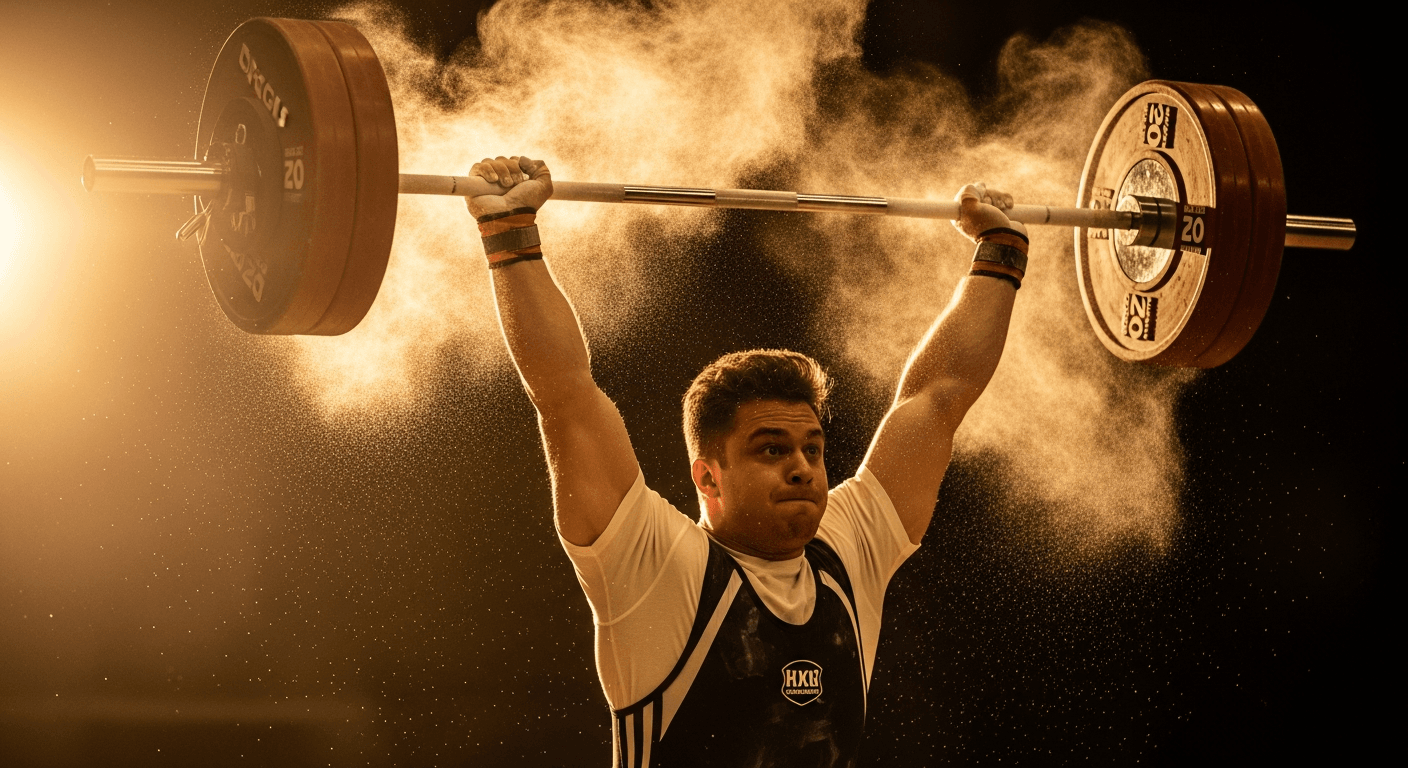
Benjamin Ferre walked into the 2026 European Weightlifting Championships as a contender. He walked out with three French national records, a top-10 finish in the 110kg category, and a performance that's worth paying attention to. Not just for weightlifting fans, but for anyone serious about understanding how elite strength is actually built.
His numbers: a 160kg snatch, followed by a 164kg snatch, and a 372kg total. Each one a new national record. Each one a marker of what's possible when periodization, recovery, and peak timing converge at exactly the right moment.
What the Performance Actually Means for French Weightlifting
French weightlifting hasn't had a consistent presence at the senior European level in the 110kg category for years. Ferre's result changes that. A top-10 finish at the European Championships isn't a footnote. It's a statement of competitive relevance on a continent that produces some of the strongest lifters in the world.
The European Weightlifting Championships consistently features athletes from Georgia, Armenia, Turkey, and across Eastern Europe. Countries with deep institutional knowledge of the sport, long-established coaching infrastructure, and athletes who start competing at the national level as teenagers. Breaking into that top 10 as a French lifter at the senior level is a legitimate achievement, and it signals that something is working in how Ferre and his coaching team have structured his development.
Three national records in a single competition also tells you something specific about how the preparation was timed. Ferre didn't just match his previous bests under pressure. He exceeded them, twice, on the snatch alone. That's not luck. That's the result of deliberate peaking.
Breaking Down the Records: What 164kg in the Snatch Actually Requires
The snatch is widely considered the most technically demanding lift in sport. You're moving a barbell from the floor to locked-out overhead in a single movement, with no pause, no second chance, and no margin for error in positioning. At 164kg, that's 361 pounds moving at peak velocity while your body drops under it in a fraction of a second.
For a 110kg lifter, a 164kg snatch represents a strength-to-bodyweight ratio of approximately 1.49x. At elite international level, that's competitive. It also means that Ferre's raw strength base, his mobility, his bar path efficiency, and his ability to stabilize under maximal load all had to be operating at their ceiling simultaneously.
The 372kg total, combining snatch and clean and jerk results, is what earns placement in competition. Totals at this level are built over years, not training cycles. But they're expressed in a single day, which is where the real complexity of elite weightlifting preparation comes in.
Periodization and Peak Performance: What Recreational Athletes Can Learn
Here's where Ferre's performance becomes directly relevant to you, even if you're not a competitive weightlifter. The principles behind how an elite athlete sets three national records in one session are the same principles that should be guiding your own training structure.
Periodization is the practice of organizing training into phases, each with a specific goal. Volume phases build work capacity. Intensity phases develop maximal strength. Taper phases allow the nervous system and musculature to recover and express peak output. When it works, you arrive at your target date stronger than you've ever been, feeling fresh enough to actually use that strength.
Most recreational lifters skip the taper. They train hard right up to a race, a competition, or simply the point where they want to see their best. The result is a ceiling on performance that's artificially created by accumulated fatigue, not actual fitness. Understanding training frequency during peak phases is a key part of getting this right. Research on how many times per week you should train each muscle shows that frequency needs to be managed carefully as intensity increases, not maintained at the same level throughout.
Ferre's ability to set a 160kg snatch and then come back and improve to 164kg in the same session also reflects something important about nervous system readiness. That kind of output doesn't happen when an athlete is carrying two weeks of accumulated fatigue into a competition.
Recovery Is Where Records Are Actually Made
Elite weightlifters don't train harder than everyone else. They recover better. That distinction matters more than most people acknowledge.
At the 110kg level, athletes are typically training six days per week, sometimes twice daily, with total weekly volume that would break most recreational lifters within a month. The reason they can sustain that is because recovery isn't treated as passive rest. It's a structured part of the program with the same level of intentionality as the lifting itself.
Sleep is the most underused recovery tool available. The relationship between sleep quality, muscle protein synthesis, and hormonal output is well established. Research consistently shows that sleep deprivation reduces testosterone, elevates cortisol, and impairs the neuromuscular coordination that lifts like the snatch depend on. If you're training seriously and not prioritizing sleep, you're working against yourself. How poor sleep is silently killing your muscle gains covers this in detail, and the mechanisms are directly relevant to anyone trying to express maximal strength.
Nutrition timing is the other variable that elite programs treat as non-negotiable. When you eat relative to your training sessions affects glycogen availability, protein synthesis rates, and recovery speed between sessions. Understanding how to sync your diet with your training schedule can close the gap between how hard you're working and how much you're actually adapting.
Strength-to-Bodyweight Development: The Long Game
One of the reasons Ferre's performance is worth analyzing is what it demonstrates about the long arc of strength development. You don't build a 164kg snatch in a year. The motor patterns alone take years to ingrain. The connective tissue adaptations take longer than muscle growth. The competition experience needed to perform at that level under pressure is accumulated over dozens of meets.
This is a useful counterpoint to a fitness culture that frequently treats strength as something that can be optimized over a 12-week cycle. Short programs have their place. But the kind of strength Ferre expressed in his European Championship performance is a function of years of consistent, well-structured work.
That means training frequency over the long term matters as much as intensity in any given phase. Research on muscle protein synthesis suggests that the window for growth within a given training stimulus closes within 48 hours, which is why why muscle growth stops at 48 hours is a concept worth understanding if you're trying to build sustainable strength over time rather than chasing short-term peaks.
Elite lifters understand intuitively what the research confirms. Consistent stimulation, adequate recovery, and progressive overload applied over years is what builds the kind of strength that can produce three national records in a single session.
What This Signals for the Sport Going Forward
Ferre's performance at the 2026 European Championships isn't just a personal milestone. It's a data point in a larger story about the global development of weightlifting. Countries that weren't historically dominant in the sport are producing competitive athletes at the senior level, and that's partly a function of better information, better coaching education, and better access to periodization science that was once the exclusive domain of Eastern European national programs.
In the US and broader English-speaking markets, weightlifting is growing. CrossFit introduced millions of people to the Olympic lifts. Social media has made elite technique accessible in ways that weren't possible a decade ago. The coaching industry around Olympic lifting in the US has expanded significantly, with qualified coaches now available in most major cities and online programs from elite-level coaches available for under $200 per month.
Performances like Ferre's matter in this context because they demonstrate what's achievable outside the traditional powerhouses of the sport. They make the ceiling feel more reachable, which tends to raise the floor for everyone competing below it.
Three Records, One Competition, One Framework for Serious Training
Benjamin Ferre's 2026 European Championship result is worth more than a headline. It's a practical illustration of what structured, long-term athletic development looks like when everything comes together on the right day.
The lessons aren't complicated: periodize your training, protect your recovery, time your nutrition deliberately, and play the long game. Whether you're chasing a national record or just trying to add 20 pounds to your deadlift, the framework is the same. The scale is different. The principles aren't.
- 164kg snatch: Ferre's peak snatch, setting a new French national record
- 160kg snatch: His opening snatch, also a national record at the time of the lift
- 372kg total: Combined snatch and clean and jerk result, a third French national record
- Top-10 finish: Achieved in the 110kg category at the 2026 European Weightlifting Championships
That's the benchmark. Now you know what building toward it actually requires.