
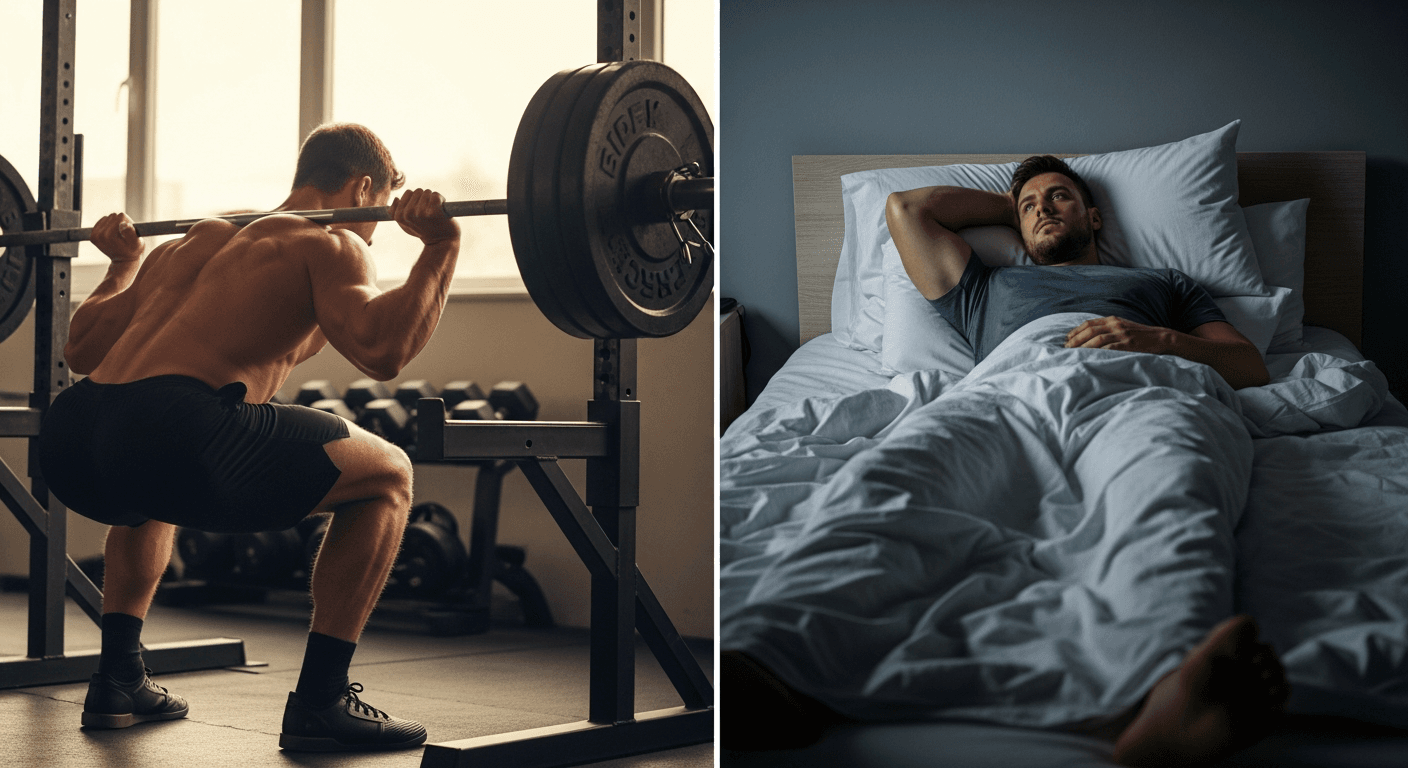
You train hard, you track your protein, you show up consistently. But if you're regularly getting under six hours of sleep, you're leaving a significant portion of your gains on the table. Not metaphorically. Physiologically. The research is unambiguous, and most lifters still aren't paying attention.
Sleep isn't passive recovery. It's the biological process through which your body actually builds the muscle you worked for in the gym. Shortcut it, and the workout was only half the job.
The 18% Problem Nobody Talks About
Muscle protein synthesis. MPS. It's the cellular process that repairs and rebuilds muscle tissue after training. Research published in sports and sleep medicine journals shows that insufficient sleep can reduce MPS by up to 18%. That's not a minor efficiency dip. That's nearly one-fifth of your potential muscle-building capacity gone, every night you underslept.
To put that in context: if you're spending money on protein supplements, optimizing your training splits, and eating in a caloric surplus, but consistently sleeping five or six hours a night, you're running a leaky system. Understanding exactly how much protein your body actually needs matters far less if your body can't efficiently process it during recovery.
The mechanism isn't complicated. Deep sleep, specifically slow-wave sleep, triggers the release of human growth hormone (HGH). The majority of your daily HGH output happens during this stage. Cut sleep short, and you compress or eliminate the phases where HGH is released, directly suppressing the anabolic signaling that drives hypertrophy.
Sleep deprivation also elevates cortisol. Elevated cortisol in a chronic state is catabolic. It breaks down muscle tissue rather than building it. The combination of suppressed HGH and elevated cortisol creates a hormonal environment that actively works against the adaptations you trained for.
The 48-Hour Anabolic Window After Training
You've probably heard of the post-workout anabolic window, the period shortly after training when your muscles are primed for nutrient uptake and repair. The reality is more complex and more forgiving than a 30-minute deadline. But it's also longer-lasting than most people realize.
Elevated muscle protein synthesis following a resistance training session can persist for up to 48 hours. That means the quality of your sleep in the 24 hours immediately after a workout is among the most critical recovery variables you have. It's not just about the night before leg day. It's about what happens while you sleep after leg day.
During those post-training hours, your muscles are in a heightened state of sensitivity. Growth signals are active. Repair processes are queued. But those processes require the hormonal environment that quality sleep produces. A poor night's sleep following an intense training session doesn't just make you feel groggy. It actively interrupts the repair cycle you triggered at the gym.
This is why sleep quality matters at least as much as sleep quantity. Interrupted sleep, even if it totals seven hours, disrupts slow-wave and REM architecture. You need both duration and continuity to maximize the anabolic window your training opened.
What the Data Says About Lifters and Sleep
The gap between high-sleep and low-sleep athletes is well-documented. Studies comparing lifters who consistently average 7 to 9 hours per night against those averaging under six hours show meaningful differences across multiple performance markers.
- Strength progression: Athletes sleeping 7 to 9 hours show significantly faster strength gains over training cycles compared to sleep-restricted peers.
- Injury rates: Research involving adolescent and adult athletes has repeatedly found that sleeping under six hours correlates with substantially higher injury risk. One study found injury rates were nearly twice as high in athletes sleeping under eight hours.
- Reaction time and coordination: Sleep deprivation impairs neuromuscular coordination, increasing the chance of poor movement patterns during heavy lifts. Bad form under fatigue is how injuries happen.
- Body composition: Chronically sleep-deprived individuals lose proportionally more lean mass and retain more fat during caloric deficits, even when protein intake is controlled.
The data points in one direction. Sleep isn't a lifestyle luxury for people with easy schedules. It's a training variable with measurable outcomes.
Practical Strategies That Actually Move the Needle
Fixing your sleep doesn't require expensive gadgets or a complete life overhaul. The interventions with the strongest evidence are also the least glamorous.
Keep a consistent sleep schedule
Your circadian rhythm governs the timing of HGH release, cortisol cycles, and sleep architecture. It runs on a 24-hour biological clock. Irregular sleep times, sleeping in on weekends, staying up late when you don't have to wake early, all of it disrupts the consistency your body needs to optimize recovery timing.
Going to bed and waking at the same time every day, including weekends, is one of the highest-leverage changes you can make. Consistency trains your circadian rhythm to initiate sleep faster and spend more time in deep stages.
Eliminate alcohol post-training
Alcohol is a particular problem for lifters, because it's common in social fitness circles and its effects on sleep are frequently underestimated. Even moderate alcohol consumption suppresses REM sleep and slow-wave sleep. It increases sleep fragmentation. And it directly interferes with post-exercise protein synthesis.
If you're serious about recovery, alcohol in the hours following training is one of the most counterproductive things you can do. Having a few drinks after the gym isn't just about empty calories. It's actively interfering with the anabolic window you just opened.
Cool your room down
Core body temperature naturally drops during sleep onset, and a cooler environment facilitates that process. Sleep research consistently identifies a bedroom temperature of around 65 to 68 degrees Fahrenheit (18 to 20 degrees Celsius) as optimal for sleep quality. Sleeping in a hot room disrupts this cooling process, reduces slow-wave sleep, and increases nighttime waking.
This is one of the simplest physical interventions available. A fan, blackout curtains that reduce heat buildup, or adjusting your thermostat before bed can measurably improve sleep depth. The investment is minimal. The return is real.
Cut screens 60 minutes before bed
Blue light from screens suppresses melatonin production by delaying its release by up to 90 minutes in some studies. Melatonin is the hormone that initiates sleep onset. Scrolling until you're ready to sleep isn't just mentally stimulating. It's biochemically delaying your ability to fall asleep and enter deep stages efficiently.
The 60-minute buffer before bed is well-supported by sleep research. Use that time for anything that doesn't involve a backlit screen. Reading, light stretching, or simply being in dim light are all effective.
If you're dealing with broader issues around chronic stress that interrupt your ability to wind down at night, reviewing what the research actually supports for stress management can help you build a pre-sleep routine with more evidence behind it.
The Supplement Shortcut That Doesn't Exist
The supplement industry will sell you recovery products without hesitation. Sleep aids, nighttime protein blends, melatonin gummies, magnesium stacks. Some of these have legitimate supporting evidence in specific contexts. Most are poorly regulated and inconsistently dosed.
Before you reach for a product, it's worth understanding that the supplement industry remains largely unregulated, meaning label accuracy and ingredient quality vary enormously. Supplements can support a well-built sleep routine. They can't replace one.
Magnesium glycinate, for example, has reasonable evidence behind it for improving sleep quality in individuals who are deficient, which many people are. Low-dose melatonin (0.5 to 1 mg) can help with sleep onset timing, particularly when adjusting to schedule changes. But neither will compensate for inconsistent sleep timing, a warm bedroom, or two hours of screen exposure before bed.
Sleep as a Training Priority, Not an Afterthought
The fitness industry has spent decades optimizing everything around sleep: training protocols, nutrition timing, supplementation, recovery tools. Sleep itself gets discussed in terms of "getting enough rest," as though it's a passive background variable rather than an active physiological process that determines how much of your training actually sticks.
Research on biological aging and fitness increasingly shows that recovery behaviors, not just training volume, drive long-term adaptation. The link between consistent fitness habits and measurable biological age reduction highlights how recovery-focused approaches compound over time in ways that training volume alone cannot replicate.
If you're training four or five days a week and sleeping six hours a night, you're not under-training. You're under-recovering. And the fix isn't adding another session. It's treating sleep with the same intention you bring to your programming.
Seven to nine hours. Consistent timing. A cool, dark room. No alcohol in your post-training window. No screens in the hour before bed. None of it is complicated. All of it works. The question is whether you're willing to prioritize recovery the same way you prioritize showing up to lift.
Your muscles don't grow in the gym. They grow while you sleep. Train accordingly.