
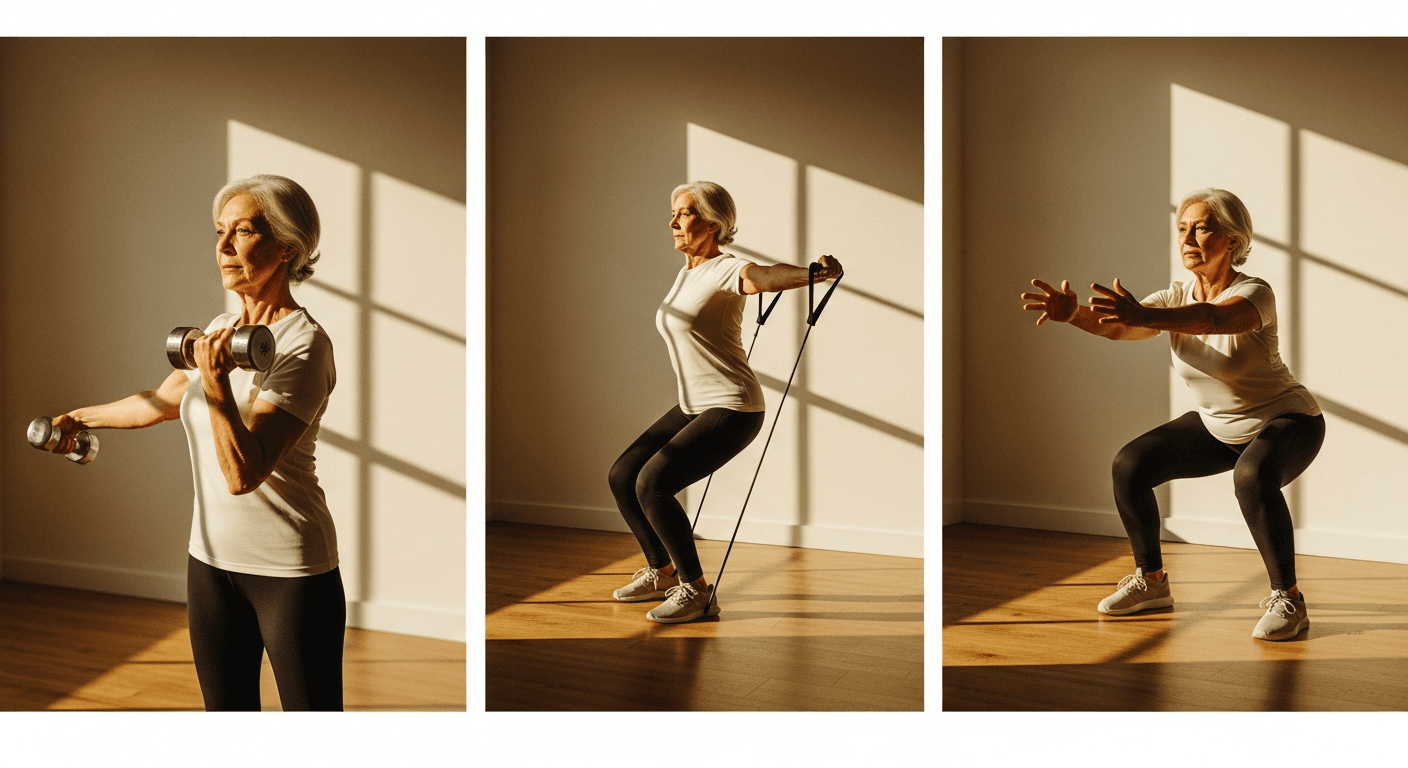
The fitness world loves picking sides. Kettlebells versus machines. Yoga versus lifting. Bodyweight versus everything else. But a 2026 study on older adults quietly made a compelling case for something less tribal: using all three major resistance training tools together, and rotating them strategically, produces better results than committing to any single one.
The study tracked participants through a 12-week functional fitness program that incorporated free weights, resistance bands, and bodyweight exercises. By the end, strength, balance, endurance, and flexibility scores had all improved significantly. Not marginally. Not in one category. Across the board.
That finding deserves more attention than it's getting.
What the Research Actually Found
The 12-week program wasn't a chaotic mix of random exercises. It was structured to cycle participants through different resistance modalities week by week, progressively increasing demand while varying the mechanical stimulus. Participants weren't just getting fitter. They were building a more complete physical profile.
Functional fitness scores measure what matters most for everyday life: can you stand from a chair without help, walk a distance without losing breath, maintain balance on uneven ground, and reach overhead without strain. These are the metrics that predict independence and quality of life far better than a one-rep max ever could.
The results showed that no single tool was responsible for the improvement. Free weights, bands, and bodyweight each contributed distinct adaptations. Remove one, and the picture changes. That's the core finding, and it has implications well beyond older adults.
Why Each Tool Does Something Different
Understanding why a mixed approach works requires understanding what each modality actually does to your body mechanically. They're not interchangeable. They're complementary.
Free weights load joints through a full range of motion with a consistent gravitational force. A dumbbell doesn't care where you are in the movement. It's equally heavy at the bottom of a curl and at the top. That consistency forces your muscles and connective tissue to manage load across the entire arc of movement, which builds both strength and joint stability.
Resistance bands work differently. The resistance increases as the band stretches, meaning the load is lighter at the start of a movement and heavier at the end. This variable resistance profile matches the natural strength curve of many muscle groups, challenging you most where you're strongest. Bands also change the tension angle continuously, recruiting stabilizing muscles in ways that straight-line free weight movements don't.
Bodyweight training removes external load entirely and places the emphasis on motor control. Movements like single-leg squats, push-up variations, and plank progressions demand coordination, proprioception, and neuromuscular precision. You're not just moving weight. You're learning to control your own body in space. That's a skill, and it transfers directly to balance, agility, and injury prevention.
Each tool trains a slightly different version of strength. Stack them together, and you cover a much wider adaptive range.
The Accommodation Problem Nobody Talks About Enough
Here's a well-documented phenomenon in exercise science: the body adapts to a fixed stimulus within roughly six to eight weeks. After that, progress slows or stops entirely. This is called accommodation, and it's one of the most common reasons people plateau on programs that initially worked well for them.
When you apply the same mechanical stress to your body in the same way, week after week, your nervous system becomes efficient at handling it. Efficiency is the enemy of adaptation. The body stops changing because it no longer needs to.
Varying your resistance tools disrupts that efficiency. A week of band-heavy training presents your muscles with a different tension profile than the week before, which was free-weight focused. Your body can't fully accommodate to a moving target. That novelty. that consistent variation in mechanical stimulus, keeps the adaptive response running longer.
This is distinct from simply changing exercises. You can swap from bench press to push-ups and still apply a similar stimulus if the loading pattern is the same. Changing the tool itself changes the fundamental nature of the demand.
This Isn't Just for Older Adults
The study population was older adults, which makes the results particularly meaningful because functional decline accelerates significantly after age 60. But the physiological principles don't change with age. Accommodation affects everyone. Variable resistance recruits different stabilizers at any age. Motor control training benefits any athlete who wants to reduce injury risk.
If you're in your 30s running a gym-based program, adding a band circuit or a bodyweight-focused week isn't a step backward. It's a way to expose your body to stimuli it isn't already adapted to, which is exactly how you keep making progress.
For athletes focused on performance, mixing modalities also trains more complete movement patterns. Band work tends to reinforce end-range strength. Bodyweight builds the kind of coordination that translates to sport. Free weights develop the raw force production capacity that underlies almost everything else.
Pairing this kind of training with adequate nutrition compounds the effect. Research consistently shows that resistance training outcomes are strongly tied to protein intake, particularly in adults over 50. Protein and Aging: What the New Science Actually Shows breaks down the specific intake thresholds that support muscle retention and growth across the lifespan.
How to Build a Mixed-Modality Program
Rotating tools doesn't mean randomness. It means intentional variation with a clear structure. Here's a framework that reflects what the research supports:
- Week 1-2: Prioritize bodyweight movements. Focus on single-leg work, push-up progressions, and core stability. This builds the motor control foundation everything else relies on.
- Week 3-4: Introduce resistance bands. Use them for lower-body pulls, shoulder circuits, and assisted hinge patterns. Emphasize end-range control.
- Week 5-6: Shift to free weights. Use dumbbells or kettlebells for compound movements. Prioritize progressive loading on squats, rows, and presses.
- Week 7-8: Combine all three within sessions. Pair a free-weight main lift with a band accessory and a bodyweight finisher. This is where integration happens.
- Week 9-12: Increase intensity across all modalities. Add load, reps, or complexity to whatever each tool allows. Let the previous weeks of varied stimulus drive new adaptation.
This isn't the only way to structure it. But the logic holds: build motor control first, layer in variable resistance, then add absolute load, then integrate. Progress follows structure.
Recovery Is Part of the Equation
A mixed-modality program increases the variety of stress placed on your body, which is the point. But that also means recovery becomes more important, not less. Different tools stress different stabilizers, different fascial lines, different energy systems. Your body needs time and resources to process all of it.
Sleep, protein intake, and active recovery all play a larger role in a varied program than in a single-modality routine. Recovery in 2026: The Strategies That Actually Work outlines the current evidence on what actually accelerates recovery versus what's just noise.
Protein distribution matters here too. It's not enough to hit a daily target. When and how you spread your intake across meals affects muscle protein synthesis directly. Protein Timing: What Actually Matters for Active Adults covers the specifics without the usual oversimplification.
And if you're adding supplements to support recovery or muscle synthesis, quality control matters more than most people realize. Not All Protein Is Equal: What the DIAAS Score Changes About How You Count Your Grams explains why the source and digestibility of your protein affects how much of it your body actually uses.
The Real Takeaway
The study's finding isn't complicated: when older adults used all three resistance tools together over 12 weeks, every major marker of functional fitness improved. Strength. Balance. Endurance. Flexibility. Not because any one tool is magic, but because each one does something the others don't.
The same logic applies at any age. If you've been doing the same thing for months and progress has stalled, the answer probably isn't a different program. It's a different tool. And then another one after that.
Free weights, bands, and bodyweight aren't competing options. They're a complete toolkit. Use all three, and you'll train aspects of fitness that a single-modality approach will always leave behind.