
Gym memberships in the US average around $50 a month. Premium facilities can run $100 or more. For a growing number of people, that cost simply doesn't make sense, especially when the science keeps confirming that you don't need any of it to get meaningfully stronger.
New research from Edith Cowan University (ECU) has reinforced what exercise scientists have been building toward for several years: short, daily sessions of slow bodyweight movements produce strength gains that compare favorably to conventional gym-based resistance training. The mechanism is eccentric loading, and once you understand how it works, the program below will make complete sense.
Why Slow and Controlled Beats Heavy and Fast
Eccentric training refers to the lengthening phase of a movement. When you lower yourself into a squat, that's the eccentric phase. When you descend from a push-up, same thing. Your muscles are working hard under load even as they're getting longer.
What ECU researchers found is that emphasizing this phase, even with just bodyweight, creates enough mechanical tension to stimulate significant strength adaptation. The key variable isn't the weight on the bar. It's the time your muscle spends under that controlled load. Slow eccentrics extend that time and amplify the training signal.
This is consistent with a growing body of evidence on the topic. If you want a deeper look at the mechanisms, you don't need pain to build strength, science confirms, and this program is built directly on that principle.
The Three Movement Patterns That Do the Work
This program is built around three core exercises. No equipment is required. You need a wall, a chair, and access to a single step or stair. That's it.
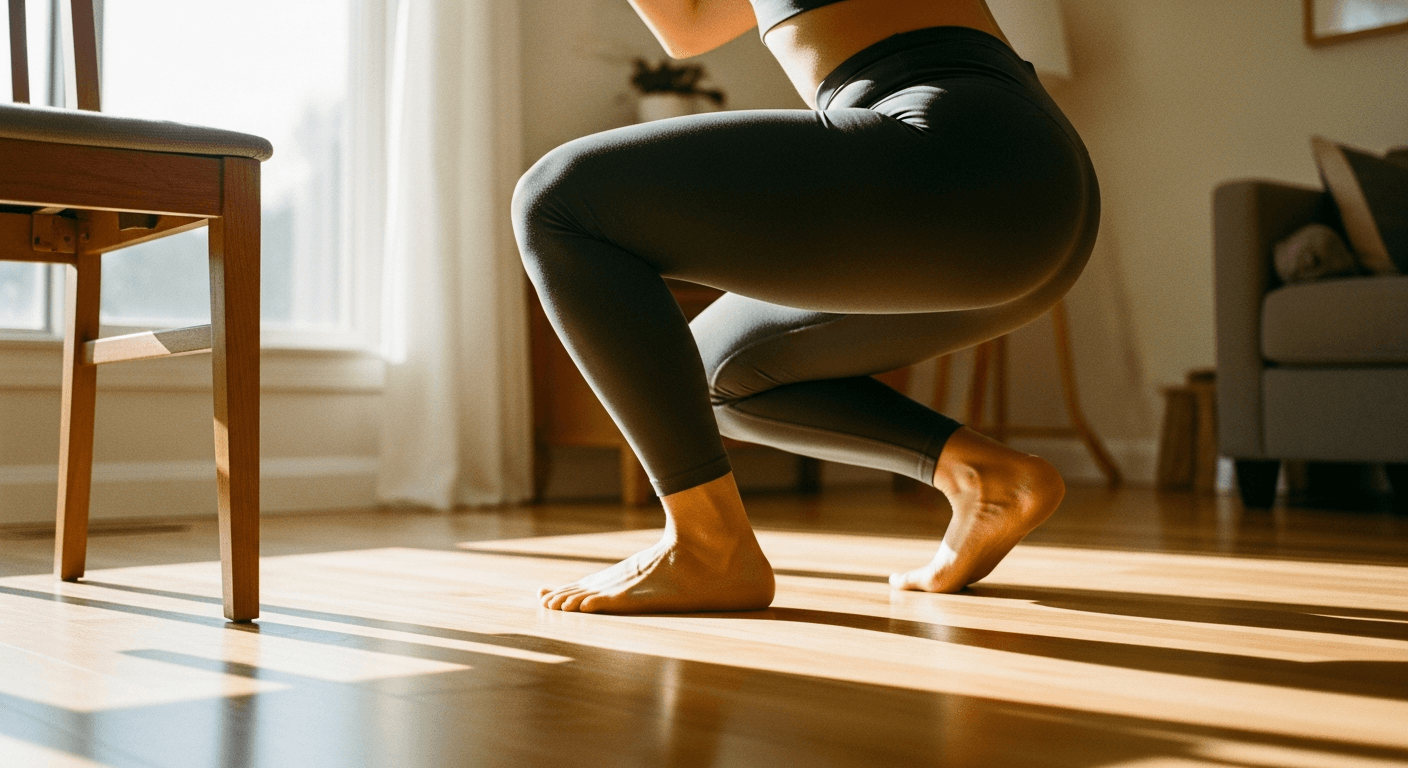
- Chair squats (lower body): Stand in front of a chair, feet hip-width apart. Lower yourself slowly toward the seat without fully sitting down, then return to standing. The chair provides a depth target and a safety net. You never need to actually sit.
- Wall push-ups (upper body): Stand facing a wall, hands flat against it at shoulder height and width. Bend your elbows to bring your chest toward the wall, then push back slowly. Easier than floor push-ups but highly effective when you slow the descent to 4 to 8 seconds.
- Stair step-downs (lower body and balance): Stand on the lowest step of a staircase. Lower one foot toward the floor slowly and with control, then return to standing. This single-leg eccentric movement is one of the most research-supported exercises for building quad and glute strength without any load beyond your own bodyweight.
These aren't beginner movements dressed up as a program. They're specifically chosen because the eccentric phase is easy to control, easy to progress, and accessible to almost any fitness level.
The 4-Week Progressive Plan
Progression in this program doesn't come from adding weight. It comes from extending the eccentric lowering phase each week. Your nervous system and muscle tissue adapt to increasing time under tension. That's the driver.
Each session runs 5 to 10 minutes. You train daily, alternating between upper body, lower body, and core focus days. This structure gives each muscle group roughly 48 hours of recovery before it's targeted directly again.
Week 1: Building the Habit (2-second eccentric)
- Chair squats: 3 sets of 10 reps, lower for 2 seconds
- Wall push-ups: 3 sets of 10 reps, lower for 2 seconds
- Stair step-downs: 3 sets of 8 reps per leg, lower for 2 seconds
- Core day: Dead bugs or bird-dogs, 3 sets of 8 reps, slow and controlled
Week 2: Increasing Tension (4-second eccentric)
- Same exercises, same sets and reps
- Lower for 4 seconds on every rep
- Rest 60 to 90 seconds between sets
Week 3: Deeper Stimulus (6-second eccentric)
- Same exercises, same sets and reps
- Lower for 6 seconds on every rep
- You'll feel this difference immediately. That's the point.
Week 4: Peak Overload (8-second eccentric)
- Same exercises, same sets and reps
- Lower for 8 seconds on every rep
- Focus on full control through the entire range. No rushing the last two seconds.
After four weeks, you can either cycle back to Week 1 with harder variations (single-leg chair squats, incline push-ups, deeper step-downs) or use this as a baseline to transition into a gym program if that becomes accessible.
How to Organize Your Week
The daily alternating structure looks like this:
- Day 1: Lower body (chair squats, stair step-downs)
- Day 2: Upper body (wall push-ups, shoulder taps)
- Day 3: Core (dead bugs, bird-dogs, slow leg lowers)
- Day 4: Lower body
- Day 5: Upper body
- Day 6: Core
- Day 7: Active rest (walk, stretch, or full rest)
The sessions are short by design. Research consistently shows that frequency matters more than session length when training volume is equated. Five focused minutes beats one skipped hour every time.
What to Do About Soreness
You will likely be sore after Week 1, especially after the stair step-downs. That's normal. Eccentric training is well-documented to cause delayed onset muscle soreness (DOMS), particularly when it's new to your system.
Don't skip your next session because of it. Light movement through the sore muscle groups actually speeds recovery by increasing blood flow. Walk around the block. Do the next day's session even if you're stiff. The soreness drops significantly after the first week once your muscles adapt.
Sleep is a critical part of this equation too. Short sleep reduces muscle protein synthesis and blunts adaptation from any training program. If you're cutting your nights short, you're leaving results on the table.
Nutrition: Don't Undo the Work
Strength training of any kind creates a demand for protein. Your muscles need amino acids to repair and rebuild the tissue you're stressing during each session. This doesn't mean you need protein shakes or supplements. It means your diet needs to consistently include quality protein sources spread across the day.
If you're a woman starting a program like this, the guidance on protein is often confusing and inconsistently applied. Protein for Women: The No-BS Practical Guide cuts through that noise with clear, practical targets.
It's also worth knowing what's working against you. A diet heavy in ultra-processed foods doesn't just affect body composition. It directly impairs the muscle-building response to exercise. The research on this connection is more direct than most people realize. the real impact of ultra-processed food on muscle strength is worth reading before you assume your training is the only variable that matters.
Some people also ask about recovery supplements. Collagen has gotten a lot of attention in this space. The evidence is nuanced, and if you're considering it, whether collagen actually helps muscle recovery is a question that now has a much clearer answer based on umbrella review data.
Tracking Progress Without a Scale
Don't use weight as your primary metric here. Bodyweight training with no caloric intervention isn't designed to rapidly change your scale number. What it is designed to do is make you functionally stronger.
Track these instead:
- How many reps you can complete with full eccentric control at each week's tempo
- Whether you feel steadier on the stair step-downs by Week 3
- Whether the wall push-ups feel easier at the same tempo by Week 4
- How quickly you recover between sets compared to Day 1
These are real strength signals. They'll show up before any aesthetic change and they're worth paying attention to.
The Bigger Picture
The fitness industry has a habit of overcomplicating things because complexity sells memberships and equipment. The ECU research cuts through that cleanly. The stimulus your muscles need to grow stronger is mechanical tension applied under control, over time, with enough frequency to accumulate adaptation.
A chair, a wall, and a staircase provide that stimulus. Four weeks of progressive eccentric loading delivers it in a format that fits into almost any schedule. You don't need a gym to get stronger in 2026. You need a plan and enough consistency to follow it.
Start with Week 1 tonight. The session takes less time than scrolling through a fitness app looking for motivation.