
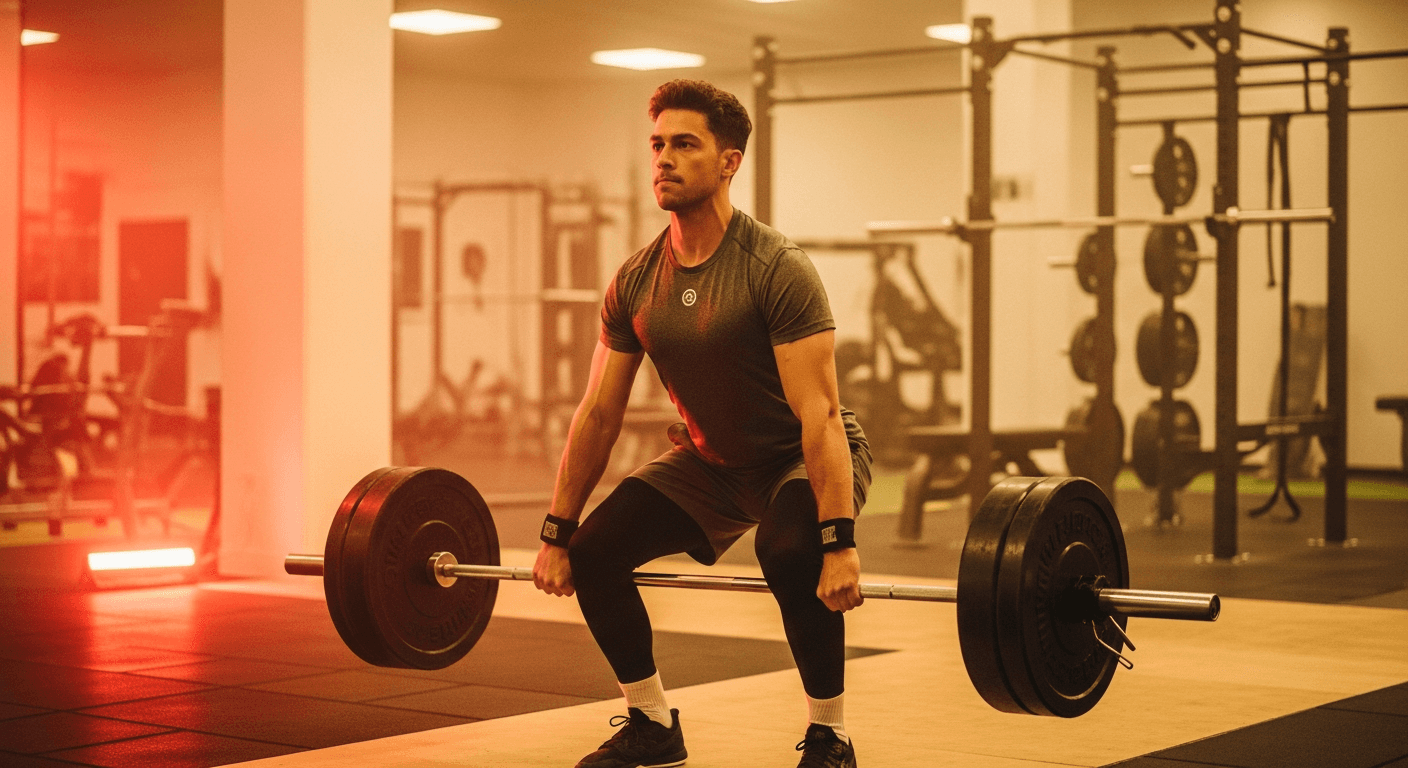
Recovery has always been the part of fitness most people treat as optional. You train hard, you leave, you maybe stretch or take an ice bath if you're feeling disciplined. What you don't do is recover while you're still lifting. That's starting to change.
On May 1, 2026, BURN launched BUILD, a training concept that combines heavy progressive strength work with low infrared heat and medical-grade LED and near-infrared (NIR) red light therapy in a single session. The premise is straightforward: instead of treating recovery as something you schedule separately, BUILD makes it part of the training environment itself. Whether the science actually supports that model is worth examining carefully.
What BUILD Is, and What It Claims
BUILD is designed around structured progressive overload. You're not doing circuit training or light resistance work. You're lifting heavy, following a periodized program, and working toward genuine strength adaptation. The difference is that the entire session happens in an environment equipped with infrared heat panels and medical-grade LED and NIR red light therapy systems.
The infrared element keeps tissue temperature elevated throughout the session, which BURN says supports blood flow and muscular readiness. The red light and near-infrared component targets deeper tissue, with claimed benefits including reduced post-exercise inflammation, lower oxidative stress, and faster recovery between sessions.
The headline claim is that you don't need to book a separate recovery session. The recovery stimulus happens concurrently with the training stimulus. That's the pitch. Now here's what the research actually says.
The Evidence for Red Light Therapy in Exercise
Red light therapy, specifically photobiomodulation using wavelengths typically between 630 and 850 nanometers, has a reasonably solid body of peer-reviewed research behind it. It's not fringe science. Several randomized controlled trials have found that applying red or near-infrared light to muscle tissue before or after exercise leads to measurable reductions in delayed onset muscle soreness (DOMS), lower markers of oxidative stress, and faster recovery of muscle function.
One consistent finding across studies is that photobiomodulation appears to influence mitochondrial activity. The light is absorbed by cytochrome c oxidase, an enzyme in the mitochondrial respiratory chain, which may enhance ATP production and reduce reactive oxygen species. That cellular mechanism is one reason researchers take it seriously.
A 2021 systematic review covering over 40 trials found that pre-exercise photobiomodulation was particularly effective at reducing DOMS and creatine kinase levels (a marker of muscle damage) in the 24 to 72 hours following resistance training. Post-exercise application also showed benefits, but the pre-application window appeared more consistently effective across subjects.
The BUILD model combines both. You're exposed to the light environment throughout the session, which means you're getting pre-, during-, and post-exercise exposure simultaneously. That's a different protocol than most of the clinical studies used, and it's worth noting that the research on continuous concurrent exposure during actual lifting is thinner than the evidence for discrete pre- or post-session application.
Does the Infrared Heat Add Anything?
Infrared heat and red light therapy are often mentioned together but they're distinct interventions. Infrared heat raises tissue temperature and promotes vasodilation, which improves blood flow and can reduce stiffness. There's reasonable evidence it supports recovery when used post-exercise, particularly for soft tissue and connective structures.
The more interesting question is whether exercising in a mildly heated infrared environment enhances the training effect itself. Some research suggests that heat acclimation during training can increase plasma volume and improve cardiovascular efficiency, with effects extending beyond the heat sessions themselves. That's not the same as therapeutic infrared, but it points to the idea that thermal stimulus during training is not inherently counterproductive.
What you want to avoid is a training environment so hot that it compromises performance or increases injury risk. BUILD describes its heat as "low infrared," which suggests a therapeutic ambient range rather than a sauna-level experience. At that level, the physiological disruption to strength output should be minimal.
Recovery as a Training Variable, Not an Afterthought
The BUILD concept reflects a broader philosophical shift happening in premium fitness. Recovery is no longer being marketed as passive rest. It's being repositioned as a trainable variable that you can optimize with the same precision you apply to your sets and reps.
That shift matters because the limiting factor for most consistent exercisers isn't effort during training. It's the quality of what happens in the 48 hours after. If you can reduce inflammation faster, clear metabolic byproducts more efficiently, and return to baseline muscle function sooner, you can train more frequently and accumulate more total training volume over time. Volume, over time, is what drives adaptation.
This is also why nutrition decisions around your training matter as much as the session itself. If you're lifting heavy with serious intent, understanding how protein needs shift when you're training hard is foundational, regardless of what recovery technology you're using. Red light therapy doesn't replace adequate protein synthesis, and no light panel will compensate for a chronically under-fueled athlete.
Similarly, if you're interested in how inflammatory load from your overall diet affects recovery capacity, the data on how ultra-processed food affects muscle strength and recovery is relevant context here. The physiological environment your red light session is working in matters.
What's Legitimate, What's Overblown
Let's be direct about what the current evidence supports and where the claims outpace the data.
- Supported: Red light and NIR therapy reduces DOMS markers and oxidative stress when applied before or after resistance training. The cellular mechanism is plausible and reasonably well studied.
- Supported: Mild infrared heat promotes blood flow, reduces tissue stiffness, and has demonstrated post-exercise recovery benefits.
- Partially supported: Combining both in a single environment is logical and not physiologically contradicted, but the specific concurrent-exposure-during-lifting protocol doesn't yet have a strong dedicated evidence base.
- Overstated: The idea that a single BUILD session fully replaces what would otherwise require a separate recovery session deserves skepticism. Recovery is multifactorial. Sleep, nutrition, stress load, and training volume all interact in ways no single technology overrides.
The claim that you don't need separate recovery sessions is a marketing simplification. What's more accurate is that the BUILD model may reduce the recovery demand from each individual session, allowing you to train again sooner or tolerate higher volumes. That's genuinely useful. It's just not the same as eliminating recovery entirely.
Research on adjacent recovery tools is also worth keeping in mind here. The evidence around collagen supplementation and muscle recovery shows a similar pattern: real biological plausibility, real effects in specific contexts, but frequently overstated as a blanket solution. The same critical filter applies to photobiomodulation.
The Premium Fitness Trend It Reflects
BUILD isn't appearing in a vacuum. Across premium fitness clubs globally, there's a growing investment in what you might call hybrid training environments. Contrast therapy suites adjacent to weight floors. Percussive therapy and compression recovery integrated into member areas. Cold plunge facilities positioned not as spa amenities but as performance infrastructure.
The logic is that serious exercisers don't want to drive to a separate recovery clinic after every heavy session. They want it built into the experience, at the same facility, ideally at the same time. The willingness to pay for that integration is real, particularly in markets where premium club memberships already run $200 to $400 per month.
This also connects to a wider shift in how high-performance training is understood. Recovery methods that once existed only in elite sport settings are now being designed into commercial fitness environments. New approaches to tracking recovery at the biomarker level are also pushing this conversation forward, giving both trainers and members a more precise vocabulary for what recovery actually means physiologically.
That mainstreaming is broadly good. The caveat is that commercial formats sometimes outpace the evidence they're built on. Asking whether the science supports the model isn't cynicism. It's due diligence.
Should You Try It?
If you're already training seriously with progressive overload, and you're interested in reducing the friction between sessions, BUILD is a concept worth taking seriously. The individual components have credible support. The integration is logical. The risk profile is low.
Where you should stay skeptical is the framing of complete recovery integration. You still need to sleep. You still need to eat well. You still need to manage your total training stress relative to your life outside the gym. No amount of red light changes the fundamentals.
But if BUILD helps you recover faster between sessions, lift more consistently, and build strength without accumulating as much residual soreness, that's a meaningful practical benefit. The science doesn't fully confirm the full-session concurrent protocol yet. It does give you enough reason not to dismiss it.