
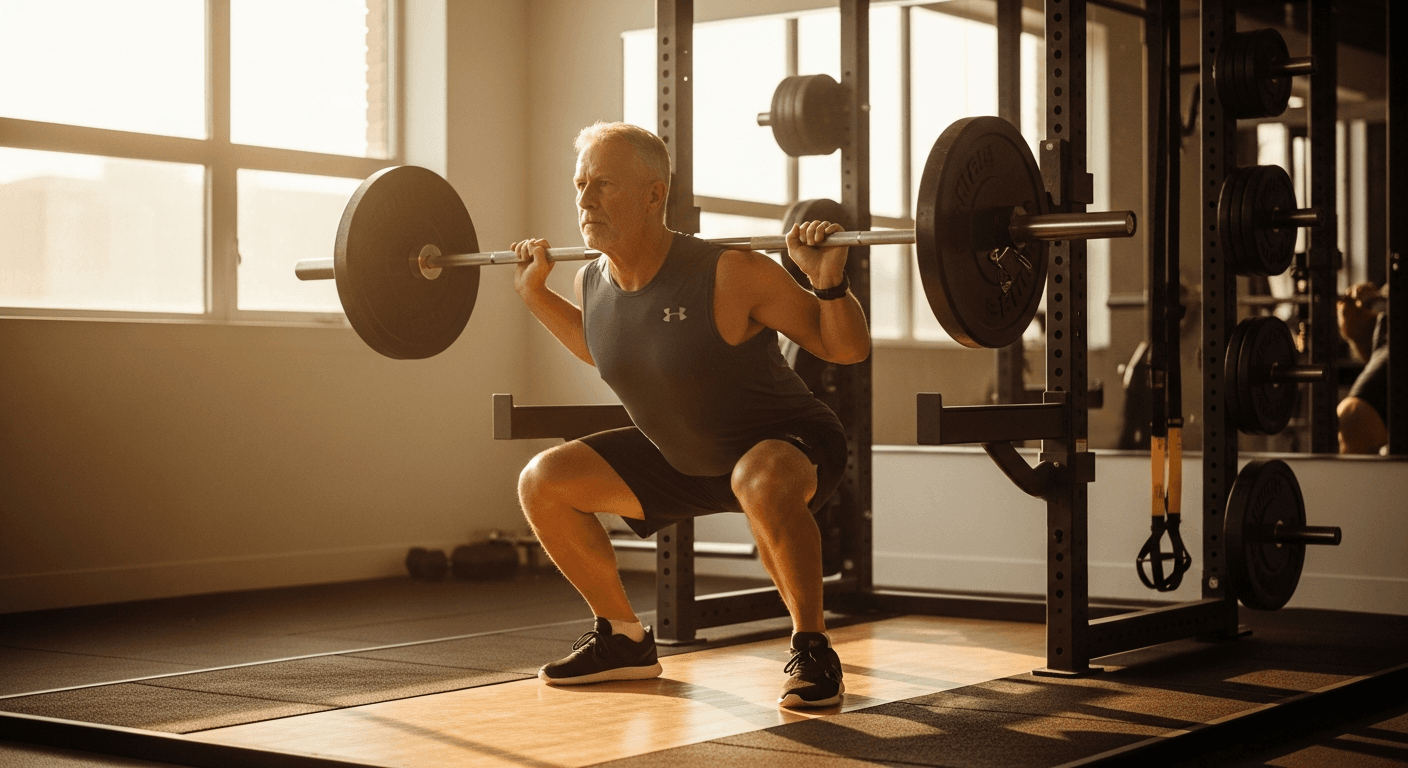
Getting Stronger After 50: The Habits That Change Everything
There's a persistent myth that strength is something you lose after 50. That muscle fades, joints protest, and the best you can do is maintain. The research tells a different story. Adults over 50 who adopt specific, consistent training and recovery habits not only stop the decline. They reverse it.
This isn't about becoming a competitive powerlifter. It's about building the kind of functional strength that makes life easier, protects your joints, reduces injury risk, and keeps you independent for decades longer. Here's what the science actually supports, and how to start applying it this week.
The Truth About Muscle Loss After 50
Sarcopenia, the age-related loss of muscle mass and strength, is real. After 50, most adults lose between 1% and 2% of muscle mass per year without intervention. After 60, that rate accelerates. But "without intervention" is the critical phrase here.
Muscle tissue responds to resistance training at any age. Studies consistently show that older adults following structured progressive overload programs gain meaningful muscle mass within 8 to 12 weeks, often matching or exceeding the relative gains seen in younger adults. Your biology hasn't shut the door. It's just waiting for the right signal.
The signal is mechanical tension. When you lift weights that challenge your muscles, your body activates satellite cells that repair and grow muscle fibers. This process slows with age but doesn't stop. What changes is how deliberately you need to manage the variables around training, including sleep, protein intake, and recovery time.
Progressive Overload Is Still the Engine
No single training principle matters more than progressive overload. It means consistently asking more of your muscles over time, whether through added weight, more reps, better range of motion, or reduced rest periods. Without it, your body has no reason to adapt.
For adults over 50, the application of this principle requires patience and precision. Jumping load too fast is one of the most common mistakes, and it leads to the injuries that derail progress for weeks or months. A more effective approach is to increase training volume incrementally. Add one set before you add weight. Add reps before you add load. Let your connective tissue adapt alongside your muscle.
If you've been lifting consistently but progress has stalled, the issue is usually one of a handful of fixable variables. Stuck in Your Lifting Progress? 4 Evidence-Based Ways to Break Through covers the most common causes and practical solutions backed by current research.
Protein Timing and the Anabolic Window After 50
Older adults have a higher anabolic resistance than younger adults. This means your muscles require more dietary protein to trigger the same muscle protein synthesis response. Research suggests that adults over 50 benefit from targeting 1.6 to 2.2 grams of protein per kilogram of body weight daily, with an emphasis on distributing intake across meals rather than concentrating it in one sitting.
The post-workout window matters more as you age. Consuming 30 to 40 grams of high-quality protein within two hours of resistance training significantly improves muscle repair and adaptation. Lean meats, eggs, Greek yogurt, and whey protein concentrate are all effective sources.
One supplement worth taking seriously is creatine monohydrate. It's one of the most studied compounds in sports nutrition, and it's particularly effective in older adults, supporting both strength output and muscle mass retention. Creatine and Strength: What the Latest Meta-Analysis Shows breaks down the evidence in detail, including dosing protocols that apply directly to adults over 50.
Habit Stacking: How the Best Results Actually Happen
Isolated habits rarely stick. What drives long-term adherence in older adults is habit stacking, linking new behaviors to existing ones so they become automatic rather than effortful. The research on behavioral change consistently shows that people who attach exercise and nutrition habits to established routines are far more likely to sustain them over six months and beyond.
A practical example: if you already drink coffee every morning, that's your anchor habit. Stack your protein intake onto it. Make a high-protein breakfast non-negotiable before the coffee is finished. Stack your training session to follow a specific regular activity, whether that's your commute, a lunch break, or a morning walk. Over time, the decision fatigue disappears.
Here's what a foundational habit stack looks like for someone over 50 focused on strength:
- Morning: 30 to 40 grams of protein at breakfast within an hour of waking
- Pre-session: 3 to 5 grams of creatine monohydrate with water
- Training: 3 to 4 resistance sessions per week, emphasizing compound movements
- Post-session: Another 30 to 40 grams of protein within two hours
- Evening: A consistent wind-down routine targeting 7 to 9 hours of sleep
Each element reinforces the others. Sleep drives recovery and hormonal balance. Protein fuels adaptation. Training creates the stimulus. Remove any one piece and the system weakens.
Why Working With a Trainer Early Is Worth the Investment
Most people over 50 who start resistance training on their own develop compensatory movement patterns within the first few weeks. These are subtle form breakdowns that feel fine initially but accumulate into overuse injuries over months. A qualified personal trainer spots and corrects these patterns before they become problems.
You don't need ongoing sessions indefinitely. Research on adherence in older adults shows that even four to six foundational sessions with a certified trainer dramatically improves both long-term form retention and training consistency. Think of it as buying an instruction manual for your own body.
In the US market, personal training rates typically range from $60 to $150 per session depending on location and credentials. A short initial block of six sessions sits between $360 and $900. That's a one-time investment that pays dividends across years of safe, effective training. Look for trainers certified through NASM, ACE, or NSCA, and prioritize those with specific experience working with adults over 50.
Recovery Is Not Optional After 50
Your muscle tissue doesn't grow during training. It grows during recovery. After 50, the time your body needs to complete that repair process extends noticeably. Treating rest days as passive or unimportant is one of the most expensive mistakes you can make in your training program.
The evidence is clear: two consecutive hard training sessions with insufficient recovery between them produce worse strength adaptations than a well-structured program that builds in strategic rest. How Long Should You Rest Between Strength Sessions? outlines the research on recovery windows by training age and intensity, which is particularly relevant for adults returning to lifting after a break.
Active recovery on rest days, including walking, light mobility work, or swimming, keeps blood circulating to repairing tissues without adding training stress. This is different from passive rest. You're not skipping training. You're doing a different kind of training.
Sleep quality is the single most underestimated recovery variable. During deep sleep, your body releases growth hormone, repairs muscle tissue, and consolidates motor patterns from the training session. Adults over 50 often experience disrupted sleep architecture, which directly limits how much strength they can build regardless of how well they train. Recovery-First Training: The Smarter Way to Build Muscle in 2026 details how prioritizing recovery as a central training strategy, not an afterthought, produces better results across every measurable fitness marker.
What to Actually Do This Week
The research is clear, but research doesn't lift weights. Here's a concrete starting point you can act on immediately, regardless of your current fitness level.
- Session 1: Three sets each of goblet squats, push-ups or incline push-ups, and a single-arm dumbbell row. Rest 90 seconds between sets.
- Session 2 (48 hours later): Three sets each of Romanian deadlifts, a seated shoulder press, and a cable or band pull-apart. Rest 90 seconds between sets.
- Daily: Hit your protein target. Prioritize sleep. Take a 20-minute walk on rest days.
- This month: Book a consultation with a certified trainer, even if it's just two sessions to assess movement quality.
Strength after 50 isn't a special category of fitness. It's fitness, applied with a little more attention to recovery, nutrition, and movement quality. The adults who make the most dramatic progress aren't the ones who train the hardest. They're the ones who train the most consistently, recover intentionally, and build habits that compound over months and years.
You don't need a perfect program to start. You need a good enough program and the discipline to show up for it. That's what changes everything.