
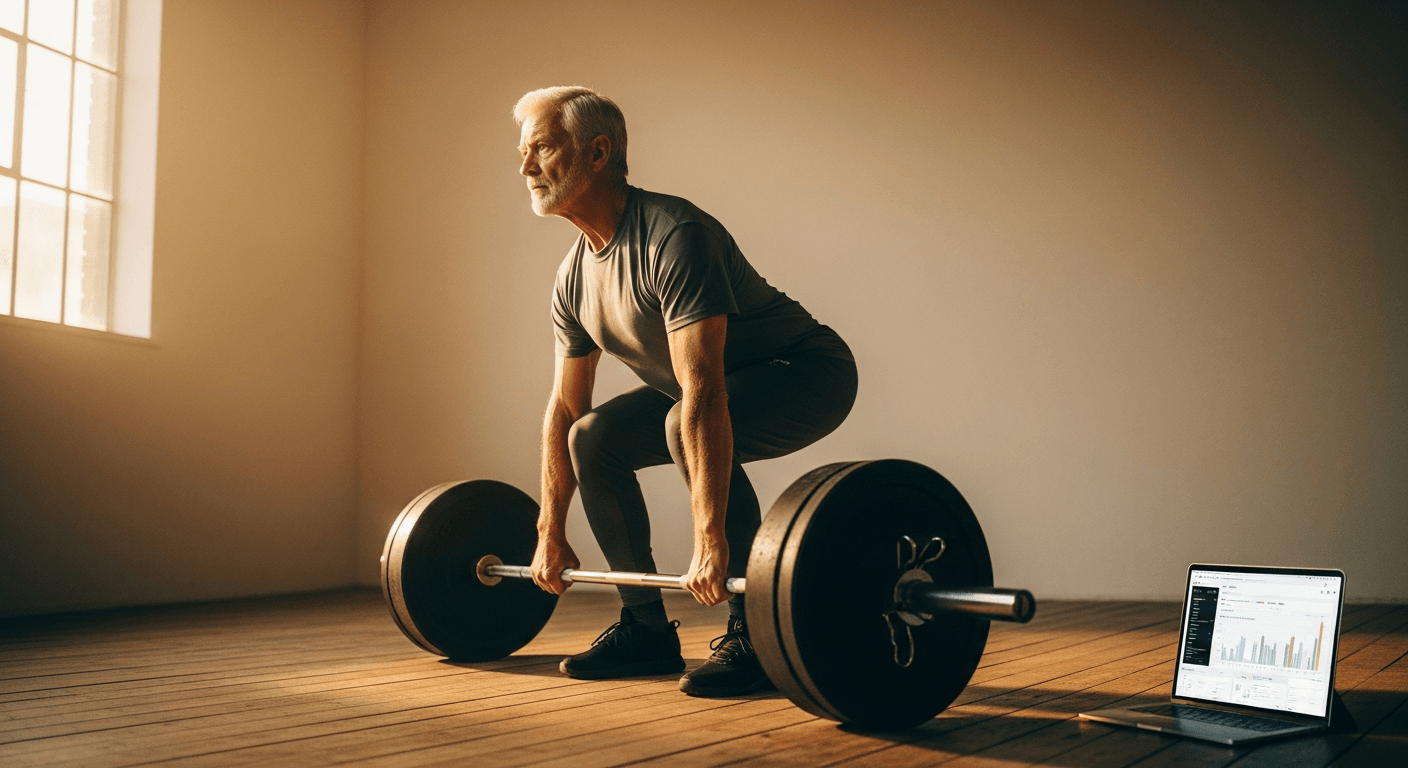
Most people who train seriously have a version of the same long-term goal: stay strong, stay mobile, stay sharp. But the way the fitness industry frames longevity is often built around the wrong metric. Living longer is easy to measure. Living well for longer is something else entirely, and it requires a different approach to training than most lifters are currently taking.
That distinction has a name. It's called health span, and understanding it could change how you think about every workout you do after 40.
What Health Span Actually Means
Lifespan is simply the total number of years you're alive. Health span refers to the years you spend in good physical and cognitive health, free from serious disease or functional decline. The gap between the two is more significant than most people realize.
Research consistently shows that the average person spends the final eight to twelve years of their life managing chronic illness, disability, or cognitive impairment. That's not a footnote. It's roughly a decade of reduced capacity, dependency, and diminished quality of life. The goal of longevity-focused training isn't to add years to your life. It's to compress that period of decline and extend the window where you're actually functional.
For lifters, this reframe matters. The metrics you've been optimizing for, including body composition, personal records, and aesthetic goals, aren't irrelevant. But they're incomplete proxies for what actually predicts a long, high-quality life.
Why Strength Training Is the Most Powerful Tool You Have
Aerobic fitness has dominated the longevity conversation for decades, and it deserves its reputation. Cardiovascular capacity is strongly associated with reduced mortality risk. But the data on strength training and long-term health is catching up fast, and in some areas, it's ahead.
Muscle mass is one of the strongest predictors of functional independence in older age. Studies tracking midlife adults into their 70s and 80s consistently show that those who maintained higher levels of lean mass and muscular strength in their 40s and 50s were significantly more likely to remain independent, mobile, and cognitively sharp decades later. Grip strength alone, often used as a proxy for overall strength, has been shown to predict cardiovascular mortality, hospitalization rates, and cognitive decline.
This isn't just about looking strong. It's about what muscle tissue does for your body systemically. Skeletal muscle is metabolically active tissue. It plays a direct role in glucose regulation, immune function, and inflammatory signaling. Losing it accelerates nearly every marker of biological aging.
The challenge is that muscle loss starts earlier than most people expect. Sarcopenia, the age-related decline in muscle mass and function, begins in the mid-30s and accelerates through the 50s and 60s if not actively countered. By the time most people notice it, they've already lost meaningful ground.
The Midlife Window That Most Lifters Miss
Your 40s and early 50s are arguably the most consequential training years of your life from a health span perspective. This is when the decisions you make about how you train, recover, and eat determine your functional trajectory for the following three decades.
The problem is that many lifters in this age group are still training with the goals and methods of their 20s and 30s. High-volume hypertrophy work, aggressive caloric deficits, minimal recovery structure, and a near-exclusive focus on aesthetics. These approaches aren't wrong exactly, but they're not optimized for what actually matters at this stage.
There's also a persistent cultural myth that serious strength training is somehow unsafe or inappropriate for people over 50. It's not. In fact, the research points the opposite direction. Heavy compound lifting, when programmed appropriately, supports bone density, preserves joint integrity, maintains hormonal balance, and protects against the metabolic conditions most associated with early functional decline. If you've encountered resistance to this idea from a trainer or coach, it's worth reading up on the strength training myths trainers still tell women over 50, many of which apply broadly regardless of gender.
How to Shift Your Training Goals Without Starting Over
Shifting toward health span doesn't mean abandoning the training you love. It means layering in new priorities and being honest about which goals are serving your long-term function and which are just habits from a different chapter.
Here's what the evidence supports for lifters entering their 40s and beyond:
- Keep lifting heavy. Progressive overload remains the most effective stimulus for maintaining and building muscle mass. Don't default to light weights and high reps because you think it's "safer." Strength requires load.
- Add genuine cardiovascular work. Not just walking, though that matters too. Zone 2 cardio, sustained moderate-intensity effort, builds the aerobic base that supports heart health, metabolic efficiency, and recovery capacity. Research on daily movement suggests that 10,000 steps a day cuts sitting-related mortality risks by up to 39%, which means baseline activity levels matter even for serious lifters.
- Train for movement quality, not just output. Functional strength, the ability to squat, hinge, press, pull, carry, and rotate through full range, is what determines your independence at 75. Single-leg work, hip mobility, thoracic rotation, and loaded carries deserve a seat in your program alongside the big lifts.
- Prioritize recovery as a training variable. Sleep, stress management, and structured rest days are not optional extras. Chronic cortisol elevation from poor recovery directly undermines muscle protein synthesis and increases visceral fat accumulation. Understanding how chronic stress quietly wrecks your fitness gains is part of training intelligently at any age, but especially after 40.
- Audit your protein intake seriously. Most lifters think they're eating enough protein. Most aren't, especially as they age. Protein requirements for muscle maintenance increase with age due to anabolic resistance, the reduced efficiency with which older muscle tissue responds to protein intake. Aim for closer to 0.7 to 1 gram per pound of bodyweight daily, distributed across meals.
The Cognitive Dimension Nobody Talks About
Health span isn't only physical. Cognitive function is a core component, and the training implications here are underappreciated.
Strength training has a measurable effect on brain health. Multiple large studies have found associations between regular resistance exercise and reduced risk of dementia, improved executive function, and slower cognitive aging. The mechanisms include improved cerebral blood flow, reduced neuroinflammation, and the release of myokines, signaling molecules secreted by contracting muscle that act on brain tissue directly.
Aerobic exercise also contributes here, particularly through BDNF (brain-derived neurotrophic factor), which supports neuroplasticity. The combination of both modalities appears to offer greater cognitive protection than either alone, which is another argument for a training approach that doesn't treat lifting and cardio as competing priorities.
Body Composition Still Matters, Just Differently
Shifting your focus toward health span doesn't mean ignoring body composition. It means understanding what about body composition actually matters for longevity and why.
Excess visceral fat, the fat stored around internal organs, is one of the most reliable predictors of metabolic disease, cardiovascular risk, and inflammation-driven decline. Emerging research on specific proteins linked to body fat storage suggests the risks go further than commonly understood. The relationship between body fat and systemic disease risk is more complex than a simple number on the scale.
Conversely, maintaining lean mass is protective in ways that go beyond strength. Muscle tissue buffers blood glucose, reduces systemic inflammation, and provides metabolic reserve during illness. This is sometimes called the "muscle insurance" concept in longevity research, and it's one of the stronger arguments for treating your training as a health investment rather than a vanity project.
If you're managing body composition changes while trying to maintain muscle, particularly in the context of significant caloric restriction or medication use, nutritional strategy matters enormously. Research-backed approaches to eating to preserve muscle are increasingly relevant for a wide range of lifters, not just those in specific clinical contexts.
The Long Game Requires a Different Scorecard
The traditional metrics of lifting success, the numbers on the bar, the body fat percentage, the before-and-after photo, aren't useless. But they're not sufficient measures of whether your training is actually building the life you want to live at 70 or 80.
Health span asks different questions. Can you get up off the floor without using your hands? Can you carry heavy objects without pain? Can you sustain effort, think clearly, and move freely through a full day? These are the benchmarks that predict independence, quality of life, and the ability to remain engaged with the things that matter to you as you age.
The good news is that the training required to build health span is not that different from what serious lifters are already doing. It requires recalibrating your goals, filling in the gaps around mobility and cardiovascular work, taking recovery seriously, and being honest about whether you're training for how you want to look or how you want to function. Those goals can coexist. But they can't both be at the top of the list forever.
The lifters who understand that shift early, in their 40s rather than their 60s, are the ones who will still be training, competing, and moving well decades from now. That's not just a longer life. That's a better one.