

The split debate never seems to end. Push/pull/legs versus bro-split versus full-body. Every gym has an opinion, and every Reddit thread turns into a war. But the research has been quietly settling this argument for years, and the answer is simpler than the noise suggests.
Here's what actually drives muscle growth: total weekly volume. Frequency is just the tool you use to get there.
Volume Is the Primary Driver of Hypertrophy
When researchers strip away all the variables and look at what consistently predicts muscle growth across studies, weekly set volume per muscle group comes out on top. The working range supported by the evidence sits between 10 and 20 sets per muscle group per week for most natural trainees.
Below 10 sets, you're likely leaving gains on the table. Above 20, you start outpacing your ability to recover, and the extra work stops paying off. That 10-to-20 window is your target. How you spread those sets across the week matters less than hitting the number.
This has direct implications if you're managing body composition during a caloric deficit or using medication. If you're navigating GLP-1 and Muscle Loss: What Training Can — and Can't — Fix, maintaining weekly volume is one of the most critical levers you have for preserving lean mass during weight loss.

Training a Muscle Twice a Week Beats Once a Week
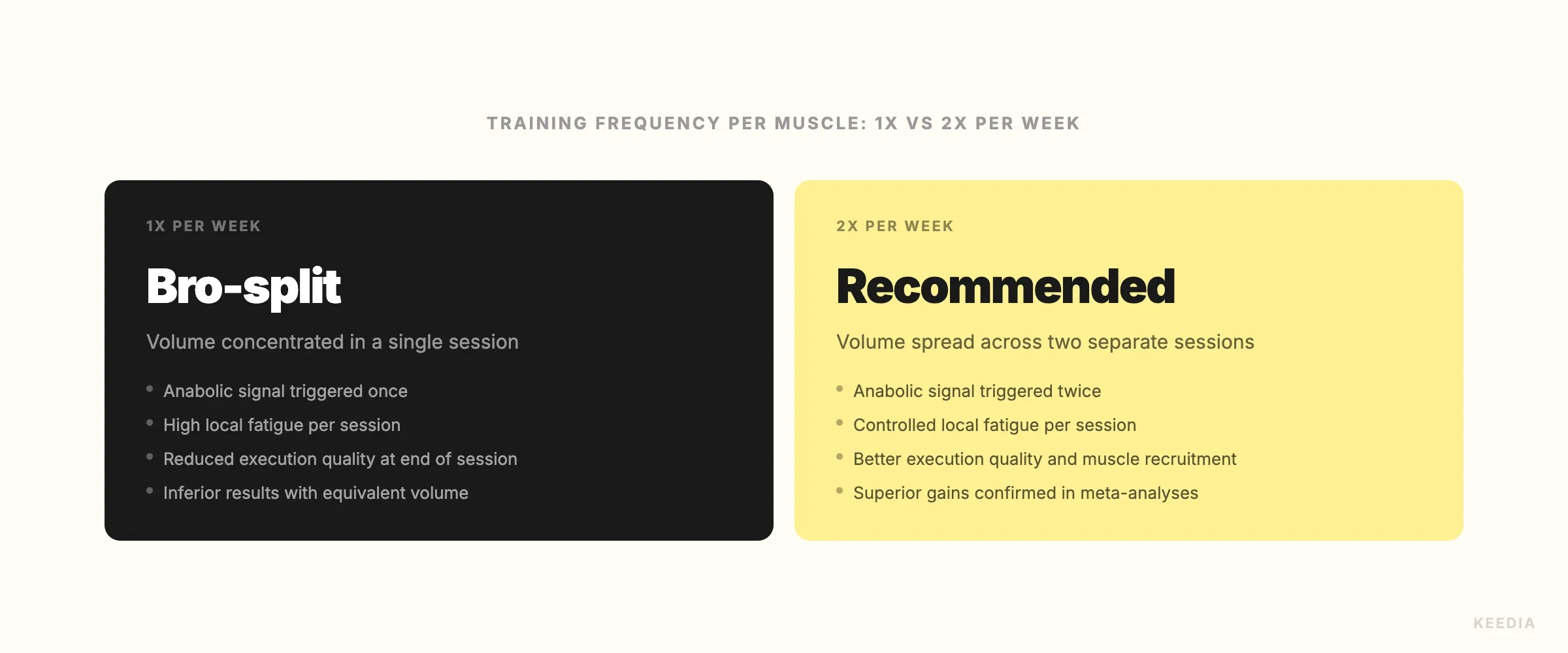
This is probably the closest thing to a settled question in hypertrophy research. Multiple meta-analyses covering hundreds of subjects consistently show that training a muscle group twice per week produces greater hypertrophy than once per week, when total volume is equated across both conditions.
The likely mechanism is protein synthesis. After a resistance training session, muscle protein synthesis elevates for roughly 24 to 48 hours, then returns to baseline. Training a muscle once a week means you're only triggering that anabolic window once every seven days. Twice a week doubles your exposure without requiring more total volume.
In practical terms, this means a bro-split where you train chest once on Monday with 15 sets is probably slightly inferior to splitting those 15 sets across two sessions earlier and later in the week. Same volume. Better signal.
Going Beyond Twice a Week: Diminishing Returns
What about three or four times per week per muscle? The research here gets murkier, and the honest answer is: it depends on your recovery capacity.
Some evidence suggests that spreading volume across three sessions per week can be beneficial for advanced trainees handling 15 to 20-plus sets per week per muscle, simply because it keeps each session more manageable. Doing 20 sets of chest in one workout isn't smart. Spreading it across three days keeps quality high.
But for most people training four to five days a week, twice per muscle group is the sweet spot. Higher frequency works if recovery allows. It doesn't automatically produce better results. Sleep quality, stress load, nutrition, and training age all influence where your ceiling sits. If recovery is a concern, it's worth looking at evidence-based supports. Magnesium and Sleep for Athletes: Which Form, What Dose, What Results is a good starting point if sleep quality is limiting your ability to recover between sessions.
The Split Itself Doesn't Matter as Much as You Think
Push/pull/legs. Upper/lower. Full-body. They all produce comparable results when weekly volume is matched. This has been demonstrated directly in research comparing different training structures, and the conclusion is consistent: the organization of sessions is a secondary variable.
Where splits differ is in their practical ability to hit your weekly volume targets based on how many days you can train. That's the real reason to choose one over another. It's not about which is superior in the abstract. It's about which one fits your schedule well enough that you actually complete it.
This also connects to how you structure training over time. If you want to think beyond weekly planning, Periodization for natural athletes: block, undulating or linear? covers how to sequence training phases to keep progressing after the beginner stage.
Which Split Works for Your Schedule
Here's the practical decision guide based on how many days you can realistically commit to.
3 Days Per Week: Full-Body Training
Full-body is the strongest choice if you're training three days a week. You hit every muscle group in every session, which means you naturally train each muscle two to three times per week. Volume is spread efficiently across the week.
A typical structure might look like three full-body sessions on Monday, Wednesday, and Friday, with each session including a compound push, compound pull, hinge, and squat pattern. Keep sets per exercise in the 3-to-4 range and you'll comfortably land in the 9-to-12 set range per muscle group per week. Add an isolation movement where needed to push toward the upper end of the volume range.
4 Days Per Week: Upper/Lower Split
Upper/lower is the most efficient four-day structure. You train upper body twice and lower body twice, hitting each muscle at least twice per week without the scheduling complexity of PPL.
- Monday: Upper (push focus, horizontal emphasis)
- Tuesday: Lower (squat pattern, quad dominant)
- Thursday: Upper (pull focus, vertical emphasis)
- Friday: Lower (hinge pattern, posterior chain)
This structure makes it straightforward to hit 12 to 16 sets per muscle group per week. It also gives you built-in recovery days and is easy to adjust if life interrupts your schedule mid-week.
5 or More Days Per Week: PPL or Push/Pull/Legs/Upper/Lower Hybrid
With five or six days available, you have more options. A classic PPL run twice in six days covers every muscle twice per week and allows higher total volume for those who need it. A five-day structure often works better as an upper/lower plus one dedicated arm or weak-point day added at the end of the week.
The risk with higher-frequency schedules isn't overtraining in the dramatic sense. It's accumulating fatigue that quietly degrades performance session by session. If you're training five-plus days and your lifts are stalling or sleep feels worse, scaling back or adding a structured deload is often the right move. Deload protocols: what the research actually says is worth reading before you push frequency higher without a plan for managing fatigue.
Common Mistakes That Undercut the Plan
Knowing the framework matters less if execution breaks down. These are the errors that most consistently prevent people from hitting their volume targets.
- Counting junk volume. Sets performed too far from failure don't count the same as challenging sets. Ten sets of bench at 50 percent effort don't equal ten quality sets taken to two reps in reserve.
- Ignoring overlap. Compound movements create shared stress across muscle groups. Your rear delts and biceps are working during every row. Count that partial stimulus when totaling weekly volume.
- Letting frequency become the goal. Training chest three times a week at six sets per session gives you 18 sets. Training it twice at nine sets per session gives you the same. Don't optimize frequency at the expense of per-session quality.
- Skipping progression. Volume is only part of the equation. You need to be adding weight, reps, or difficulty over time. Progressive overload is what converts volume into adaptation.
The Bottom Line
Your split is a scheduling tool. It's not a training philosophy. The goal is to accumulate 10 to 20 quality sets per muscle group each week, train each muscle at least twice, and do it in a structure you can sustain consistently over months.
Full-body works for three days. Upper/lower works for four. PPL or a hybrid works for five or six. Pick the one that fits your life. Protect your volume. Hit your muscles twice a week. Then stay consistent long enough for the process to compound.
Everything else is details.