

You've probably spent more time researching training programs than actually training. You've compared periodization models, debated rep ranges, color-coded your workout spreadsheet, and switched plans at least twice before seeing any real results. If that sounds familiar, you're not alone. And according to a growing body of research, you're also not getting anywhere faster for the effort.
The science is becoming hard to ignore: simple training works just as well as complex training for most people. And the complexity you've been sold isn't just unnecessary. It's actively working against you.
Simple Strength Programs Produce the Same Results as Complex Ones
Periodization has been a cornerstone of strength programming for decades. The idea is that systematically varying your training variables over time produces superior adaptations. It sounds logical. The problem is that the evidence increasingly doesn't support it, at least not for recreational lifters.
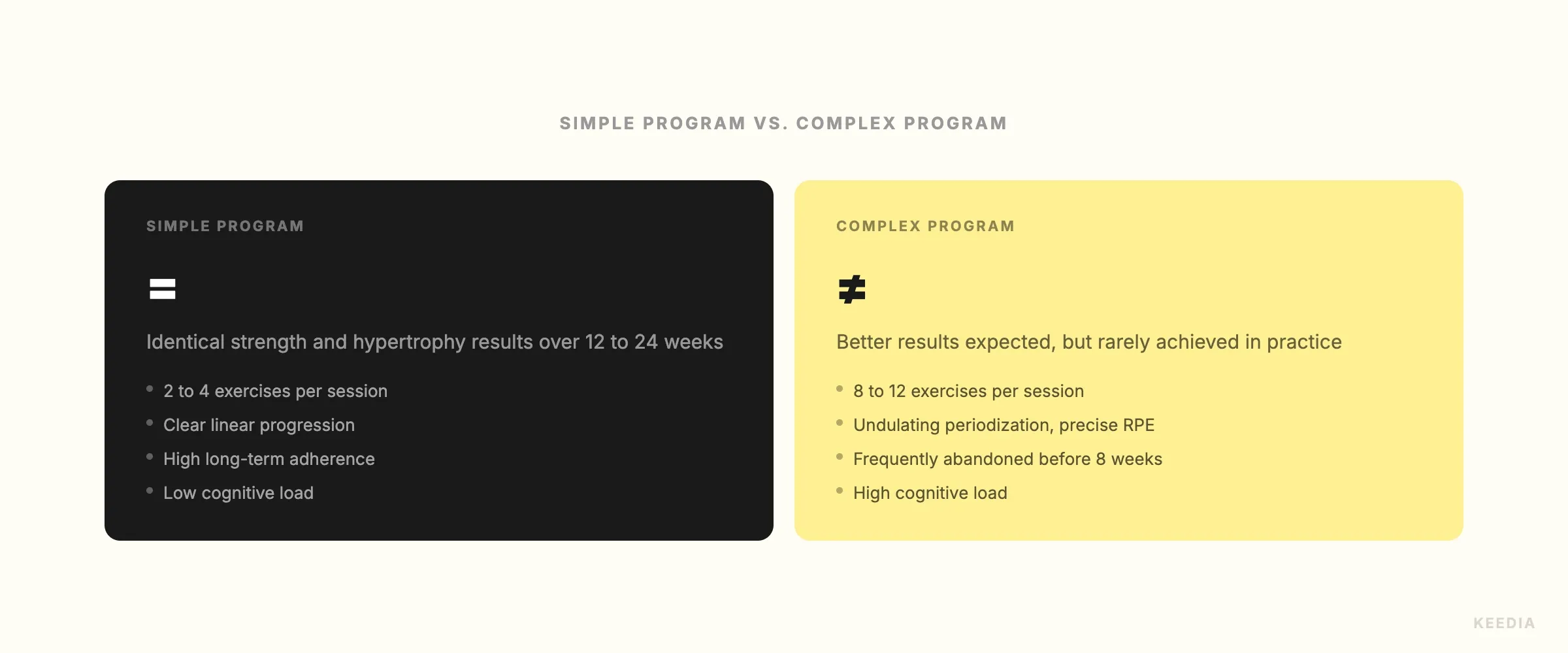
Recent meta-analyses comparing linear programming with more complex periodized approaches found no statistically significant difference in hypertrophy or strength gains in non-elite populations over periods of 8 to 24 weeks. The training stimulus matters. The precise sequencing of that stimulus, within reason, largely doesn't.
This aligns with new global lifting guidelines that have also challenged widely held beliefs about training intensity, including the assumption that more sophisticated protocols are inherently superior. What drives progress is consistent exposure to progressive overload. That can be achieved with a three-exercise full-body plan done three times a week.
For the average person training to look better, feel better, and get stronger, the evidence increasingly points to the same conclusion: the marginal benefit of complexity is near zero, and the cost in time, confusion, and adherence is very real.
Once-Weekly Cardio Is More Effective Than You've Been Led to Believe
The frequency obsession extends well beyond strength training. For years, public health messaging and fitness culture have pushed the idea that cardio must be distributed across multiple sessions throughout the week to be effective. Recent research is complicating that narrative significantly.
Studies comparing once-weekly high-intensity interval training against three-sessions-per-week protocols have found comparable improvements in fat loss, VO2 max, and cardiometabolic markers when total weekly volume is matched. The body responds to the cumulative stimulus, not the scheduling pattern you used to deliver it.
This connects directly to the broader findings around what weekend-only training actually does to your muscle health and fitness outcomes. The picture is more nuanced than conventional wisdom suggests, and more forgiving of real-world schedules than most fitness content will ever admit.
If your week only allows one dedicated cardio session, doing that session hard and consistently is not a compromise. It's a legitimate training strategy backed by data.
Complexity Kills Adherence, and Adherence Is Everything
Here's where the real cost of program complexity shows up. Research consistently finds an inverse relationship between program complexity and adherence in recreational lifters. The harder a plan is to follow, the less likely you are to actually follow it. This isn't a willpower problem. It's a design problem.
A training plan that requires you to track seven variables, rotate exercises on a three-week undulating cycle, and hit precise percentages of your one-rep max on alternating days is not a well-designed plan for someone with a job, a family, and a normal life. It's a plan optimized for looking sophisticated on paper.
The research on habit formation and behavior change is unambiguous on this point: simplicity increases execution rates. A plan you do 90% of the time beats a plan you do 50% of the time, every single time, no matter how superior the latter looks on a whiteboard.
If you're working with a coach or considering hiring one, this is one of the most important things to evaluate. A trainer who actually follows the science will prioritize your consistency over the complexity of your program. That distinction matters more than any certification on their wall.

The Fitness Industry Profits From Your Confusion
Let's be direct about something that rarely gets said plainly in fitness media: complexity is a business model.
Simple advice doesn't generate recurring content. "Squat, press, pull, and walk more" doesn't sell a $150/month app subscription or justify a $300/month coaching package. It doesn't give influencers a reason to post daily. It doesn't keep you coming back for the next variation, the next upgrade, the next phase of your "periodized nutrition and training block."
The fitness media ecosystem, including premium content, coaching platforms, and supplement marketing, is structurally incentivized to make you believe that what you're currently doing is insufficient. That there's a smarter protocol just behind the next paywall. That the reason you're not progressing is because your program isn't sophisticated enough, not because you're skipping sessions or under-recovering.
This even extends to nutrition content, where complexity is routinely manufactured around topics that don't require it. Questions about things like protein timing are frequently made far more complicated than the actual evidence supports. The total amount you eat matters. The precise timing, for most people, matters very little.
None of this means all coaching or premium content is a scam. It means you should be skeptical of any program or service that sells complexity as a feature rather than a last resort.
How to Audit Your Current Program and Strip It Back
If you suspect your training is more complicated than it needs to be, here's a practical framework for cutting through the noise. You don't need to start from scratch. You need to identify what's actually driving your results and protect that, while eliminating everything else.
Step 1: Identify your primary adaptive stimulus. For strength and hypertrophy, this means progressive overload on compound movements. Are you getting stronger over time on your main lifts? If yes, the program is working. If no, complexity isn't the fix. Consistency, sleep, and nutrition are.
Step 2: Count your decisions. How many choices does your program require you to make per session? Exercise selection, rep ranges, load percentages, rest periods, tempo, exercise order. Every decision is a cognitive tax. Reduce the number of daily decisions your program requires and your adherence will improve almost automatically.
Step 3: Assess your week honestly. How many sessions are you actually completing versus how many are programmed? If you're hitting 3 out of 5 scheduled sessions, a 3-day program isn't a downgrade. It's a correction.
Step 4: Cut any element you can't explain. If you don't know why a particular exercise, set scheme, or protocol is in your program, it probably shouldn't be. Ask yourself what result you expect it to produce. If the answer is vague, cut it.
Step 5: Build in real recovery. Complexity often crowds out recovery by filling every available hour with training stimulus. A balanced program leaves space for adaptation. What a genuinely well-designed weekly plan looks like is often simpler than most gym-goers expect.
The goal of this audit isn't minimalism for its own sake. It's to remove friction so that the things that actually drive results, training hard, recovering well, staying consistent, become easier to do.
What Simple Actually Looks Like
Simple doesn't mean easy. Squatting three times a week and pushing yourself to add weight over time is brutally effective and brutally hard. Simple means that the structure of your program should never be the obstacle between you and doing the work.
Three to four days of resistance training built around compound movements. One to two cardio sessions done at meaningful intensity. Protein targets hit consistently. Sleep taken seriously. That's the framework the evidence actually supports for the vast majority of recreational lifters.
Everything else is optimization at the margins. And the margins only matter once the fundamentals are locked in. For most people, they never are, because they're too busy optimizing the margins to build the base.
Stop auditing your program and start executing it. The science has been telling you this for years.