
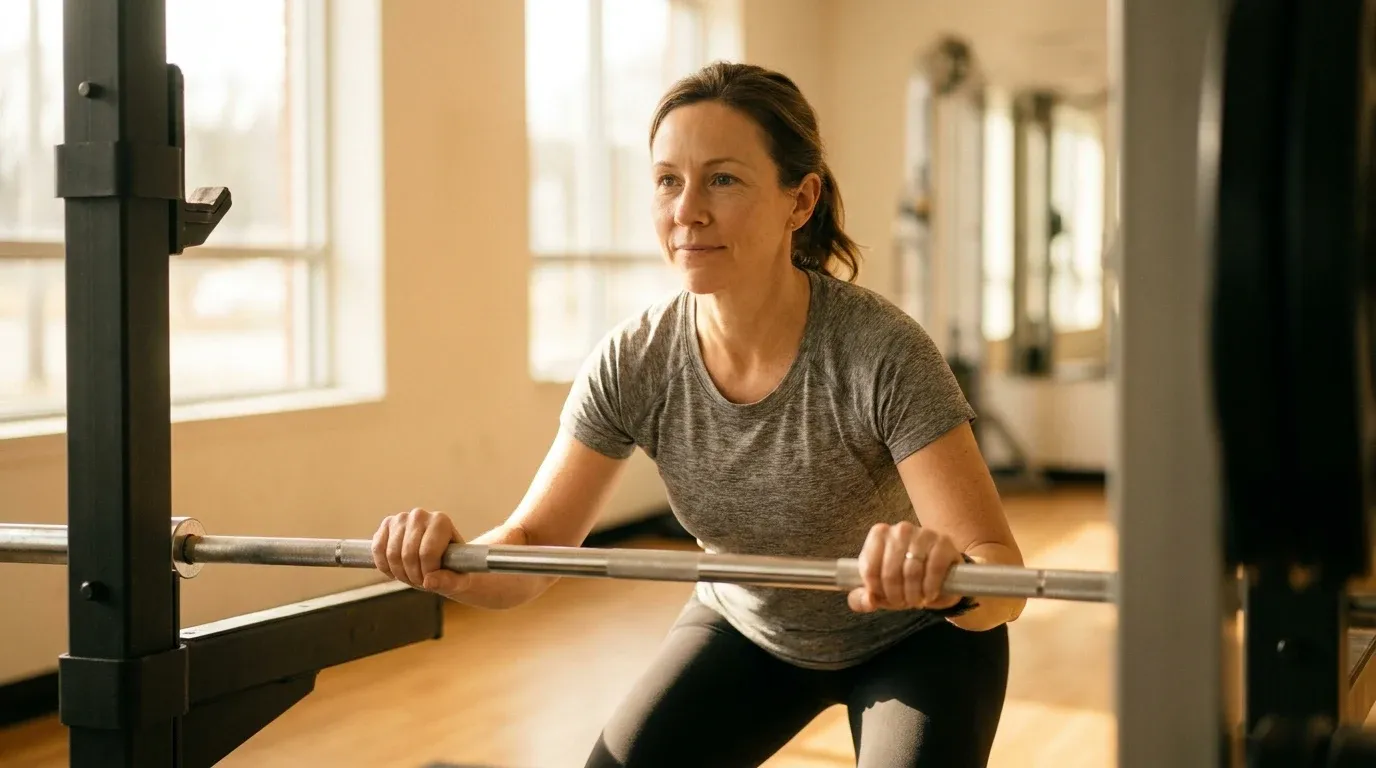
If you've been meaning to start strength training and keep putting it off, you're not alone. And new research suggests the delay is costing you more than you think. Women between 40 and 60 are consistently identified as the group with the most to gain from resistance training, yet they remain the least represented in gym environments and the least targeted by fitness programming.
That gap isn't a personal failure. It reflects decades of fitness culture built around aesthetics, around men's physiology, and around intimidating spaces that were never designed with midlife women in mind. But the science has caught up, and the entry point is simpler than the industry wants you to believe.
Why This Decade Matters More Than Any Other
Perimenopause and menopause bring a measurable drop in estrogen that directly accelerates muscle loss, bone density decline, and metabolic slowdown. Research consistently shows that women can lose up to 1 percent of bone mass per year in the years surrounding menopause, with some estimates reaching 2 to 3 percent annually in the first few years post-menopause. Muscle loss follows a similar trajectory without intervention.
The good news is that resistance training is one of the few interventions with strong evidence for reversing or slowing all three. It stimulates bone remodeling, preserves lean muscle mass, and improves insulin sensitivity at a time when metabolic function often starts to drift. For a fuller picture of what exercise actually protects against in women specifically, Women's Health and Fitness: The Risks Exercise Actually Reduces lays out the evidence in detail.
This isn't about aesthetics, although strength training changes body composition in ways many women find meaningful. It's about keeping your body functional, resilient, and metabolically healthy through a decade that will shape how you feel for the next thirty years.
The Research on Starting Points Is More Encouraging Than You've Heard
One of the most persistent myths around lifting is that you need to train frequently, intensely, and consistently from day one to see results. The data doesn't support that. Studies show that two full-body resistance training sessions per week at moderate intensity are sufficient to produce measurable improvements in muscle strength, muscle mass, and bone density within 12 weeks in previously untrained women over 40.
Moderate intensity, in practical terms, means working at roughly 60 to 70 percent of your maximum effort. You should feel challenged but not destroyed. You should be able to finish a set and know you had a few reps left in reserve. That's the zone where adaptation happens without overwhelming your recovery systems.
For women who've been cautious about exercise intensity, the evidence on lower-effort training is also worth knowing. Is Gentle Exercise Actually More Effective Than We Think? explores how moderate-intensity movement produces stronger long-term adherence and comparable physiological gains for many populations, including older adults returning to training.
The Barriers Are Real. So Are the Workarounds.
Gym intimidation is documented, not imagined. Research on exercise behavior consistently identifies perceived social judgment and unfamiliarity with equipment as primary reasons women in midlife avoid or delay strength training. Here's what actually works to get past that barrier.
Start at home or in low-traffic spaces. You don't need a gym to begin. Resistance bands, a set of dumbbells, and your bodyweight are enough to run an effective 12-week beginner program. A pair of adjustable dumbbells costs $40 to $120 and covers most movements you'll need. If you eventually want access to a gym, off-peak hours (early morning or mid-afternoon on weekdays) are significantly less crowded, and most facilities have introductory floor walkthroughs on request.
Joint sensitivity is common and manageable. Many women over 40 carry some degree of joint discomfort, particularly in the knees, hips, and wrists. This doesn't mean lifting is off the table. It means starting with controlled range of motion, avoiding pain (which is different from effort), and choosing exercises with lower joint loading until your connective tissue adapts. Goblet squats, seated rows, and floor presses are all effective and joint-friendly starting points. Progressing slowly over 8 to 12 weeks gives tendons and ligaments time to strengthen alongside the muscles.
Time pressure has a real solution. Two 45-minute sessions per week is less than 2 hours total. Full-body training formats mean you're not splitting muscle groups across five days. Supersets (pairing two exercises back to back with minimal rest) can reduce total workout time by 20 to 30 percent without reducing training volume. If 45 minutes feels like too much at first, starting with 25 to 30 minutes is still enough to produce adaptation in the early weeks.
What a Beginner Program Actually Looks Like
A simple two-day full-body program for a beginner over 40 doesn't need to be complicated. Each session should include a lower-body push (squats or variations), a lower-body pull (deadlift or hip hinge variation), an upper-body push (press), an upper-body pull (row or lat pulldown), and a core movement. That's five movement patterns. Everything else is detail.
A workable structure:
- Day 1 and Day 2 are separated by at least 48 hours (for example, Monday and Thursday).
- 3 sets of 10 to 12 reps per exercise at a weight that feels challenging by the final 2 to 3 reps.
- 90 seconds of rest between sets is enough to recover without letting your heart rate drop too far.
- Progressive overload every 2 to 3 weeks, meaning you add a small amount of weight or one more rep before increasing load. This is what drives continued adaptation.
Recovery between sessions matters as much as the sessions themselves. Understanding how your body repairs after training, and what supports that process in the first 24 hours, is worth knowing early. Recovery Methods Work Best in the First 24 Hours covers what the evidence actually supports, which is more practical and less expensive than most post-workout routines suggest.
What to Expect in the First 12 Weeks
The first two to three weeks are mostly neurological. Your muscles aren't changing much yet. What's happening is that your nervous system is learning to recruit muscle fibers more efficiently. You'll feel more coordinated, more stable, and you'll notice strength gains that feel disproportionate to any visible change. That's normal and it's real progress.
By weeks four through six, you'll start to notice shifts in how you feel outside the gym. Better posture, less lower back fatigue, more ease in daily movements like carrying groceries or climbing stairs. These functional changes are often more motivating than aesthetic ones, and they're a sign that your training is working.
Between weeks eight and twelve, measurable changes in muscle volume and bone density markers are possible with consistent training. Research on neuromuscular adaptation in older adults helps explain why these timelines work the way they do. Why Aging Muscles Lose Strength: Scientists Found a Missing Piece explains the underlying biology and why the adaptation window in your 40s and 50s is more open than many people assume.
Do You Need a Trainer?
Not necessarily, but guidance accelerates results and reduces injury risk, particularly around technique. If budget allows, even two to four sessions with a trainer to learn the foundational movement patterns is more valuable than ongoing weekly sessions. In the US, a single session with a certified personal trainer typically costs between $60 and $120 depending on location and experience level. That's a one-time investment in movement quality, not an ongoing commitment.
If you do decide to work with a coach, understanding what makes that relationship productive is worth thinking about before you start. What Makes a Trainer-Client Partnership Actually Work breaks down how to find someone aligned with your goals rather than someone who simply puts you through a generic program.
If budget is a constraint, structured video programs (many available for free or under $15 per month), form-checking communities online, and beginner lifting guides from evidence-based sources are all legitimate alternatives. The barrier to entry is much lower than the fitness industry's marketing suggests.
Consistency Is the Only Variable That Compounds
Strength training after 40 isn't about finding the perfect program or the perfect gym. It's about showing up twice a week, adding a little more load every few weeks, and letting biology do its job. The women who see the most significant long-term changes aren't the ones who trained hardest in the first month. They're the ones who were still training six months later.
The research is clear, the barriers have workarounds, and the biological case for starting now is stronger than at almost any other point in your life. Two sessions a week is where it starts. Twelve weeks is when you'll start to feel the difference.