
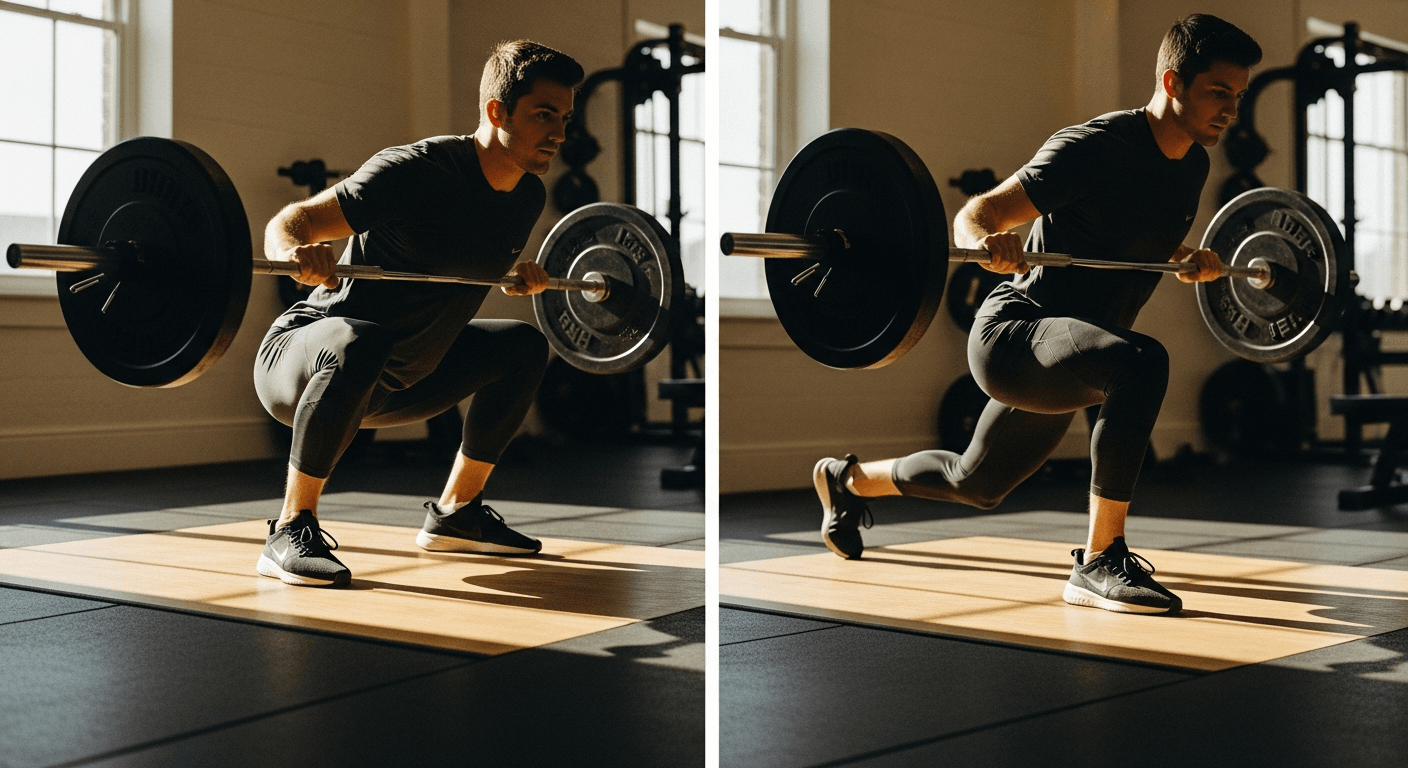
If you've been building your lower-body training around the back squat, you're not alone. It's been the default strength exercise for decades. But emerging periodization research is challenging that default, suggesting that single-leg exercises like lunges can preserve the strength stimulus you're after while generating significantly less systemic fatigue. For lifters training four or more days per week, that difference matters more than most people realize.
What the Research Is Saying About Fatigue and Exercise Selection
The back squat is a high-demand bilateral movement. It loads the entire posterior chain, taxes the central nervous system, and requires substantial recovery between sessions. That's fine if you're running a low-frequency program. But when training volume is spread across four, five, or six sessions per week, the fatigue generated by heavy squats can quietly accumulate and erode performance across all your other work.
Recent periodization research has started to quantify this more precisely. Studies looking at fatigue-to-stimulus ratios in strength exercises show that the back squat carries one of the highest fatigue penalties relative to the strength signal it produces. Single-leg exercises, including lunges, split squats, and Bulgarian split squats, consistently come out with more favorable ratios. You get a comparable strength stimulus with meaningfully less systemic cost.
This doesn't mean squats are bad. It means that for high-frequency training blocks, swapping the back squat for a single-leg variation could let you maintain the strength adaptations you're working toward without digging a recovery hole you can't climb out of by your next session.
Recovery quality also plays into this equation in ways that go beyond exercise selection. Rest and recovery are increasingly recognized as foundational training variables, not just afterthoughts once the hard work is done.
Why Single-Leg Training Does Things Bilateral Squats Can't
Here's a structural reality that bilateral training often masks: your left leg and your right leg are probably not equally strong. Most people have meaningful asymmetries in hip strength, quad development, and glute activation, side differences that a back squat happily allows the dominant leg to compensate for.
Lunges and their single-leg variations force each leg to work independently. There's no opportunity for your stronger side to pick up the slack. Over time, this addresses the muscular imbalances that can quietly increase injury risk, particularly in the knees and hips, as load and training frequency go up.
Single-leg training also demands significantly more from your stabilizing muscles. Every lunge rep requires your hip abductors, adductors, and core to manage lateral stability in ways that a bilateral squat doesn't trigger to the same degree. That translates to functional strength that carries over well into sports, running, and everyday movement patterns.
Research on ankle and knee injury prevention consistently points to single-leg strength and neuromuscular control as key protective factors. Training with lunges builds both simultaneously.
Programming Lunges Without Losing Strength Gains
The concern most lifters raise is straightforward: if lunges are lighter and feel easier, won't your absolute strength suffer? The answer depends on how you program them.
Loading lunges progressively with dumbbells, a barbell, or a trap bar allows you to drive meaningful strength adaptations. Bulgarian split squats, in particular, can be loaded quite heavily and have been shown in comparative studies to produce lower-body strength gains comparable to bilateral squats over matched training periods, with less next-day soreness and faster readiness for subsequent sessions.
A practical structure for high-frequency training might look like this:
- Day 1: Heavy back squat as the primary lower-body lift, lower session volume overall
- Day 2: Loaded lunges or Bulgarian split squats as the primary lower-body movement, allowing for higher total training quality in the session
- Day 3: Single-leg work again, or a hinge-dominant day, preserving the squat pattern's integrity without repeating its fatigue cost
This kind of structure lets you maintain back squat practice, which matters if absolute squat strength is a goal, while distributing the fatigue load more intelligently across the week.
The Fatigue Load Problem at Four-Plus Days Per Week
Most strength training advice is built around two or three sessions per week. At that frequency, almost any well-designed program works because recovery windows are generous. But the picture changes significantly when you're training four or more days per week, which is increasingly common among recreational lifters who also have life commitments that push sessions closer together.
At higher frequencies, managing fatigue through exercise selection becomes as important as managing volume through sets and reps. Choosing a lower-fatigue variation of a given movement pattern isn't a compromise. It's a programming decision that can allow you to sustain quality across all your sessions rather than grinding through accumulated tiredness that caps your output by day three.
Nutrition also plays a role here that's easy to underestimate. Adequate protein intake supports muscle protein synthesis and limits breakdown between sessions, and pairing protein with dietary fiber has emerged as a particularly effective nutritional strategy for lifters managing heavier training loads. Protein and fiber together are shaping up as 2026's most important nutritional pairing for performance and recovery.
Supplementation timing and strategy also matters for high-frequency athletes. If you're considering adding a supplement like creatine to support output across multiple sessions per week, it's worth understanding what the evidence actually supports. The research on creatine loading protocols is more nuanced than most people assume.
When the Back Squat Remains the Right Choice
None of this is an argument to retire the back squat. For powerlifters whose sport requires a maximal back squat, there's no substitute for practicing the specific movement under load. For athletes building a strength base in a lower-frequency program, the squat is efficient and effective. And for any lifter who simply enjoys squatting and recovers well from it, there's no reason to make a wholesale swap.
The case for lunges as a substitution is specifically strongest in these situations:
- You're training four or more days per week and noticing that your later sessions feel flat
- You have a persistent left-right strength imbalance that bilateral squats aren't correcting
- You're coming back from a knee or hip issue and need to rebuild strength while managing joint stress
- You're in a hypertrophy-focused training block where muscle development matters more than peak bilateral strength
- You have limited recovery resources due to life stress, sleep disruption, or inadequate nutrition
Sleep quality, in particular, is an underappreciated variable in how much fatigue you accumulate from a given training load. Poor sleep amplifies fatigue and slows adaptation, meaning the same session that's manageable when you're well rested becomes a recovery liability when you're not. Research consistently links adequate sleep and moderate exercise as a paired foundation for long-term physical and mental health.
A Practical Decision Framework
Rather than choosing between lunges and back squats as if it's a permanent decision, think about it as a periodization tool. Your program should be asking: what is the most appropriate movement for this training block, at this frequency, given my recovery status?
During high-frequency blocks or periods of high life stress, rotate in lunges and split squat variations as primary lower-body work. Reserve heavy back squatting for lower-frequency blocks where you have the recovery runway to support it properly.
Track how your sessions feel across the week. If Wednesday's training quality is noticeably lower than Monday's, that's a signal your fatigue load is exceeding your recovery capacity. Adjusting exercise selection is often a more sustainable fix than simply cutting volume, because it preserves the training stimulus while reducing the systemic cost.
It's also worth paying attention to what's happening outside the gym. Emerging research on vagus nerve stimulation and recovery suggests that how your nervous system is managing stress has direct effects on how well you adapt to training. Single-leg work, which carries a lower CNS demand than heavy bilateral squats, is a way of being more respectful of that system when it's already stretched.
The Bottom Line
Lunges and back squats aren't competitors. They're tools, and smart lifters use the right tool for the context. If you're training frequently and noticing that your performance across the week is inconsistent, exercise selection may be the lever worth pulling before anything else. Swapping some of your back squat volume for loaded single-leg work could be the adjustment that makes your whole training week more productive, not just one session.
The goal isn't to train harder. It's to train in a way that actually compounds over time.