
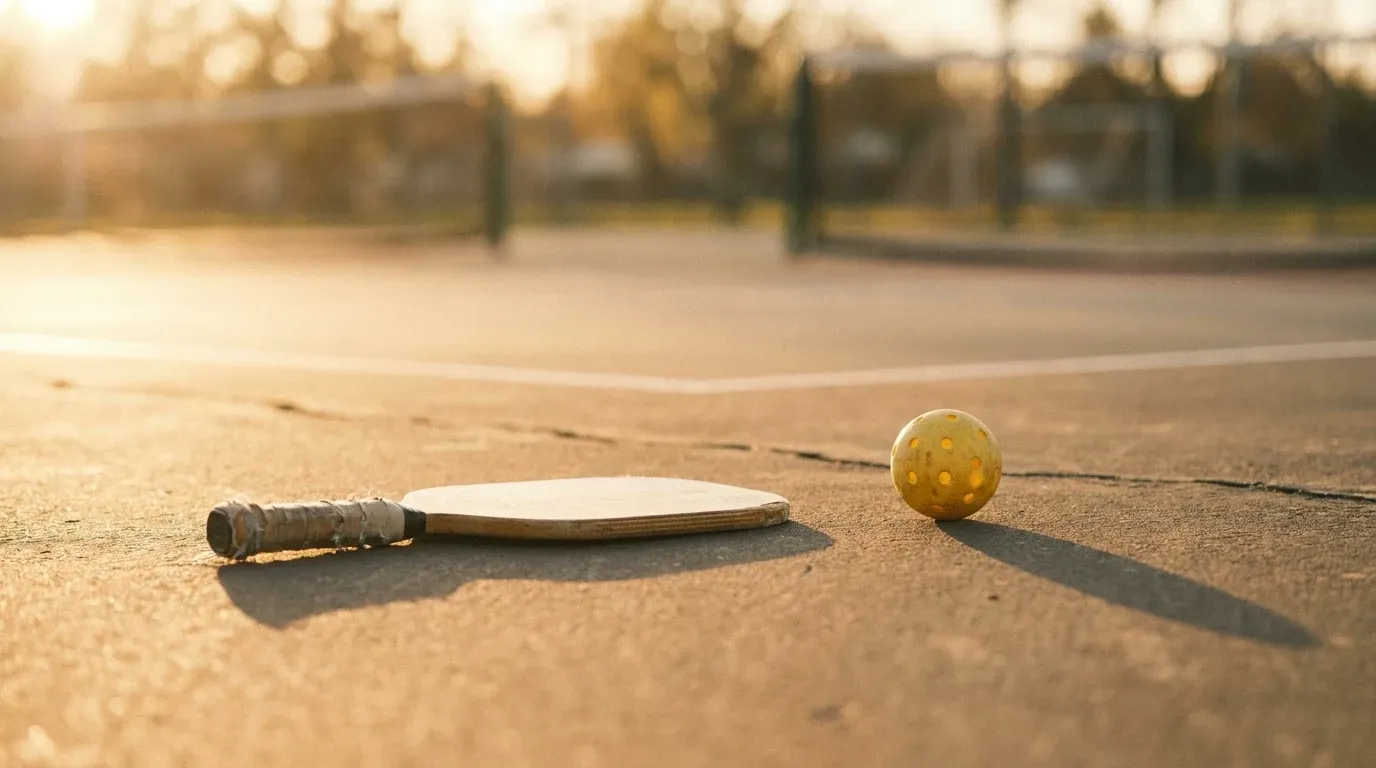
For the past several years, pickleball has been inescapable. Courts were going up inside converted warehouses, tennis clubs were repainting their lines, and celebrity investors were pouring money into professional leagues. The sport added millions of players annually and seemed immune to the usual fitness trend cycle. Then came October 2026, when a major pickleball brand filed for bankruptcy, and a much harder question moved to the front of the conversation: was this boom already running out of steam?
The data, when you look at it closely, tells a nuanced story. Pickleball isn't dead. But several signals suggest it's entering a new, more complicated phase, one where the gap between cultural visibility and commercial viability is getting harder to ignore.
The Bankruptcy Signal That Fitness Insiders Noticed
Bankruptcy filings in any industry don't always mean a category is collapsing. Companies overextend. Supply chains get mismanaged. Investor expectations outpace reality. But when a prominent brand in a supposedly exploding market can't stay solvent, it forces analysts to revisit their assumptions.
The pickleball equipment and apparel market saw enormous investment between 2021 and 2024, built on the assumption that player growth would translate directly into sustained consumer spending. That assumption is now being stress-tested. Manufacturing capacity was scaled aggressively. Retail partnerships were expanded. And when the conversion from casual player to committed gear buyer proved lower than projected, the financial model broke down.
This pattern isn't unique to pickleball. It mirrors what happened with boutique cycling, with certain CrossFit affiliates, and with the foam roller and mobility accessory market that ballooned during the pandemic recovery period. The sport or format grows fast. Commercial infrastructure races ahead of the actual customer base. Then reality arrives.
What Payment Data Reveals About Who's Actually Playing
One of the more revealing data points to emerge recently comes from Venmo payment behavior. When researchers and analysts look at how people split costs for recreational fitness, the demographic profiles become surprisingly sharp. Pickleball payments skew younger, particularly toward adults in their early-to-mid twenties, suggesting the sport is increasingly attracting a demographic that's enthusiastic but not necessarily high-spending in terms of gear, court memberships, or organized events.
That's a commercial problem even if it isn't a participation problem. Younger players are less likely to invest in premium rackets, branded apparel, or paid league registrations. They're more likely to borrow equipment, use public courts, and organize casually through group chats. That behavior keeps the sport alive at the grass-roots level but doesn't sustain the commercial ecosystem that was built around projected spending.
Compare that to HYROX, the competitive fitness format combining running and functional workout stations, which is showing strong dominance among women aged 30 to 44. This demographic tends to spend more on training, nutrition, coaching, and event registration. It's a market segment that converts from interest to revenue much more efficiently. For fitness brands deciding where to allocate sponsorship and product development budgets, that gap matters significantly.
HYROX and the Rise of the Performance-Oriented Adult
HYROX isn't just growing. It's growing in exactly the demographic that fitness brands, gym operators, and wellness companies most want to reach. Women between 30 and 44 are among the highest-value fitness consumers in the market. They're more likely to work with coaches, more likely to invest in structured programs, and more likely to track their training data consistently.
This connects to a broader shift in how fitness-oriented adults think about their training. There's growing interest in formats that are structured, measurable, and progressive. HYROX offers a finish line and a clock. It gives you a result you can compare against your previous self and against a global field of competitors. That kind of framework appeals to people who want their fitness to function like a system, not just a hobby.
If you're thinking about what kind of support structure works best for that type of training, it's worth understanding how choosing between a coaching app and a human coach can shape your long-term results. The answer isn't always obvious, and it often depends on what stage of training you're in.
The broader coaching conversation has also evolved. As one analysis from the fitness industry notes, the personal trainer of 2026 is focused on behavioral change and longevity, not just programming sets and reps. That shift aligns closely with the expectations of the 30-to-44 demographic that HYROX is capturing.
Boom-and-Bust: Where Does Pickleball Fit?
Analysts tracking fitness trends have a useful framework for sorting sports and formats into categories: core activities that establish permanent cultural footholds, and trend-driven spikes that plateau or contract after initial enthusiasm fades. Pickleball's trajectory is currently ambiguous enough to fit either description, and which way it goes depends on a few specific factors.
The first is whether its recreational base holds. Pickleball's greatest strength has always been accessibility. It's easy to learn, it's social, and it's lower-impact than tennis or running, which matters especially for adults managing joint stress. If it retains that casual, accessible identity, it can survive as a durable recreational sport even if the commercial apparatus around it shrinks.
The second factor is demographic diversification. If pickleball remains concentrated in younger, lower-spending players, the commercial market will continue to struggle regardless of participation numbers. But if the sport successfully pulls in more adults in their thirties and forties, including those who are already invested in their fitness and willing to spend on it, the economics start to look more sustainable.
The third is competition from formats like HYROX, padel, and functional fitness events that are actively competing for the time and money of fitness-motivated adults. The fitness market isn't static, and formats that offer clearer progression structures are pulling attention away from purely recreational options.
What This Means for You as an Active Person
If you play pickleball, none of this means you need to stop. A sport being commercially overhyped doesn't make it a worse workout or a less enjoyable way to spend time. In fact, for many people, the social and accessible nature of pickleball fills a specific role that more structured formats can't. Regular recreational play that keeps you moving, lowers stress, and builds community has real value, even if it isn't the most optimized form of training.
The relevant research on this point is consistent. Recreational physical activity, even at moderate intensities, contributes meaningfully to mental health outcomes. Studies looking at resistance training, for example, have found that structured lifting can reduce anxiety in women by up to 54 percent, but that finding points to the value of consistent activity rather than any single format being uniquely superior.
What the pickleball data should prompt you to think about is whether your current fitness approach is built around what's popular or around what actually works for your goals. Trends create social momentum that can be genuinely useful for getting started or staying consistent. But they can also pull your attention toward formats that don't match your body, your schedule, or your long-term objectives.
Recovery is also worth mentioning here, because one underappreciated aspect of high-frequency recreational sport is what you do between sessions. Pickleball's low barrier to entry means people often play several times a week, sometimes without giving enough attention to what happens afterward. Sometimes the most effective recovery strategy is doing nothing at all, and that's a principle that applies regardless of which sport or format you're currently drawn to.
The Bigger Picture for Fitness Trends
Pickleball's uncertain moment is a useful reminder of how fitness trends actually work. A format can be genuinely good, widely enjoyed, and culturally significant while simultaneously being commercially overbuilt. Those two things aren't contradictory. They just reflect the difference between a healthy sport and a healthy market.
The sports and formats that tend to survive long-term share a few common traits. They offer a clear progression path so participants can improve measurably over time. They build community structures that exist independently of commercial branding. And they appeal across a wide enough age range to sustain both participation and spending as their core users move through different life stages.
Pickleball has some of those traits and not others. HYROX, padel, and functional fitness formats are currently stronger on the demographic and commercial metrics. But fitness landscapes shift, and the smart move as an individual isn't to follow whichever format is trending, but to find the combination of activities that keeps you consistent, challenged, and physically capable over time.
That's a less exciting answer than declaring a winner. But it's the one that actually holds up.