
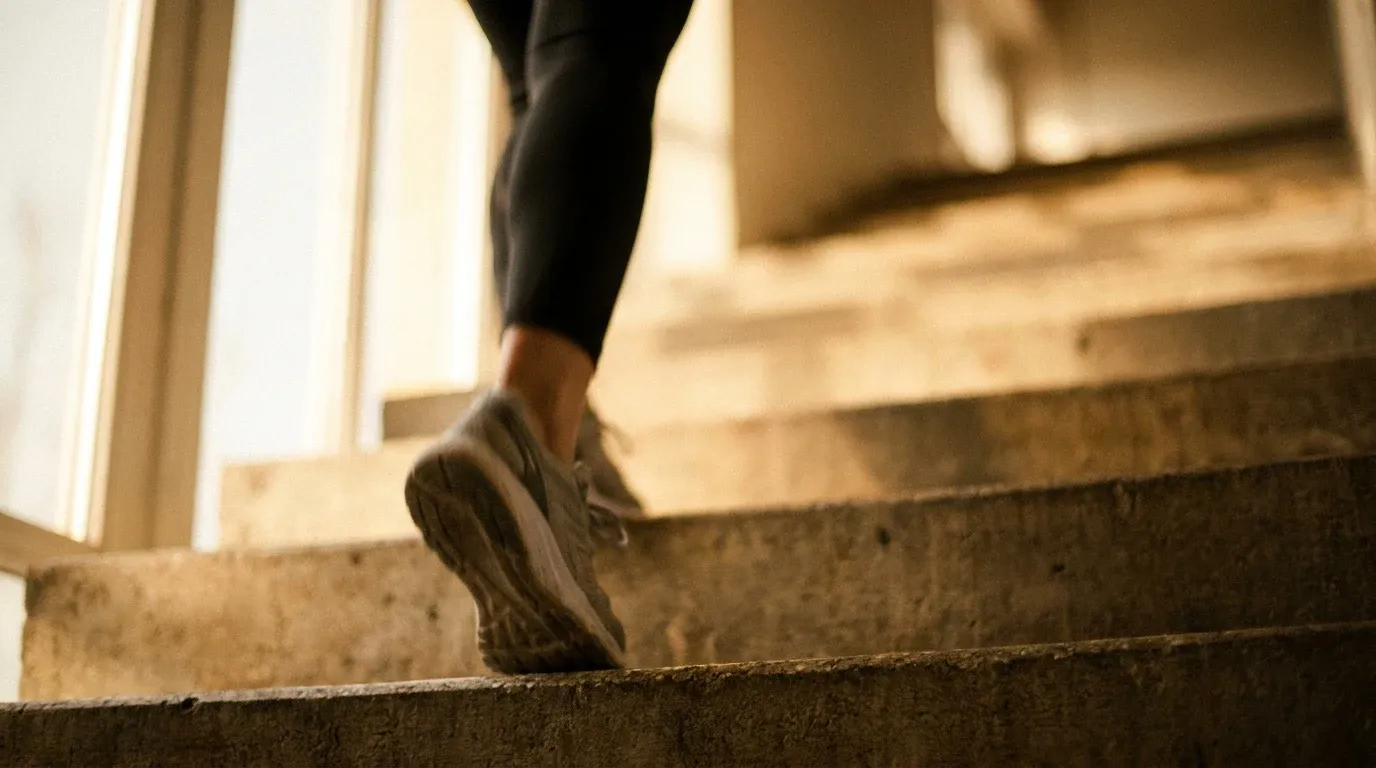
You probably walk past a staircase every single day without giving it a second thought. That's about to change. A large-scale analysis of nearly 500,000 people has found that regularly climbing stairs is associated with a 39% lower risk of dying from cardiovascular disease, and a 24% lower risk of death from any cause. The movement doesn't have to be structured, scheduled, or even long. It just has to happen.
This is not a niche finding buried in an obscure journal. It was highlighted by Harvard Health, drawing attention to what researchers are calling one of the most underused and accessible forms of physical activity available to nearly everyone, regardless of fitness level, gym membership, or free time.
What the Research Actually Found
The analysis pooled data from multiple studies involving close to half a million participants across a range of ages, fitness backgrounds, and health statuses. Researchers looked at stair-climbing habits and tracked outcomes over time, specifically cardiovascular mortality and all-cause mortality.
The results were striking. People who climbed stairs regularly, even without formal exercise routines, showed a 39% reduction in cardiovascular death risk compared to those who avoided stairs. That same group also had a 24% lower risk of dying from any cause, suggesting the benefits extend well beyond heart health.
What made this analysis particularly compelling was the breadth of participants. This wasn't a study of elite athletes or people already deep into structured fitness programs. It included everyday people, many of whom weren't doing anything else noteworthy in terms of exercise. Stair climbing alone moved the needle significantly.
Why Stairs Work So Hard in So Little Time
Climbing stairs is classified as vigorous-intensity activity. That classification matters because vigorous movement generates cardiovascular and metabolic adaptations that moderate activity simply doesn't match minute-for-minute. When you climb a flight of stairs, your heart rate spikes, your leg muscles recruit more motor units, and your body burns significantly more energy per unit of time than it would on a flat surface at the same pace.
This intensity is exactly what makes brief bouts count. Research on high-intensity incidental physical activity, sometimes called HIIPA, has consistently shown that short, vigorous bursts embedded in daily life can produce meaningful health improvements. Five minutes of stair climbing isn't a warm-up hack or a consolation prize. It's a legitimate cardiovascular stimulus.
The mechanism behind these benefits connects directly to how your body responds to physical stress at a cellular level. Exercise triggers hormonal and metabolic shifts that improve insulin sensitivity, reduce arterial stiffness, and lower systemic inflammation. If you want to understand how that process works at a deeper level, How Exercise Rewires Your Metabolism Through One Hormone breaks down the specific pathway involved.
The Sedentary Problem That Stairs Can Help Offset
Here's the uncomfortable reality most people don't want to hear. If you're sitting for eight to ten hours a day, your morning workout may not be doing as much as you think. Studies have shown that prolonged unbroken sitting carries independent health risks that a single exercise session doesn't fully neutralize. That's not an argument against structured training. It's an argument for more frequent movement throughout the day.
This is where incidental activity like stair climbing becomes especially valuable. It breaks up sedentary time. It introduces multiple small spikes of cardiovascular demand across the day rather than concentrating all physical effort into a single window. That pattern of movement is closer to how the human body was designed to function, and the data reflects it. Your Workout Doesn't Cancel Out Sitting All Day covers this dynamic in full, and it's worth understanding before you assume one gym session is enough.
For office workers, commuters, or anyone with a desk-heavy lifestyle, stairs are one of the simplest ways to interrupt that sedentary pattern without requiring a schedule change, extra time, or any equipment at all.
Who Benefits Most (and It's Not Who You'd Expect)
The 39% reduction in cardiovascular death risk is impressive across the board, but the magnitude of benefit tends to be largest among people who are least active to begin with. That's a consistent finding in exercise research. The more sedentary your baseline, the more any movement moves the needle.
This doesn't mean stair climbing is only useful for beginners. For people already doing structured resistance or cardio training, stairs function as a useful layer of additional cardiovascular work without adding recovery cost. A flight of stairs between sets, or a few floors climbed after a session, contributes to your weekly aerobic load in a low-friction way.
Women in particular stand to benefit from stacking incidental activity with structured training. Research increasingly supports the idea that combining resistance work with consistent cardiovascular activity produces superior longevity outcomes, especially for women in midlife and beyond. Is Strength Training the Key to Women's Longevity? outlines the evidence behind that combination clearly.
Older adults also see significant returns. As cardiovascular efficiency tends to decline with age, maintaining regular vigorous movement through any accessible means helps preserve cardiac output, leg strength, and balance. Stair climbing happens to train all three simultaneously.
How to Actually Use This in Your Routine
The practical translation here is simple. You don't need to build a stair-climbing program. You need to stop avoiding stairs and start treating them as a default.
- At work or in your building: Take the stairs every time, without exception. If you work on a high floor, start with three to five floors and build from there.
- At the gym: Use a staircase, stair stepper, or incline treadmill as a warm-up tool before your main session. Even five minutes at a brisk pace elevates heart rate and primes your cardiovascular system without compromising your strength work.
- During your commute: If you use public transit, exit one stop early and find a staircase somewhere in the walk. Many stations have them and most people skip them entirely.
- At home: If you have a staircase, use it deliberately. A few intentional trips up and down during a TV break, a lunch break, or between tasks adds up fast.
- On rest days: Stair climbing is low enough in impact that it works well as an active recovery movement, particularly for people doing heavy lower-body training who still want to keep the heart rate working.
The goal isn't to hit a specific step count or time target every day. The goal is to make stair climbing a default behavior, the kind of thing you do automatically rather than something you schedule. That's how incidental activity compounds over months and years into meaningful health outcomes.
The Broader Picture: Small Efforts, Large Returns
What makes this research significant isn't just the numbers. It's what the numbers say about how health actually works. People tend to frame fitness in all-or-nothing terms. Either you're training consistently with structure and intensity, or you're not really doing anything that matters. The evidence keeps pushing back on that framing.
Brief, vigorous, incidental movement produces real cardiovascular and metabolic benefits. Those benefits compound with structured training when both are present, but they don't require structured training to exist at all. That's an important message for the significant portion of the global population that isn't currently exercising in any formal sense. You don't need a gym. You need a staircase.
It's also worth noting that the longevity benefits of physical activity don't operate in isolation. The combination of consistent movement with strong nutritional habits produces outcomes that neither achieves alone. If you're interested in how those two factors interact, Why Diet and Exercise Together Beat Either One Alone covers the evidence behind that synergy in detail.
The 24% reduction in all-cause mortality seen in this analysis points toward something broader than cardiovascular health. Regular stair climbing appears to influence systemic health in ways that touch multiple organ systems, likely through the same anti-inflammatory and metabolic pathways triggered by other forms of vigorous exercise. That means every flight of stairs is working harder for you than it looks.
The Bottom Line
A 39% reduction in cardiovascular death risk from an activity that requires no equipment, no cost, and as little as five minutes of daily effort is not a minor footnote in fitness research. It's a significant finding that reframes what accessible health intervention looks like for the average person.
You don't have to overhaul your lifestyle. You don't have to wake up earlier or reorganize your schedule. You have to stop taking the elevator. That's where it starts, and for a meaningful number of people, that change alone could make a measurable difference to how long and how well they live.