

Most people who want to start strength training never do. Not because they're lazy, and not because they lack equipment. They stop before they start because every resource they find tells them to do too much. Five days a week. Progressive overload. Compound lifts. Macros. It's a wall of complexity dressed up as helpfulness.
Two studies published this week cut through that noise in a meaningful way. Both looked at previously inactive adults. Both used very small doses of exercise. Both produced real, measurable strength gains. Together, they form something rare in fitness research: a scientifically grounded argument for starting almost embarrassingly small.
What the Research Actually Found
The first study examined what happens when sedentary adults perform a single eccentric contraction lasting just three seconds per day. An eccentric contraction is the lowering phase of a movement. Think about putting a heavy bag down slowly, or the descent in a bicep curl. That controlled lengthening under load is where a significant share of muscle-building stimulus comes from.
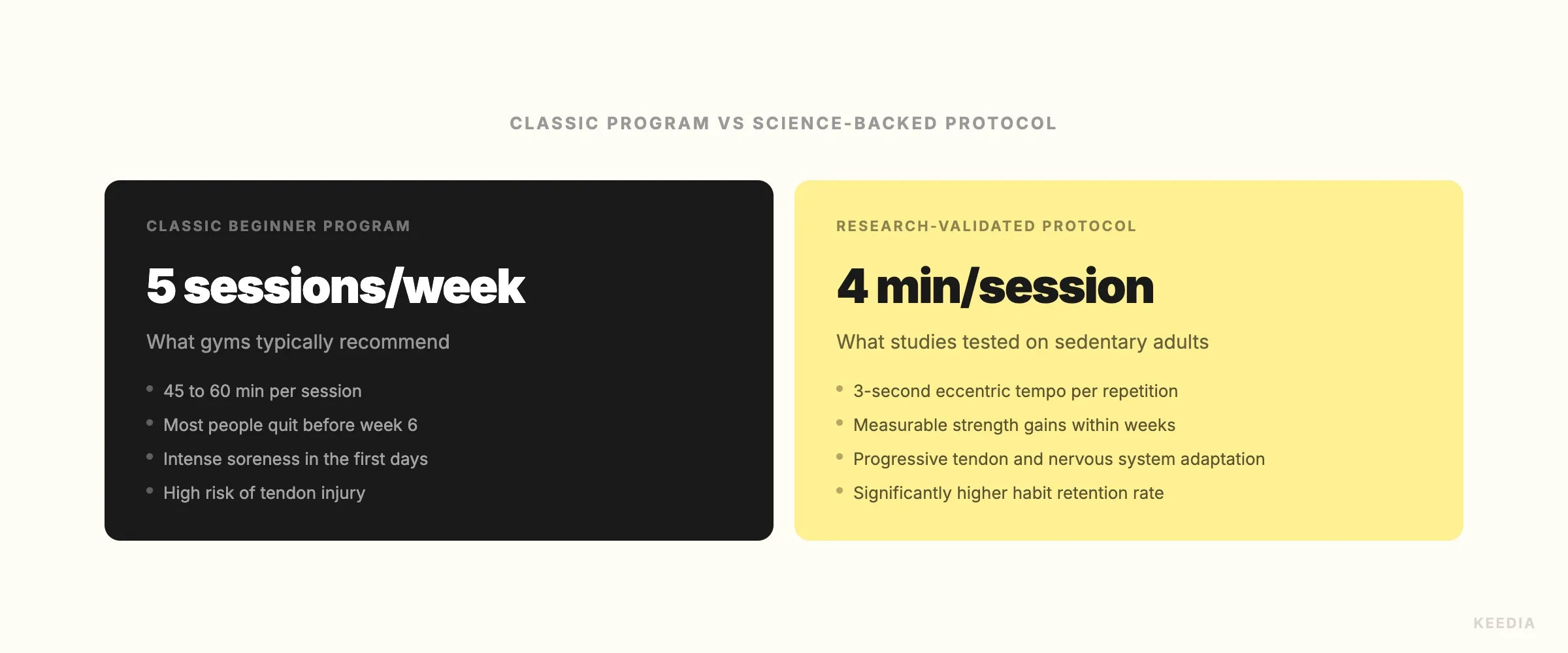
Participants who performed one three-second eccentric repetition daily, five days per week, saw strength increases of around 10 percent over four weeks. That's not a rounding error. That's a real adaptation in people who were doing essentially nothing beforehand.
The second study focused on session length. It found that four-minute resistance training sessions, performed consistently, produced meaningful improvements in muscular strength and endurance in untrained individuals. Four minutes. Not as a warm-up. As the entire session.
What both studies share is a common finding: the dose required to trigger adaptation in a true beginner is far lower than the fitness industry has historically acknowledged. The body responds to novel stimulus. When you've been sedentary, almost any deliberate mechanical load qualifies as novel.
The Real Barrier Isn't Fitness. It's Overwhelm.
Exercise science has known for years that beginners respond faster and more dramatically to resistance training than advanced athletes. A trained powerlifter needs sophisticated programming to squeeze out marginal gains. A person who hasn't lifted in years, or ever, can build strength from almost any consistent effort.
Yet the advice beginners receive rarely reflects this. Standard gym onboarding often involves full-body programs with eight to twelve exercises, three sets each, three times per week. Even if that volume is appropriate eventually, presenting it on day one is what researchers who study exercise adherence call "the overwhelm threshold." It's the point at which the perceived effort of starting exceeds the perceived benefit.
The dropout numbers back this up. Studies tracking beginner exercise programs consistently find that attrition accelerates around weeks five to eight, often reaching 50 percent or higher by the three-month mark. The problem isn't week six. It's the size of the commitment people make in week one, which becomes impossible to sustain when novelty fades and life gets in the way.
Starting smaller doesn't just reduce the burden. It reframes the identity shift. You're not a person trying to become an athlete. You're a person who does four minutes of intentional movement before work. That's a narrative your brain can hold.
A Week-One Protocol Built From Both Studies
Here's a practical starting point that synthesizes both findings. It's designed for someone who currently does no structured exercise and finds most beginner programs intimidating. The goal of week one is not transformation. It's consistency and a small, verifiable strength signal.
Session length: Four minutes. That's it. Set a timer.
Frequency: Five days per week, with two rest days. This mirrors the daily stimulus used in the eccentric study while keeping total volume very low.
Structure of each session: Choose two movements. Perform each for two minutes, alternating between them. Focus entirely on the lowering phase of each rep, counting to three on the way down. That's your eccentric tempo.
Suggested movement pairs for week one:
- Bodyweight squat and countertop push-up. Lower into the squat over three seconds. Lower your chest to the counter over three seconds. No equipment needed.
- Glute bridge and assisted single-leg stand. Lower your hips to the floor over three seconds. Hold the top of the bridge for one second before descending.
- Wall sit hold and slow calf raise descent. Control the lowering phase of the calf raise over three to four seconds. Rest briefly between reps.
Rest as needed between reps. The point is not to gasping exhaustion. The point is to accumulate several controlled eccentric repetitions per movement in a compressed window.
What to track: Write down how many reps you completed per movement, per session. You don't need an app. A notebook works fine. Watching that number grow across the week is your first measurable proof of adaptation.

Why Eccentric Tempo Is the Beginner's Secret Weapon
Slowing down the lowering phase of a movement does several things at once. It increases time under tension without requiring heavier loads. It forces neuromuscular control, which is precisely the skill untrained people are building. And it reduces injury risk compared to explosive or uncontrolled movement.
Research consistently shows that eccentric training produces greater strength gains per unit of effort than concentric-only training, particularly in untrained populations. The mechanism involves greater mechanical tension on muscle fibers during lengthening, which is a potent trigger for the cellular processes that lead to strength adaptation.
For beginners, there's a practical bonus. Eccentric focus naturally slows sessions down. It makes four minutes feel purposeful rather than frantic. You're not just moving. You're moving with intent, which is a habit worth building from the start.
Progressing Without Hitting the Motivation Wall
The six-week drop-off that plagues most beginner programs has a predictable cause: people add too much too fast during the first flush of motivation, then collapse when that motivation fades. The fix is to build progression into the structure before motivation has a chance to wobble.
Here's a simple progression ladder tied to the week-one protocol:
- Weeks 1-2: Four-minute sessions, five days per week, two movements per session, three-second eccentric focus.
- Weeks 3-4: Extend sessions to six minutes. Add a third movement. Keep the eccentric tempo.
- Weeks 5-6: Extend to eight minutes. Introduce a small load where appropriate, such as a light resistance band or a water bottle held during squats. Begin adding one second to the eccentric count on at least one movement.
- Weeks 7-8: Ten-minute sessions. Consider shifting to three slightly longer sessions per week rather than five shorter ones, now that the habit is embedded.
Each progression step is small enough that it doesn't feel like a new program. It feels like a continuation of what you're already doing. That continuity is what prevents the restart cycle most beginners experience repeatedly.
It's also worth remembering that movement outside your sessions contributes to your overall adaptation. Everyday Movement Counts as Much as Your Workout covers how non-exercise activity meaningfully supports the physiological processes that formal training initiates. During a beginner phase, this matters more than most people realize.
What to Add When You're Ready
Once you've completed eight weeks of consistent short sessions, you're no longer a true beginner in the physiological sense. Your nervous system has adapted. Your connective tissue has been exposed to load. Your movement patterns have been rehearsed enough to build on.
At this point, nutrition starts to matter more. Adequate protein is the obvious lever, but other compounds have genuine evidence behind them for people building strength from a low baseline. Creatine, HMB, and Hydration: Does the All-in-One Stack Deliver? offers a clear look at which combinations have research support and which are largely marketing. And if cognitive focus during sessions is something you're interested in, Creatine and Your Brain: What Lifters Should Know examines the neurological benefits that often go unmentioned in standard lifting advice.
Sleep becomes a genuine performance variable at this stage too. Strength adaptations consolidate during sleep. If yours is poor or fragmented, the training signal you're sending your body is partly lost. The evidence-based options for improving sleep quality are more robust than most people know and don't require medication.
Beyond supplementation and sleep, the most important thing you can add after eight weeks is curiosity rather than obligation. The beginner phase ends when exercise stops feeling like a task you're completing and starts feeling like information you're collecting about your own body. That shift takes time. The research says it takes less time than you think, and it starts with far less than the fitness industry has ever been willing to tell you.