
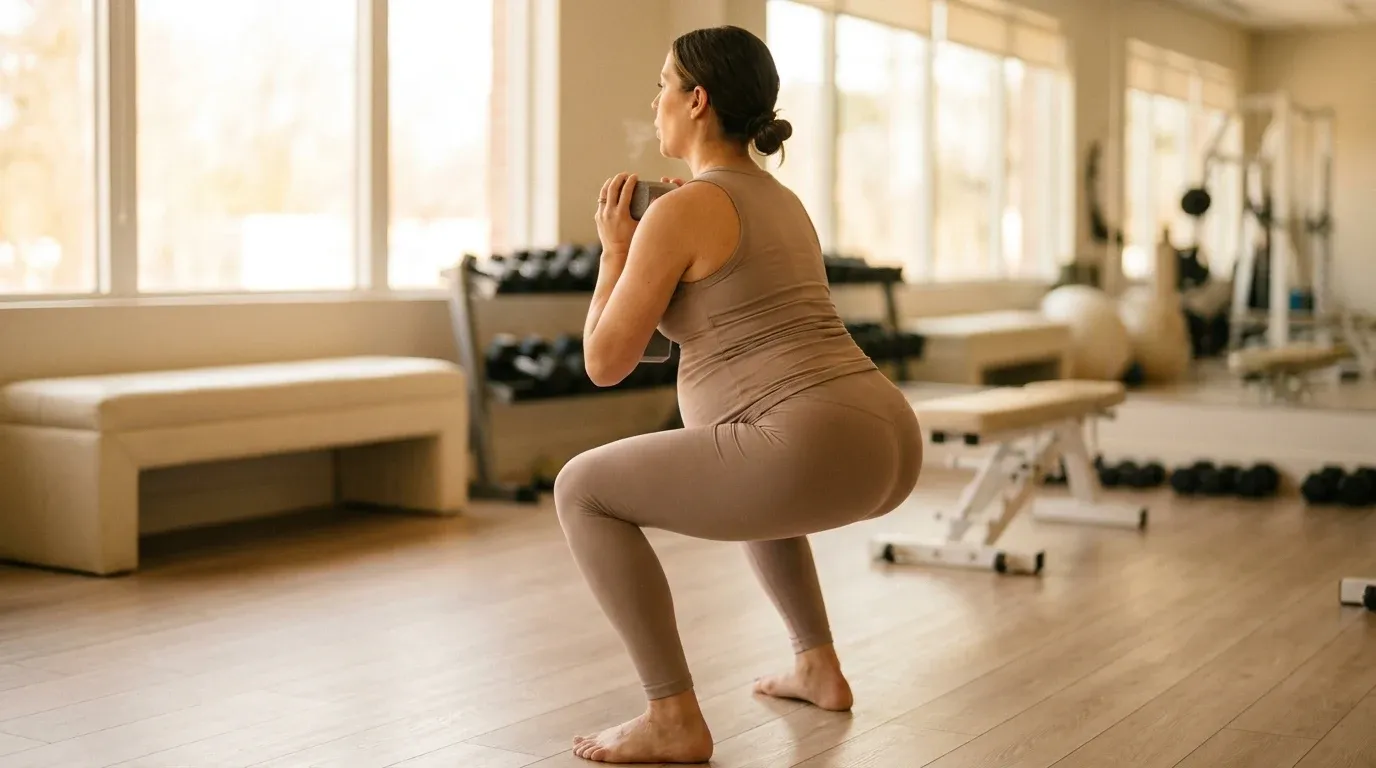
The old advice was simple and wrong: rest, walk a little, don't push it. Current evidence tells a different story. Major health organizations, including the American College of Obstetricians and Gynecologists (ACOG), now explicitly recommend resistance training as part of a healthy, uncomplicated pregnancy. The question isn't whether you should lift. It's how to do it intelligently across all three trimesters.
This guide is for women who were already training when they got pregnant, and for those who want to start. Both groups need a framework, not vague reassurances about "listening to your body."
The Medical Consensus Has Shifted
ACOG guidelines recommend at least 150 minutes of moderate-intensity aerobic activity per week during pregnancy, and they explicitly include muscle-strengthening exercises. This isn't a cautious footnote. It's a primary recommendation backed by a growing body of evidence showing that strength training reduces gestational diabetes risk, lowers the rate of excessive weight gain, supports better delivery outcomes, and reduces low back pain, one of the most common complaints during pregnancy.
The research is consistent enough that the burden of proof has flipped. The question is no longer whether lifting is safe. It's whether avoiding it is wise. For uncomplicated pregnancies, the answer is no. Inactivity carries its own risks, and the fitness community has been slow to internalize that.
That said, "strength training is recommended" is not a green light to do whatever you were doing before. Adjustments are necessary, and they vary significantly by trimester.
First Trimester: Keep Moving, Start Adjusting
For most women, the first trimester allows the most training continuity. Your center of gravity hasn't shifted dramatically, your belly isn't yet a structural obstacle, and your connective tissue, while beginning to loosen due to relaxin, hasn't yet made joint stability a significant concern.
That doesn't mean training as usual. A few principles apply from week one:
- Reduce maximal effort lifts. Working at 70-80% of your previous 1-rep max is a reasonable ceiling. Grinding out heavy singles and triples adds compressive stress and breath-holding patterns that aren't worth it now.
- Start modifying the Valsalva maneuver. The hard breath-hold used in heavy compound lifts dramatically increases intra-abdominal pressure. Begin transitioning to controlled exhale on exertion.
- Monitor fatigue differently. Fatigue in the first trimester can be severe and unpredictable. Your perceived exertion scale has shifted. A session that felt like a 6 out of 10 effort before may now hit like an 8. Honor that.
- Stay hydrated and fueled. Training while nauseous and undereating is a real risk in early pregnancy. Fall Hydration: The Mistake Too Many Athletes Make covers hydration patterns worth revisiting here, since nausea-driven underdrinking is common in the first trimester.
Second Trimester: The Biggest Structural Adjustments
The second trimester is where programming needs the most deliberate restructuring. The uterus is now large enough to affect circulation, exercise mechanics, and intra-abdominal pressure in ways that matter.
Supine positioning becomes a problem. After 20 weeks, lying flat on your back compresses the inferior vena cava, reducing venous return to the heart. Bench pressing, floor-based ab work, and supine dumbbell exercises need to be modified or replaced. Incline pressing, seated variations, and cable work fill most of these gaps cleanly.
Load and rep ranges should shift toward moderate weight, higher reps. Sets of 10-15 at controlled tempo serve you better than sets of 4-6 with near-maximal loads. The goal is maintaining muscle, supporting joint integrity, and keeping connective tissue strong, not peak strength output.
Exercise selection matters more now. Bilateral squats, Romanian deadlifts, hip thrusts (with appropriate wedge support), rows, and pressing variations all remain viable with sensible load management. Heavy barbell back squats and conventional deadlifts with a full Valsalva are where most practitioners draw a line. Front-loaded or goblet squat variations, trap bar deadlifts, and Romanian deadlifts with a controlled exhale are common replacements.
If you're unsure how to restructure your program, this is one situation where working with a qualified trainer who has prenatal experience pays off clearly. What Hiring a Trainer Teaches You About Your Body is a good starting point for understanding what that kind of coaching relationship can actually offer.
Third Trimester: Train to Maintain
The third trimester is not the time to push output. It's the time to protect what you've built, stay mobile, manage discomfort, and prepare your body for delivery and early postpartum recovery.
Load typically drops further here, not because strength training is suddenly dangerous, but because mechanics are harder to control and recovery is slower. Shorter sessions, reduced volume, and more unilateral work to address asymmetries and keep hips and glutes strong are practical priorities.
Core work requires the most careful navigation at this stage. Not because core training is off-limits, but because the wrong variations actively contribute to diastasis recti, which brings us to the most important structural issue in prenatal lifting.
Diastasis Recti: What Every Lifter Needs to Understand
Diastasis recti (DR) is the separation of the rectus abdominis at the linea alba. Some degree of separation is nearly universal by the third trimester. The problem is when that separation is large, doesn't close adequately postpartum, or is worsened by exercises that generate excessive intra-abdominal pressure against a weakened midline.
Exercises that significantly increase the risk of problematic diastasis include traditional crunches, sit-ups, double-leg lowering, heavy loaded flexion under load, and any movement that causes visible "coning" or "doming" at the midline. If you're doing an exercise and your belly forms a ridge or peak down the center, stop that exercise.
What helps instead: diaphragmatic breathing, deep core work focusing on the transverse abdominis, modified planks and side planks, and exercises where you can maintain midline integrity throughout. The goal during pregnancy isn't a strong six-pack. It's a functional, intact linea alba that closes properly postpartum.
DR affects long-term training capacity. Women who ignore it during pregnancy often face a harder and longer postpartum return to lifting, including persistent core weakness, low back instability, and pelvic floor dysfunction.
Contraindications: When to Stop or Not Start
Strength training during pregnancy is not appropriate for everyone. ACOG outlines clear absolute contraindications, and any prenatal training program must account for them through a proper screening process. These include:
- Hemodynamically significant heart disease
- Restrictive lung disease
- Incompetent cervix or cerclage
- Multiple gestation at risk for premature labor
- Persistent second- or third-trimester bleeding
- Placenta previa after 26 weeks
- Premature labor in the current or prior pregnancy
- Ruptured membranes
- Preeclampsia or pregnancy-induced hypertension
Relative contraindications also exist and require a physician's clearance before training continues. These include severe anemia, unevaluated cardiac arrhythmia, chronic bronchitis, poorly controlled type 1 diabetes, and extreme obesity or underweight status.
If you're starting a lifting program for the first time during pregnancy, physician clearance is not optional. It's the floor, not a formality.
Postpartum: Progressive Return, Not Immediate Reload
The postpartum return to lifting is where a lot of damage gets done. Six weeks of clearance from an OB-GYN is not a signal that your body is ready to squat your pre-pregnancy max. It means acute healing has progressed to a point where medical monitoring is no longer required. Those are different things.
The tissues that matter most for lifting, including the pelvic floor, the linea alba, and the deeper core musculature, can take 3-6 months or longer to return to functional strength. That timeline extends further for cesarean deliveries, where the abdominal wall has been surgically cut and needs full tissue healing.
A progressive postpartum return protocol typically looks like this:
- Weeks 1-6: Diaphragmatic breathing, gentle pelvic floor activation, walking, and posture work.
- Weeks 6-12: Low-load bodyweight movements, progressive core reintegration, light resistance if pelvic floor symptoms are absent.
- Months 3-6: Gradual reintroduction of loaded compound movements at significantly reduced intensity. Volume increases before load.
- Month 6+: Systematic reload toward pre-pregnancy performance benchmarks, contingent on absence of symptoms.
Symptoms to watch for at any stage include leaking (urine or feces) during exercise, pelvic pressure or heaviness, pain, and visible DR coning. Any of these signals mean you've moved too fast. The solution is always to step back, not push through.
Protein intake during this phase also matters more than most people realize. Your Protein Needs Change With Life Stage. Here's How. addresses how needs shift during major hormonal transitions, and the postpartum period qualifies fully.
Recovery capacity is also genuinely different postpartum. Sleep disruption, hormonal flux, and the physical demands of feeding and carrying a newborn all affect how quickly your body adapts to training stress. Why Recovery Takes Longer After 40 (And What to Do) covers the physiological mechanics of reduced recovery capacity in a way that maps directly to the postpartum context, even for younger women.
The Bottom Line
Strength training during pregnancy is not a risk to manage around. For uncomplicated pregnancies, it's a tool with documented benefits for both mother and infant outcomes. The work is in adjusting your program intelligently, trimester by trimester, understanding the structural changes your body is undergoing, and returning to lifting postpartum with a protocol that respects the timeline of tissue recovery.
What doesn't work is treating pregnancy as a pause button and postpartum as a reset. Your body went through a significant physiological event. The training response to that should be deliberate, evidence-based, and built around where you actually are, not where you were before.