
Last updated: June 8, 2026
After menopause, bone density loss accelerates to 1-3% per year without intervention. At the same time, age-related muscle loss (sarcopenia) increases. Both are linked, cumulative, and their impact on quality of life at 60, 70, and 80 is significant.
The good news: progressive resistance training is the most effective intervention for both. Not calcium supplements alone. Not light walking. Progressive resistance, properly structured.
Key Takeaways
- Post-menopause: 1-3% bone density loss per year. Osteoporosis risk doubles within 10 years.
- Progressive resistance training is the most effective non-pharmacological bone density intervention
- Protocol: 2-3 sessions/week, compound movements, progressive overload is mandatory
- Protein: 2-2.5g/kg post-50 (due to age-related anabolic resistance)
- Impact exercises (step-ups, jumps) stimulate different bone pathways than resistance alone
Why the Estrogen Drop Changes Everything
Estrogens regulate bone remodeling. They inhibit osteoclasts (cells that break down bone tissue) and favor osteoblasts (cells that build bone).
When estrogen drops at menopause, this balance breaks. Bone breakdown accelerates, construction slows. Result: rapid bone density loss in the 5-10 years following menopause.
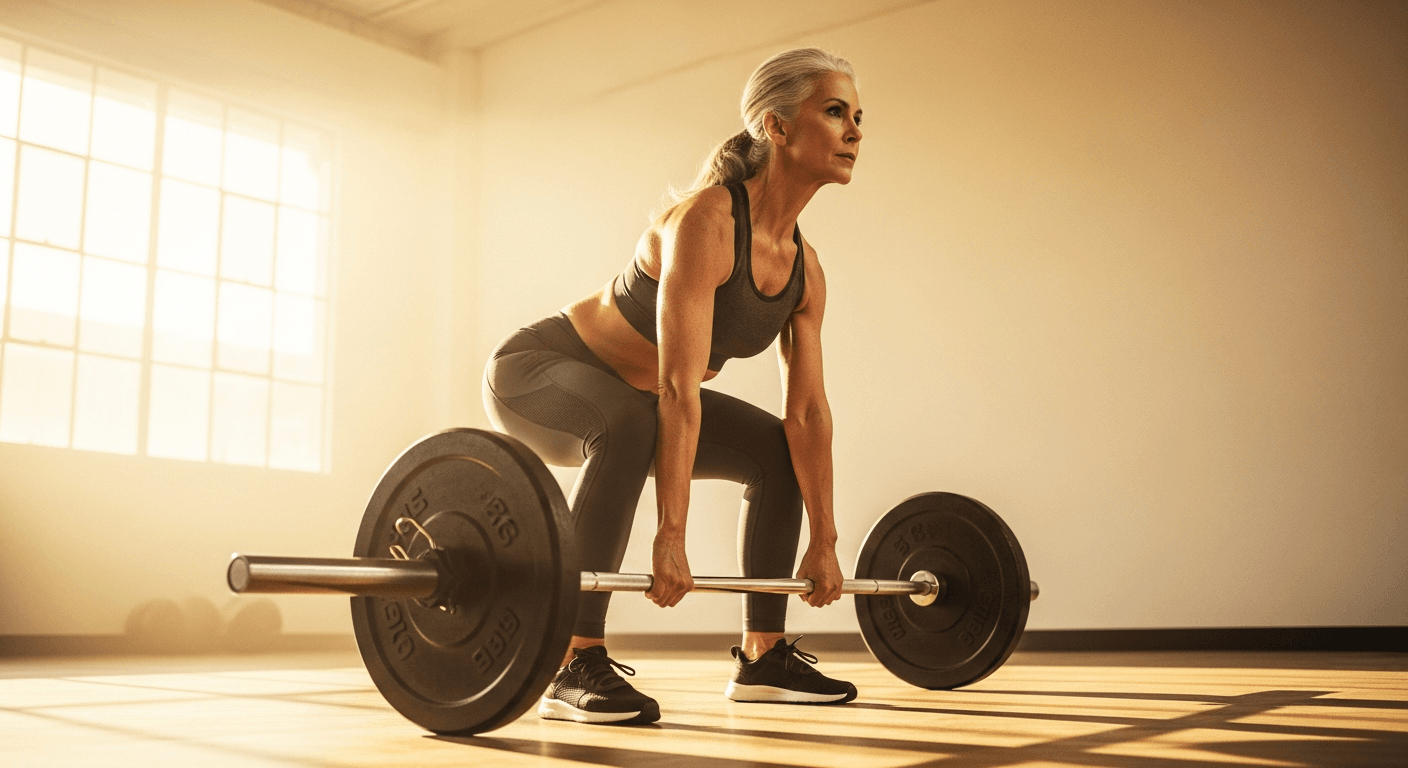
Progressive resistance training counteracts this through a different pathway. The mechanical stress applied to bones during resistance exercises directly stimulates osteoblasts — independent of estrogen levels. The body perceives mechanical load as a construction signal.
The Exercises That Build Bones
Not all exercises stimulate bone density equally. The general rule: bone adapts to forces applied to it.
Axial loading exercises (best for bones):
- Squat (barbell or goblet) — load on the axial skeleton and legs
- Romanian Deadlift — load on hip and lower back
- Overhead press — load on cervical and thoracic spine
- Bench press — load on sternum and clavicles
- Lunges — load on hip and femur
Impact exercises (stimulate different bone pathways):
- Step-ups (onto a box) — impact on hip and tibia
- Light jump squats (if condition permits) — controlled bone impact
- Jumping jacks — low but systemic general impact
The combination of resistance + impact is more effective than either alone according to recent meta-analyses.
The Concrete Protocol
Frequency: 2-3 sessions per week. Fewer than one session per week doesn't produce sufficient stimulus for bone density.
Intensity: progressive overload is MANDATORY. It's not the weight itself that matters — it's the progression. Years of sessions at the same load without progression don't stimulate bone remodeling. Bone adapts to the habitual signal. It needs a progressive signal.
Sample program for 2 sessions per week:
Exercise
Sets
Reps
Notes
Goblet squat or barbell squat
3-4
8-10
Increase load every 2-3 weeks
Romanian Deadlift
3
8-10
Posterior chain focus
Dumbbell bench press
3
10-12
Full range of motion
Dumbbell or cable row
3
10-12
Flat back, scapular retraction
Dumbbell overhead press
3
10-12
Standing for axial loading
Step-ups (8-10 inch box)
2-3
10 per leg
Hold a dumbbell for overload
The Critical Role of Protein Post-50
Anabolic resistance increases with age: women's muscles over 50 respond less efficiently to the same protein dose as at 30. To get the same muscle protein synthesis response, the dose needs to increase.
Current data-based recommendation for women 50+ doing resistance training: 2-2.5g of protein per kg of body weight per day. And aiming for 3g of leucine per meal to optimally trigger muscle protein synthesis.
What Doesn't Work
Walking alone. Walking benefits cardiovascular health and weight maintenance. It doesn't produce sufficient mechanical stimulus for bone density. Studies on walking and bone density in menopausal women show minimal effects on the femur and lumbar spine compared to progressive resistance in women over 50.
Calcium supplements alone. Calcium is a building material for bones. But without the mechanical signal from exercise, the body isn't incentivized to build. It's like having bricks without an architectural plan.
Sources: Zhao R. et al. — The effect of resistance training on bone mineral density. Archives of Osteoporosis, 2015 | Beck BR et al. — ESSA position statement on exercise for osteoporosis management. Journal of Science and Medicine in Sport, 2017