
The assumption this study just knocked down
There's a persistent myth about strength training after 50, especially for women: that muscles stop responding meaningfully, that the body is too old to build anything real, and that gentle cardio and flexibility work are the safer, smarter choice.
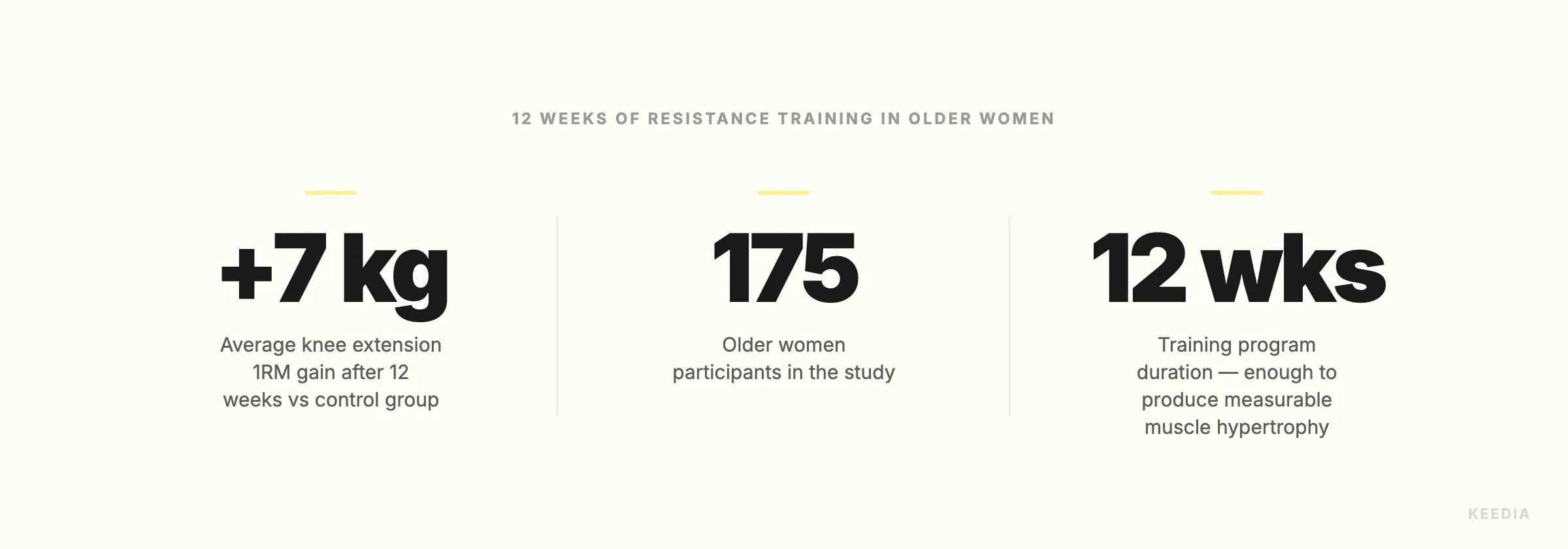
A study published in April 2026 in Applied Physiology, Nutrition, and Metabolism directly contradicts that. 175 older women went through 12 weeks of resistance exercise training, and the results are clear: muscles grow, strength increases, and the mechanism is the same as in younger adults.
What the study measured — and found
The researchers wanted to answer a specific question: when older women get stronger through resistance training, is it mainly because their nervous systems learn to recruit existing muscle better (neuromuscular adaptation) — or because their muscles actually grow (hypertrophy)?
The answer: hypertrophy is the primary driver. Participants averaged a 7kg improvement in knee extension one-rep max compared to the control group, and that gain correlated directly with actual muscle growth, not just neural adaptations.
This matters because it means women over 50 respond to resistance training through the same fundamental mechanisms as younger women. The body hasn't given up on building muscle. It just needs the right stimulus.
Why muscle mass matters more after 50 than before
After 50, the body naturally loses muscle mass at roughly 1-2% per year without intervention — a process called sarcopenia. It's not inevitable, but it's the default trajectory if nothing is done to counter it.
The consequences go well beyond how you look:
- Muscle is metabolically active tissue. Less muscle means a slower metabolism, easier fat gain, and reduced insulin sensitivity.
- Lower body muscle strength is one of the strongest predictors of fall risk in older adults. A woman who strengthens her quads and hamstrings directly reduces that risk.
- Resistance training is the most effective known intervention for maintaining bone density and slowing osteoporosis. Cardio alone doesn't create the mechanical stress needed to stimulate bone remodeling.
What this actually changes for your training
If you're over 50 and mainly doing cardio — walking, cycling, swimming — you're doing something good for cardiovascular health. But you won't address age-related muscle loss without adding resistance training.
Here's what the evidence supports:
Frequency: 2-3 resistance training sessions per week is enough to produce meaningful results. You don't need to be in the gym every day.
Load: the same principles apply as for any adult. For strength, you need loads around 70-80% of your max. For muscle volume, lighter loads with longer sets work too — the key is pushing close to maximum effort.
Progression: this is the most commonly skipped part. If you've been doing the same exercises with the same weights for months, you'll maintain what you have but you won't build more. Progressive overload — gradually increasing loads or volume — is non-negotiable, regardless of age.
The protein piece you can't ignore
Training alone isn't enough. To build muscle after 50, protein needs go up. Research points to around 1.6-2g of protein per kilogram of body weight per day for active adults trying to build muscle mass — which is typically more than most women in this age group are currently eating.
The bottom line: it's not too late. It was never too late. The 2026 science confirms that your body at 50, 60, or even 70 can still respond to serious training. It just needs you to give it a reason to.