
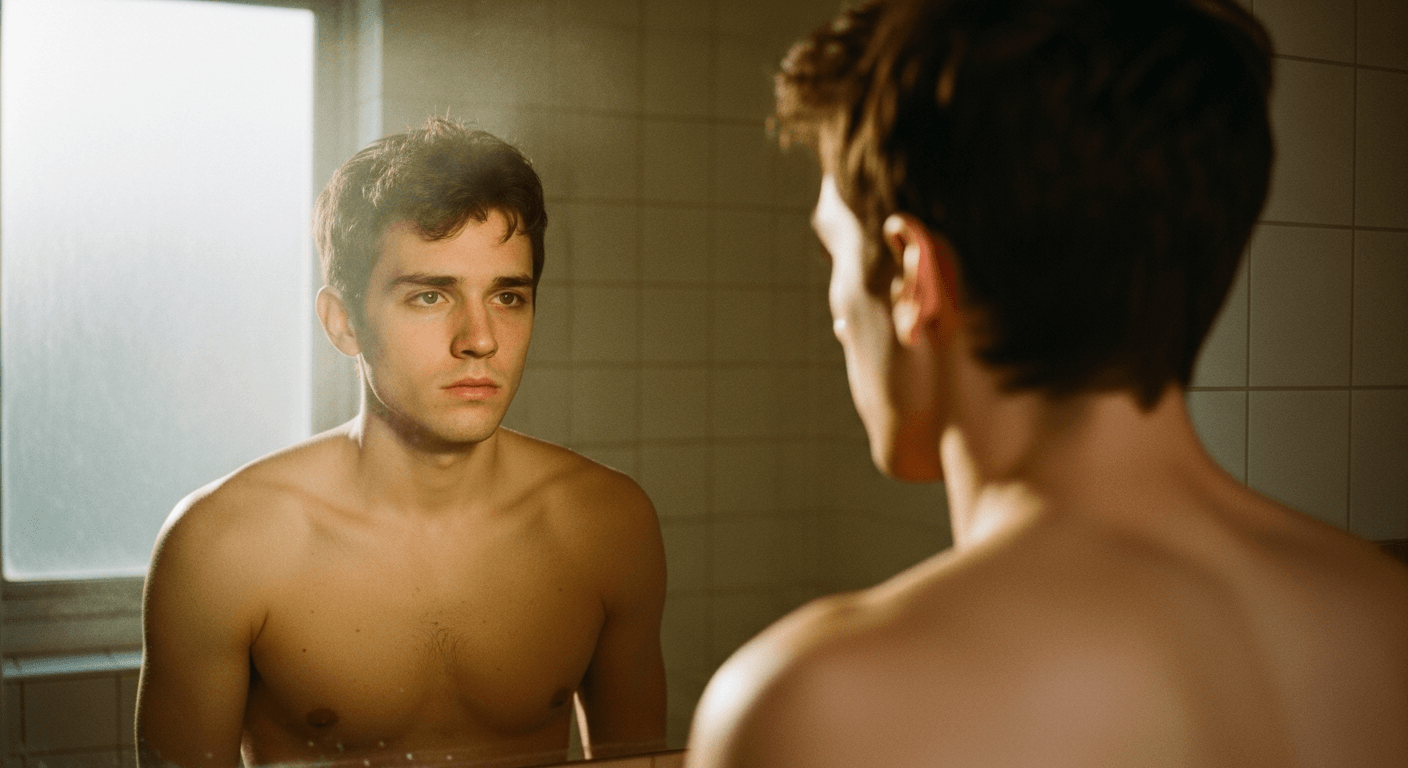
Open TikTok for twenty minutes and watch what the algorithm serves you. If you've ever searched a fitness term, watched a gym video, or paused on a transformation post, the feed recalibrates fast. Within a few sessions, you're looking at shredded physiques, extreme bulk-and-cut timelines, and supplement stacks presented as normal parts of a training routine. The content is relentless, and for young men, it's doing measurable damage.
This isn't a generational panic about screens or social media in the abstract. It's a specific, documented problem with a specific mechanism. TikTok's recommendation engine is surfacing extreme physique content at scale, distorting what a trained body actually looks like, and accelerating a psychological condition that doesn't get nearly enough attention in mainstream fitness conversations.
The Algorithm Isn't Neutral
TikTok's For You Page is built on engagement signals, not wellbeing signals. Content that triggers a strong reaction, whether that's admiration, aspiration, or even inadequacy, performs well because people stop scrolling. Extreme physiques stop scrolls. That's not a bug. That's the product working as designed.
The result is a systematic overrepresentation of bodies that exist at the far edge of the human genetic and pharmacological spectrum. A teenager watching fitness content on TikTok isn't seeing a cross-section of what dedicated training produces over years. They're seeing the top 0.1% of physiques, repeatedly, until that becomes their subconscious benchmark for what a "fit" body looks like.
Research on social comparison theory consistently shows that upward appearance comparisons, comparing yourself to someone who looks significantly more developed or lean, correlate with lower body satisfaction and increased drive for muscularity. TikTok's architecture makes those upward comparisons nearly unavoidable for young male users who show any interest in fitness content.
Muscle Dysmorphia Is Not a Niche Problem
Muscle dysmorphia is a subtype of body dysmorphic disorder. It's sometimes called "reverse anorexia" because the core distortion runs in the opposite direction: the person perceives themselves as too small, insufficiently muscular, or not lean enough, regardless of their actual size or conditioning. The clinical criteria include compulsive training, rigid dietary rituals, significant distress when workouts are missed, and social or occupational impairment caused by the preoccupation with physique.
It's not a fringe condition. Prevalence estimates vary, but studies suggest somewhere between 1% and 3% of men who train regularly meet clinical criteria, with subclinical symptoms, meaning the behaviors and thinking patterns are present but not yet diagnosable, appearing in a much broader population. Adolescent boys and men in their early twenties are consistently overrepresented in the research.
The condition frequently co-occurs with disordered eating, anxiety, and depression. Chronic stress and the depressive symptoms it wires into the body can both drive and deepen muscle dysmorphia, creating a feedback loop that's hard to break without intervention. Yet because the behavior looks like dedication from the outside, it rarely gets flagged early.
Short-Form Video Accelerates the Cycle
The specific format matters. A long-form YouTube video or a written training article can carry nuance. It can explain periodization, note that a transformation took four years, or contextualize that an athlete is using pharmaceutical assistance. TikTok's format doesn't reward that nuance. Fifteen-second physique reveals, six-week transformation side-by-sides, and "what I eat in a day" clips from genetically exceptional athletes get stripped of all context by the medium itself.
What young men absorb isn't "this person trained hard for a long time under specific conditions." What they absorb is the before-and-after image and the implicit message that the gap between where they are and where that person is should be closed, quickly, through whatever means necessary.
That urgency feeds a predictable cycle. Comparison triggers dissatisfaction. Dissatisfaction drives overtraining. Overtraining produces fatigue and injury. Fatigue and injury generate anxiety about losing gains. Anxiety pushes heavier supplement use. And through all of it, the body never looks like enough because the benchmark is being constantly refreshed by an algorithm surfacing more extreme content.
The supplement angle deserves specific attention. The global sports nutrition market is projected to exceed $50 billion by 2028, and a significant portion of that growth is driven by young men buying products they don't need because content creators they follow present those products as prerequisites to results. Understanding what the current research actually says about protein and nutrient timing would save a lot of young men considerable money and unnecessary stress about hitting arbitrary supplement windows.
The "Natural vs. Enhanced" Silence Is Part of the Problem
Here's the conversation the fitness industry consistently avoids: a substantial portion of the physiques driving aspiration on TikTok are built with pharmacological assistance. Anabolic steroids, peptides, SARMs, and other performance-enhancing compounds are widespread in the communities generating the most-watched fitness content. And almost nobody talks about it openly.
This silence creates a genuinely toxic information environment. When a young man watches an influencer who is on a drug protocol present their results as the product of discipline, diet, and a specific training split, that young man internalizes a false model of what natural training can produce. He trains harder, eats more precisely, sleeps more carefully, and still doesn't close the gap. The obvious conclusion, that the model is false, doesn't occur to him. The conclusion he reaches instead is that he's not working hard enough.
The bodybuilding world has always had this tension, but it was largely contained to a subculture. The lessons from elite competitive bodybuilding, where the pharmacological context was at least understood by participants, are now being stripped of that context and broadcast to teenagers who have no frame of reference for what they're looking at.
What Coaches and Influencers Actually Owe Their Audiences
If you're a coach, a personal trainer, or a fitness creator with any meaningful following, you have a direct role in this. Not because you're responsible for TikTok's algorithm, but because your content choices either add to the distortion or push back against it.
Posting transformation content without disclosing timelines, drug use, or genetic advantages isn't neutral. It actively contributes to unrealistic benchmarks. Selling a program positioned around achieving a physique that required chemical assistance to build isn't just misleading. It's extracting money from people who are already psychologically vulnerable around their bodies.
Concrete steps the fitness community should be taking include:
- Disclosing timelines honestly. If a transformation took three years, say three years. If it involved performance-enhancing drugs, say so or don't use it as a selling point.
- Normalizing plateau and maintenance phases. Most of a training life is spent maintaining, not transforming. Content that only shows transformation creates a warped picture of what training actually looks like long-term.
- Talking about recovery as a serious training variable. Recent research on post-exercise recovery confirms what good coaches have always known: the adaptation happens during rest, not during the session. Overtraining isn't dedication. It's a failure to understand the process.
- Addressing the mental side directly. Body dissatisfaction, compulsive checking, and training through injury or illness are not signs of commitment. Naming these patterns publicly, when you see them in your own community, matters.
What You Can Do If This Is Affecting You
If you recognize the pattern in yourself, the overtraining, the persistent dissatisfaction with your body regardless of progress, the anxiety when you miss a session, it's worth taking seriously. These are not character flaws or signs of weakness. They're symptoms of a condition that responds well to intervention when it's caught early.
Audit your feed deliberately. The accounts you follow are shaping your perception of normal. If every physique you're exposed to daily is at the extreme end of what human genetics and pharmacology can produce, your reference point for your own body becomes calibrated against something most people cannot achieve naturally.
Pay attention to recovery and sleep as seriously as you track training. The relationship between chronic stress, gut health, and mood regulation is well-established, and a training culture that glorifies overreaching without adequate recovery is producing stressed, inflamed athletes who feel worse the harder they push. That's not a productivity problem. That's a signal the approach needs to change.
And if the behaviors are significantly affecting your daily life, relationships, or mental health, talk to a professional. Muscle dysmorphia is treatable. The hardest part for most people is recognizing that what looks like discipline from the outside might be something that needs care, not more reps.
The Fitness Community Needs to Have This Conversation
The fitness industry has a complicated relationship with body image. On one hand, training genuinely improves mental health, builds confidence, and creates community. On the other hand, a significant portion of the industry's revenue model depends on people feeling perpetually inadequate about their bodies.
TikTok didn't create that tension. But it has amplified it to a scale and a speed that the industry hasn't caught up to yet. Young men are being harmed by content that the fitness community is largely producing without accountability. That's a problem worth addressing honestly, not just with a disclaimer slide at the end of a transformation video.
The conversation about what realistic, sustainable, natural training actually looks like, and what it doesn't look like, is overdue. Starting it now, loudly, is the minimum the community owes the next generation of lifters.