
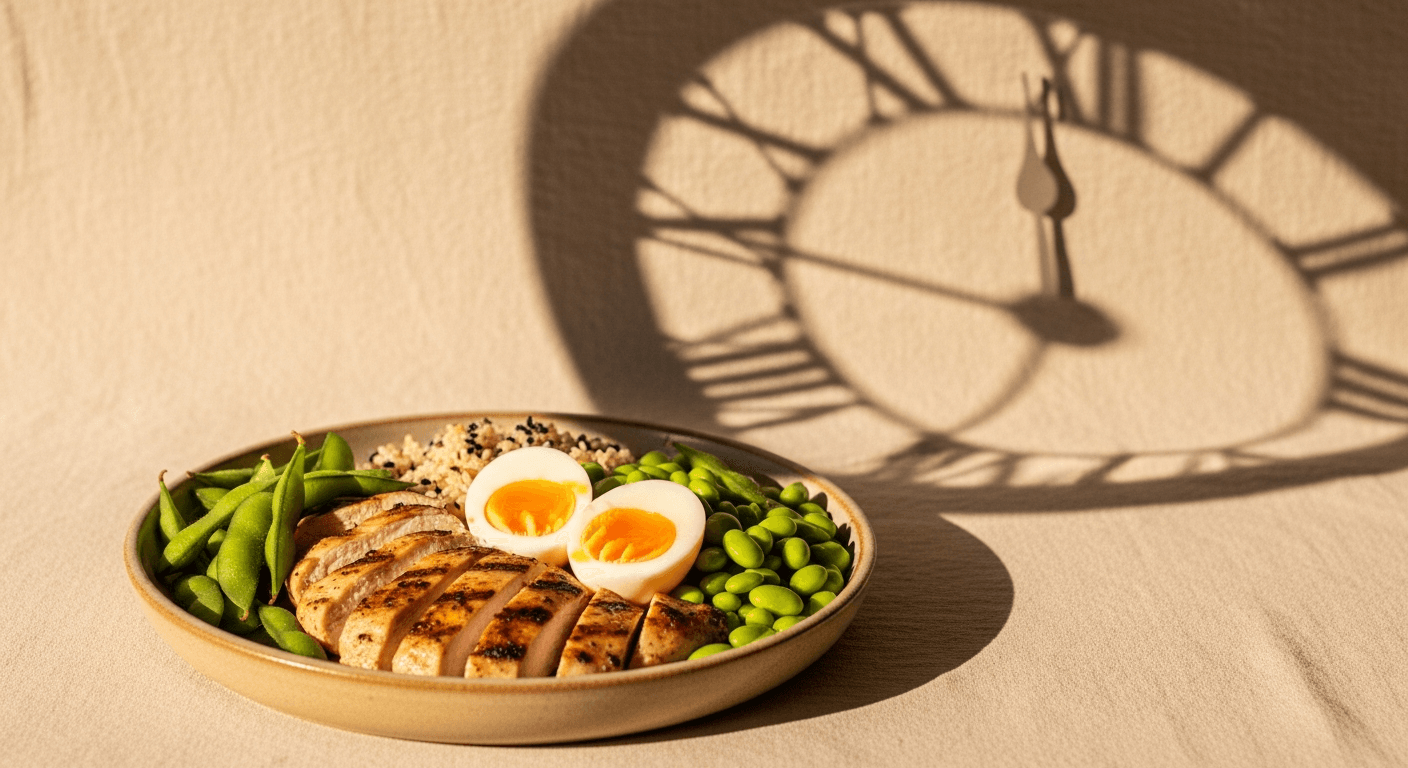
The "anabolic window" has been debated for two decades. Early gym culture insisted you had 30 minutes post-workout to slam a shake or watch your gains evaporate. That version of the story is largely dead. But the replacement narrative, that timing is completely irrelevant as long as you hit your daily protein target, is also starting to crack under newer evidence.
What 2025 and 2026 trial data actually show is more nuanced: timing matters less than total intake for most people, but it matters significantly more than previously assumed for specific populations. Here's what the current evidence says, and what it means for how you structure your eating.
The 30-Minute Window Is Gone. The 2-Hour Window Is Real.
For recreational athletes training 3 to 5 days per week, the pressure to consume protein within 30 minutes of finishing a workout is not supported by the evidence. Muscle protein synthesis (MPS) remains elevated for roughly 24 to 48 hours after a resistance session, meaning a single post-workout shake consumed 90 minutes after you leave the gym is not going to cost you meaningful muscle growth.
The more accurate framing is a broader 2-hour post-exercise window, and even that only applies when total daily protein intake is adequate. Studies consistently show that individuals consuming 1.6 to 2.2 grams of protein per kilogram of bodyweight per day don't show statistically significant differences in lean mass gains based on whether they eat immediately after training or wait an hour or two.
What this means practically: if your daily intake is on target, the stress of racing to a protein source the moment you rack the bar is unnecessary. Focus your energy on consistency across the day, not on the clock above the squat rack.
This connects to a broader point about training frequency and recovery. As covered in Why Muscle Growth Stops at 48 Hours (And What to Do), the window for muscle protein synthesis is considerably longer than gym folklore suggests, which gives you more flexibility in structuring both your training and your nutrition.
After 40, Per-Meal Protein Distribution Changes Everything
Here's where the story shifts. For adults over 40, the concept of anabolic resistance means the muscle-building signal triggered by a given dose of protein becomes less efficient. The leucine threshold required to maximally stimulate MPS rises with age, and the practical implication is significant.
Research published in 2025 and early 2026 supports a per-meal protein target of at least 40 grams for older adults, compared to the 20 to 25 grams that's sufficient for younger trainees. Eating three meals at 20 grams each doesn't produce the same MPS response as eating two meals at 40 grams each for this population, even when total daily intake is identical.
This is not a minor refinement. It's a structural shift in how protein guidance should be communicated to anyone in their 40s, 50s, or beyond who is actively resistance training. Smaller, more frequent protein doses that work well for a 25-year-old may genuinely under-serve an older athlete's recovery needs.
If you're in this age group and you're currently spreading protein thinly across multiple small meals, it's worth auditing whether each meal is actually crossing the 40-gram threshold. Greek yogurt and a handful of almonds won't get you there.
Pre-Sleep Protein: The Evidence Has Solidified
Pre-sleep protein has moved from a promising hypothesis to one of the better-supported timing strategies in sports nutrition. Across multiple trials conducted between 2024 and 2026, consuming 30 to 40 grams of casein protein within 30 minutes of sleep consistently elevated overnight MPS rates compared to placebo conditions.
The mechanism is straightforward: casein's slow digestion rate provides a sustained release of amino acids over the 7 to 8 hours of overnight fasting, when MPS would otherwise decline due to substrate unavailability. The effect size is meaningful, not marginal, particularly in older adults and in athletes undergoing high training volumes.
Casein remains the most studied substrate for this application, but whole-food equivalents show comparable effects. Cottage cheese (approximately 28 grams of protein per cup), quark, and full-fat Greek yogurt all contain naturally occurring casein and have shown positive results in more recent trials. You don't need a supplement if whole-food sources are your preference.
It's also worth noting that sleep quality and protein utilization interact directly. Disrupted sleep reduces the anabolic signaling that makes pre-sleep protein worth consuming in the first place. How Poor Sleep Is Silently Killing Your Muscle Gains covers this relationship in detail, and it's relevant context if you're adding a casein dose but not addressing underlying recovery quality.
Four Meals Beats Two: What the Distribution Data Shows
A growing body of research compares protein distribution patterns head-to-head rather than just looking at total intake. A 12-week intervention published in 2025 in resistance-trained adults found that distributing daily protein across four meals produced meaningfully better lean mass outcomes than distributing the same total protein across two larger meals.
The likely explanation involves MPS kinetics. Each protein-containing meal triggers a discrete MPS response that peaks and then returns to baseline over roughly 3 to 5 hours. Four meals create four stimulation events per day rather than two, and the cumulative effect on net protein balance over weeks and months is detectable in body composition data.
The practical structure this suggests for most resistance-trained adults:
- Meal 1 (morning): 35 to 45g protein, ideally within 1 to 2 hours of waking
- Meal 2 (midday): 35 to 45g protein, balanced with carbohydrates around training if applicable
- Meal 3 (afternoon or early evening): 35 to 45g protein
- Meal 4 (pre-sleep): 30 to 40g slow-digesting protein (casein or whole-food equivalent)
This framework aligns well with the principles discussed in Chrono-Nutrition: How to Sync Your Diet With Your Training, which addresses how meal timing interacts with circadian biology and performance outputs more broadly.
Plant Proteins Require a Different Calculation
Plant-based athletes have been told for years to simply "eat more protein" to compensate for lower bioavailability. That advice is correct but incomplete. The specific issue is leucine content, the key amino acid that triggers the MPS signaling cascade.
Whey protein contains roughly 10 to 11 grams of leucine per 100 grams of protein. Pea protein contains approximately 8 grams per 100 grams, and rice protein sits around 7.5 grams. Neither source alone provides the leucine density of whey at equivalent serving sizes, which means a 25-gram serving of pea protein produces a meaningfully lower MPS response than 25 grams of whey.
The practical solution backed by current research is blending pea and rice protein at roughly a 70:30 or 60:40 ratio. The amino acid profiles of these two plant sources complement each other, and the resulting blend achieves a leucine concentration and essential amino acid distribution that is comparable to whey. Several 2025 trials using this blend found no statistically significant difference in MPS response when serving sizes were matched at 30 to 40 grams.
For plant-based eaters, this has two implications. First, use a blended source rather than a single-ingredient plant protein if MPS optimization is the goal. Second, use higher per-meal doses. A 20-gram serving of plant protein that might suffice for MPS stimulation in a 28-year-old eating whey is unlikely to be adequate. Target 35 to 45 grams per meal, especially if you're over 40.
Before purchasing any protein supplement, it's also worth checking third-party testing data. Protein Bars: What Independent Tests Actually Reveal documents how frequently labeled protein content diverges from actual content in commercially available products. The same scrutiny applies to protein powders.
What This Means for Your Actual Routine
The research in 2025 and 2026 doesn't overturn the foundations of protein nutrition. Total daily intake still dominates. If you're consistently hitting 1.6 to 2.2 grams per kilogram of bodyweight, timing refinements are secondary variables. But they're not irrelevant variables, particularly if you're older, training seriously, or eating primarily plant-based.
The actionable updates from current evidence come down to a few clear shifts:
- Stop fixating on the 30-minute window. Eat protein within 2 hours of training and prioritize getting your daily total right.
- If you're over 40, audit your per-meal doses. Smaller protein servings spread across many meals may be leaving MPS stimulus on the table.
- Add a pre-sleep protein dose. 30 to 40 grams of casein or cottage cheese is one of the better-supported timing strategies currently in the literature.
- Distribute across 4 meals rather than 2. The body composition data over 12-week periods favors more frequent stimulation events.
- Plant-based athletes should blend sources and increase per-meal doses. Pea plus rice at 35 to 45 grams per meal is a defensible approach for matching the MPS response of whey.
Nutrition science moves slowly, and the temptation to chase every new finding is real. But the 2025 to 2026 data on protein timing represents genuine refinement rather than noise. Incorporating these adjustments into an already solid intake framework is low-cost and evidence-backed. That's a combination worth acting on.