
Most gym-goers assume they've covered their bases. They lift a few times a week, walk their daily steps, and treat bone health as something that takes care of itself. New research is complicating that picture significantly.
Bone density doesn't respond to effort. It responds to specific mechanical signals. And the signals most commonly produced in a typical gym session, or during a 30-minute walk, may not be strong enough to trigger the remodeling process that keeps bones dense and fracture-resistant as you age.
Why Bone Remodeling Requires More Than You Think
Bone is living tissue. It continuously breaks down and rebuilds through a process called remodeling, driven by osteoclasts and osteoblasts. What determines how aggressively your skeleton rebuilds is largely mechanical load. Specifically, the speed, magnitude, and novelty of force applied to the bone.
Walking produces low-magnitude, repetitive loading. Your skeleton adapts to it quickly, and once adapted, it largely stops responding. Research on bone strain thresholds suggests that habitual activities, even moderately strenuous ones, fall below the stimulus needed to generate new bone formation once the body has adjusted to them.
Standard resistance training is better, but it's not automatically sufficient. Slow, controlled lifting, the kind most programs emphasize for safety and muscle hypertrophy, produces relatively low strain rates. Bone responds not just to the amount of force applied, but to how fast that force is applied. A slow squat and a jump squat may load the same muscles, but they send very different signals to your skeleton.
The Case for High-Impact and Plyometric Loading
Studies comparing impact-based exercise with traditional resistance training consistently show that high-impact activities produce greater gains in bone mineral density, particularly at sites like the hip, femoral neck, and lumbar spine. These are the locations most associated with osteoporotic fractures in adults over 50.
Plyometric training, which includes jumps, bounds, and explosive push-off movements, appears to stimulate bone formation through two mechanisms. First, the rapid ground reaction forces generated at impact are transmitted up the skeletal chain at a rate that exceeds what slow lifting typically achieves. Second, the repeated brief loading cycles during plyometric work may be more effective than sustained loading at signaling osteoblast activity.
One analysis of premenopausal women found that just 10 to 20 jumps performed daily over several months produced measurable increases in hip bone density. The volume was low. The intensity was high. That combination appears to be the key variable most people are missing.
This doesn't mean you need to train like an athlete. It means your program needs to include at least some loading that moves quickly and forcefully through the skeleton, not just controlled movement under tension.
What Standard Lifting Gets Right, and Where It Falls Short
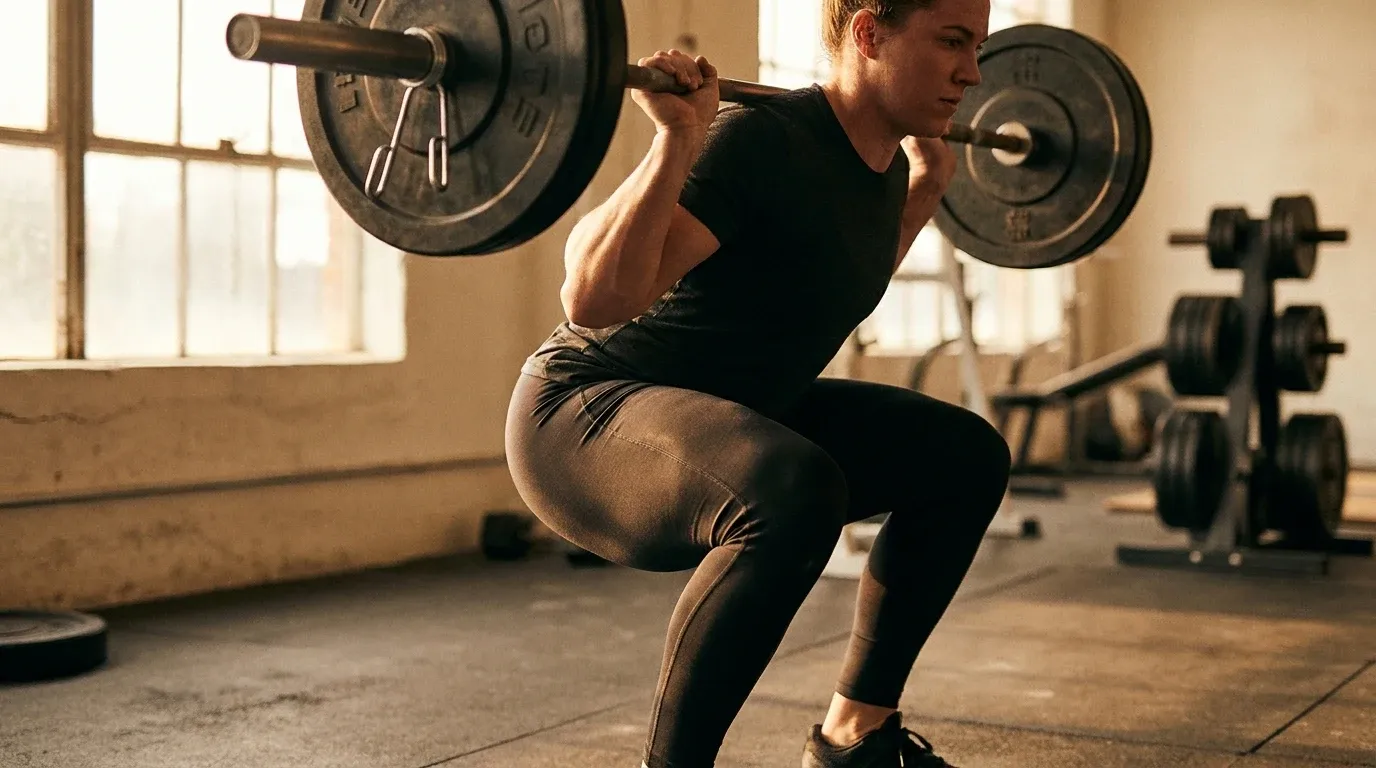
Resistance training absolutely contributes to bone health. Heavy compound movements, particularly those that load the axial skeleton, such as squats, deadlifts, and overhead presses, do produce meaningful bone stimulus. The problem isn't that lifting is useless for bones. It's that most people lift in ways that underperform their potential.
Tempo matters here. If you've been rushing through your lowering phases or treating each rep as a means to an end, you're missing a significant piece of the stimulus puzzle, and not just for muscle growth. Controlled eccentric loading and appropriate training tempo affect tendon stiffness, joint loading patterns, and muscle activation, all of which influence how force is distributed through bone.
Machine-based training, which isolates muscles and stabilizes the body artificially, also tends to produce lower bone stimulus than free-weight or functional movement patterns. Machines protect the skeleton from the kind of multi-directional loading that appears to stimulate bone remodeling most effectively.
If your program is built primarily around cable machines, isolation exercises, and treadmill cardio, your bones may be receiving very little useful stimulus regardless of how hard you feel like you're working.
Practical Additions That Close the Gap
You don't need to overhaul your entire routine. The evidence points toward a few targeted additions that can produce meaningful bone stimulus without dramatically increasing training time or injury risk.
- Jump training: Even simple box jumps, broad jumps, or jump rope sessions added two to three times per week appear to be sufficient to generate osteogenic stimulus. Prioritize landing mechanics first, then build volume gradually. Ten to twenty quality jumps per session is a reasonable starting point for most healthy adults.
- Heavy axial loading: Exercises that load the spine and hips vertically under meaningful weight, such as barbell back squats, trap bar deadlifts, and loaded carries, produce greater bone stimulus than horizontal or isolation movements. If you've been avoiding heavy lower-body work, that's precisely where the bone-building signal is strongest.
- Odd-object carries: Farmer's carries, sandbag carries, and single-arm suitcase carries create multi-directional loading and lateral stress through the spine and hips that standard bilateral lifting doesn't replicate. They also require whole-body stabilization, which distributes mechanical stress across a wider area of the skeleton.
- Stair climbing and incline work: While flat walking produces minimal bone stimulus once your body adapts, incline walking and stair climbing increase ground reaction forces and add hip extension demand. It's not a replacement for impact training, but it's a meaningful upgrade over flat-surface cardio.
- Brief plyometric circuits: Two to three sets of jump squats, lateral bounds, or medicine ball slams added to the beginning of a strength session take under 10 minutes and can meaningfully improve the osteogenic quality of your training week without adding significant fatigue or recovery cost.
Who This Matters Most For
Bone density peaks in your late 20s to early 30s and gradually declines from there. The window to build peak bone mass is finite. The window to slow its decline is long, but it requires consistent mechanical stimulus to remain open.
Women face disproportionate risk. Bone loss accelerates sharply at menopause due to estrogen's role in modulating osteoclast activity. By the time a woman reaches 65, she may have lost 20 to 30 percent of her peak bone mass. Standard gym training without specific bone-loading strategies does not adequately address this trajectory.
Men are not exempt. Male bone density declines more slowly, but fracture risk rises significantly after 70. Research suggests that many men who lift regularly throughout middle age are still losing bone at clinically meaningful rates, particularly at the hip and spine.
If you're new to structured training and trying to build a foundation that serves your long-term health, the science behind beginner strength training increasingly supports approaches that include compound loading, appropriate tempo, and progressive overload. That foundation is more valuable if it also accounts for skeletal health from the start.
The Nutrition Side of the Equation
Mechanical loading drives bone remodeling, but it doesn't work in isolation. Adequate calcium, vitamin D, protein, and magnesium are all required substrates for bone formation. Training hard without nutritional support limits how much of the mechanical signal actually converts into new bone tissue.
Some foods have demonstrated direct or indirect relevance to bone health beyond the standard calcium conversation. Regular fish consumption has been associated with improved bone mineral density markers in several longitudinal studies, likely due to omega-3 fatty acids' role in reducing bone resorption and supporting osteoblast function.
Protein intake is frequently underemphasized in bone health discussions. Bone matrix is roughly 30 percent collagen by weight. Without sufficient dietary protein, your body lacks the raw materials to rebuild bone effectively regardless of training stimulus. Most bone health recommendations focus on calcium while protein requirements remain underappreciated.
Rethinking What Bone-Healthy Exercise Actually Looks Like
The image of a bone-healthy exercise routine probably doesn't include jump training, heavy loaded carries, and explosive circuits. But the evidence increasingly suggests it should. Walking has real value for cardiovascular health, mood, and longevity. Standard resistance training builds muscle, improves metabolic health, and reduces injury risk. Neither of these things is in question.
What is in question is whether they're sufficient for the specific goal of maintaining or improving bone density across your lifespan. The answer, for most people, is no. Not without deliberate additions that provide the kind of rapid, high-magnitude loading that bones are specifically designed to respond to.
Your program doesn't need to be complicated. It needs to include the right signals. A few sets of jumps, some heavy axial loading, and an occasional odd-object carry each week may do more for your skeletal health than months of steady-state effort that your bones stopped noticing long ago.
If you're already paying close attention to how you structure your training stimulus, emerging research on brief but precise loading strategies continues to challenge assumptions about minimum effective dose. The pattern holds across multiple domains of musculoskeletal health. Quality of stimulus outperforms quantity of effort, more often than most training programs acknowledge.