
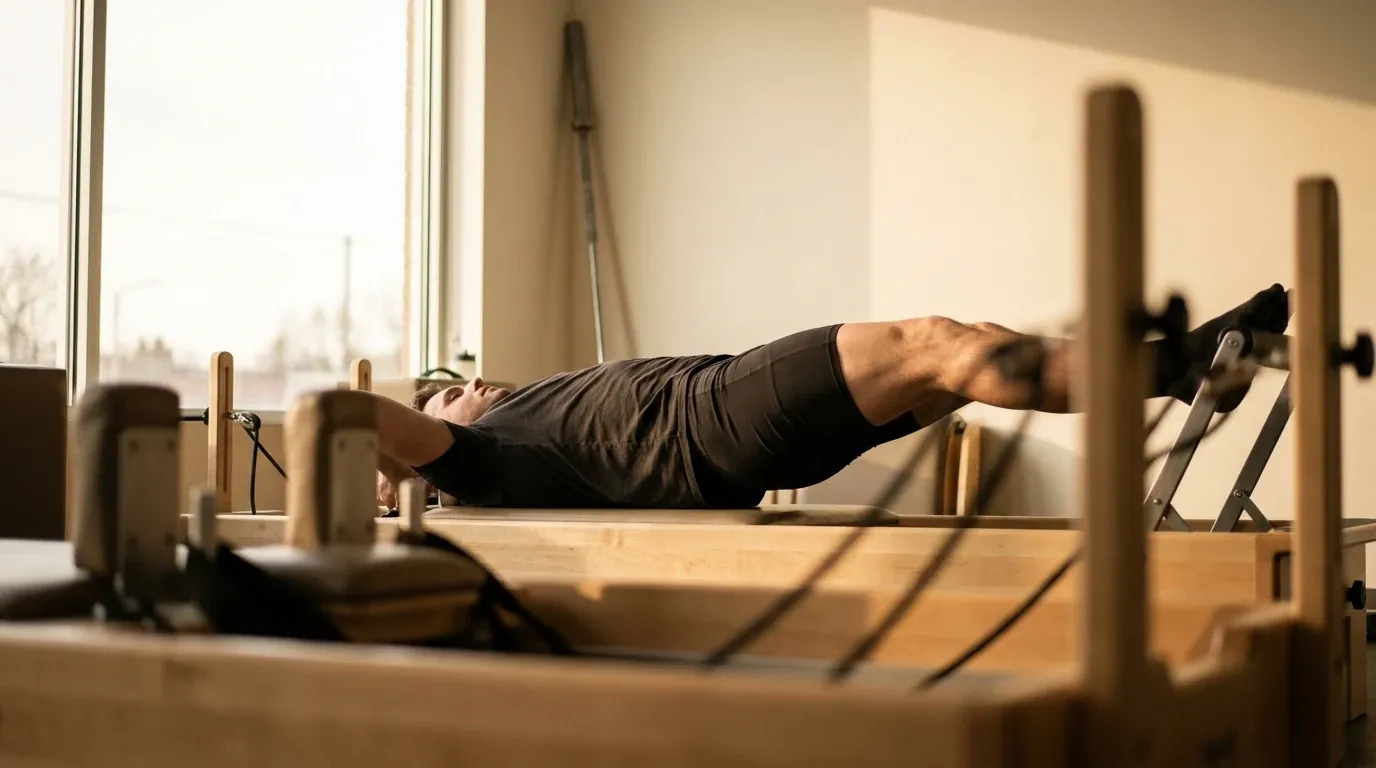
It's not the aesthetic crowd driving this shift. Across powerlifting gyms, CrossFit boxes, and Olympic weightlifting platforms, more serious strength athletes are quietly adding Pilates to their weekly training. Not because it's trending on social media, but because it's solving problems that heavy barbell work consistently creates.
The physiological case is straightforward once you understand what compound lifts actually miss. Here's what the research and coaching data are showing.
The Stability Gap Heavy Lifters Rarely Acknowledge
Squats, deadlifts, and overhead pressing are extraordinary tools for building global muscle strength. They recruit large, superficial muscle groups efficiently. What they don't do particularly well is train the deep stabilizer system: the transversus abdominis, multifidus, pelvic floor, and hip rotator complex.
These muscles don't produce force in the way your glutes or quads do. Their job is positional control. They keep joints centered under load, manage intra-abdominal pressure, and coordinate the transfer of force between your lower body and spine. When they're underdeveloped relative to your prime movers, the result is compensatory loading patterns that eventually manifest as lumbar pain, hip impingement, or nagging SI joint dysfunction.
Research consistently links deficits in deep spinal stabilizer activation to higher rates of lower back injury in strength athletes. Studies in Journal of Strength and Conditioning Research have documented that even well-trained lifters show measurably reduced multifidus activation during fatigue, which increases shear stress on lumbar discs. Pilates addresses this directly. Its foundational exercises are explicitly designed to isolate and load these deep structures before layering on global movement.
This is also where Pilates differs from simply adding accessory core work. Hollow holds and cable crunches train your rectus abdominis. Pilates systematically trains coordination between deep and superficial layers, which is what actually protects your spine under a heavy bar.
Reformer vs. Mat: What Actually Transfers to Barbell Sport
Both reformer and mat Pilates offer real benefits, but they don't transfer equally to strength training contexts. Understanding the distinction helps you invest your time and money wisely.
Reformer classes in the US typically run $30 to $50 per session at boutique studios, or $150 to $300 per month for unlimited memberships. The spring-loaded resistance and moving carriage create an unstable load environment that challenges proprioception and lateral hip stability in ways mat work doesn't easily replicate. For lifters dealing with hip tracking issues or asymmetrical loading patterns, reformer work often accelerates correction faster than mat-only protocols.
That said, mat Pilates is where the most transferable movement patterns live. Specifically, these exercises have the strongest documented carryover to barbell lifting:
- Pelvic clock and imprinting drills: Teach lumbar neutral and segmental spinal control, directly improving your ability to maintain position under load.
- Single-leg stretch and dead bug variations: Build anti-rotation core stiffness and contralateral coordination, which transfers to split-stance pulling and lunging movements.
- Hip hinge with spinal elongation: Reinforces posterior chain control in the exact movement pattern used in Romanian deadlifts and good mornings.
- Side-lying hip series: Strengthens hip abductors and external rotators, reducing valgus collapse under squat load.
- Swan and prone back extension: Targets erector spinae and thoracic extensors, supporting overhead positioning and bracing efficiency.
If you're working with a limited budget or schedule, a quality mat-based Pilates practice two days per week will cover most of the gaps that heavy compound work creates. If you have access to a reformer, adding one reformer session per week for six to eight weeks when addressing a specific movement deficit is worth the investment.
Posterior Chain Control: The Overlooked Connection
Most lifters think of their posterior chain as a strength asset. Glutes, hamstrings, and erectors are big, strong, and heavily trained. The problem is that raw strength in these muscles doesn't guarantee the eccentric control and positional awareness needed to express that strength safely under fatigue.
Pilates addresses the posterior chain from a control angle rather than a loading angle. This is complementary, not redundant. Exercises like the leg pull front, swimming, and spine stretch forward develop eccentric hamstring coordination, thoracic mobility under tension, and gluteal activation sequencing. These aren't qualities you build with a heavier Romanian deadlift. They're built through slow, deliberate, high-awareness movement.
This is why coaches working with competitive powerlifters and Olympic weightlifters have increasingly incorporated Pilates into GPP phases. The goal isn't to replicate the stimulus of barbell training. It's to fill the control and coordination gaps that heavy loading creates over years of training.
If you're making common technical errors under fatigue that your coach keeps correcting, the answer might not be more technical practice. It might be deeper proprioceptive development. A resource like 15 Gym Mistakes Coaches Say You're Still Making outlines several technique failures that have their roots in exactly this kind of stabilizer deficit.
Injury Resilience and Long-Term Training Longevity
The strongest argument for Pilates in a serious lifting program isn't performance. It's longevity. Most strength athletes who've been training for more than five years can identify at least one chronic issue, whether that's a persistent hip flexor strain, recurring lumbar tightness, or a shoulder that needs careful management before heavy pressing.
A significant proportion of these injuries share a common upstream cause: inadequate stabilizer development failing to protect joints during high-load or high-fatigue conditions. Clinical Pilates has been validated as a rehabilitation protocol for lumbar spine dysfunction across multiple randomized controlled trials, with studies showing reductions in pain scores and improvements in functional movement quality over eight to twelve-week intervention periods.
Critically, this isn't just rehabilitation-grade evidence. Prevention-focused research shows that strength athletes who incorporate regular low-load stabilization training report fewer training interruptions annually than those who rely exclusively on progressive overload and passive recovery.
Recovery quality matters here too. Sleep, stress management, and nervous system recovery all influence how well your stabilizer system functions. If your recovery protocols need attention, understanding what sleep debt recovery actually looks like in practice is worth adding to your overall program strategy.
Integrating Pilates Without Sacrificing Your Gains
The practical concern most lifters raise is volume. Adding Pilates sessions means adding training stress, and if they replace recovery time, they could compromise progressive overload. This is a legitimate concern with a straightforward solution.
The key is treating Pilates as a skill and stabilization practice, not as an additional conditioning or strength session. When programmed correctly, it doesn't compete with your barbell work. It supports it.
Here's a framework that works within standard four to five-day strength programs:
- Week structure: Place Pilates sessions on active recovery days or low-intensity training days, not immediately before or after heavy compound sessions.
- Session length: 45 to 60 minutes is sufficient. You don't need a 90-minute class to get the stabilization stimulus. Many effective Pilates protocols for athletes run 30 to 40 minutes.
- Frequency: One session per week is enough to build awareness and address acute deficits. Two sessions per week produces measurable improvements in stabilizer activation patterns within six to eight weeks.
- Intensity management: Pilates should feel like focused, deliberate work. Not exhausting. If you're leaving a session feeling significantly fatigued, you're likely pushing through movements without the stabilization control they require, which defeats the purpose.
- Programming phases: During peaking phases for competition or testing cycles, reduce to one session per week. During off-season or GPP blocks, two sessions per week accelerates the movement quality gains you're trying to build.
For lifters who are newer to structured programming, the principles in starting your lifting practice without beginner errors apply equally well to integrating Pilates. Learn the movement before loading it. Control before complexity.
What to Look for in a Pilates Instructor
Not all Pilates instruction is equal, and finding a coach who understands athletic training makes a significant difference in the quality of carryover you'll experience.
Look for instructors with credentials from organizations like the Pilates Method Alliance (PMA) or STOTT Pilates, which both require comprehensive anatomy training and supervised teaching hours. More importantly, look for instructors who have experience working with athletes, not just general fitness clients. The cueing, pacing, and exercise selection are meaningfully different when the goal is functional transfer rather than postural aesthetics.
If you're in a smaller market without strong local options, online Pilates platforms have improved substantially. Several offer athlete-specific programming tracks at $20 to $50 per month, which is a reasonable entry point for testing whether the practice addresses your specific deficits before committing to studio pricing.
The Bigger Picture for Strength Athletes in 2026
The lifters adding Pilates this year aren't abandoning progressive overload. They're recognizing that training age eventually exposes the limits of strength-only programming. After years of compound lifting, the weak links tend to be in exactly the places Pilates systematically addresses: deep spinal stability, hip rotator coordination, and the proprioceptive precision that keeps your movement patterns intact when you're fatigued and under load.
There's also a broader performance argument. Research into how diverse training modalities affect brain-body coordination suggests that varied movement practices improve neuromuscular efficiency across contexts. The work being done on how exercise affects brain activity and neural coordination supports the idea that movement variety isn't just physically useful. It sharpens the nervous system's ability to express strength safely and efficiently.
The case isn't ideological. It's mechanical. Your barbell program builds force production. Pilates builds the control infrastructure that lets you express that force without injuring yourself in the process. For serious lifters with serious training goals, that's a practical investment worth making.