
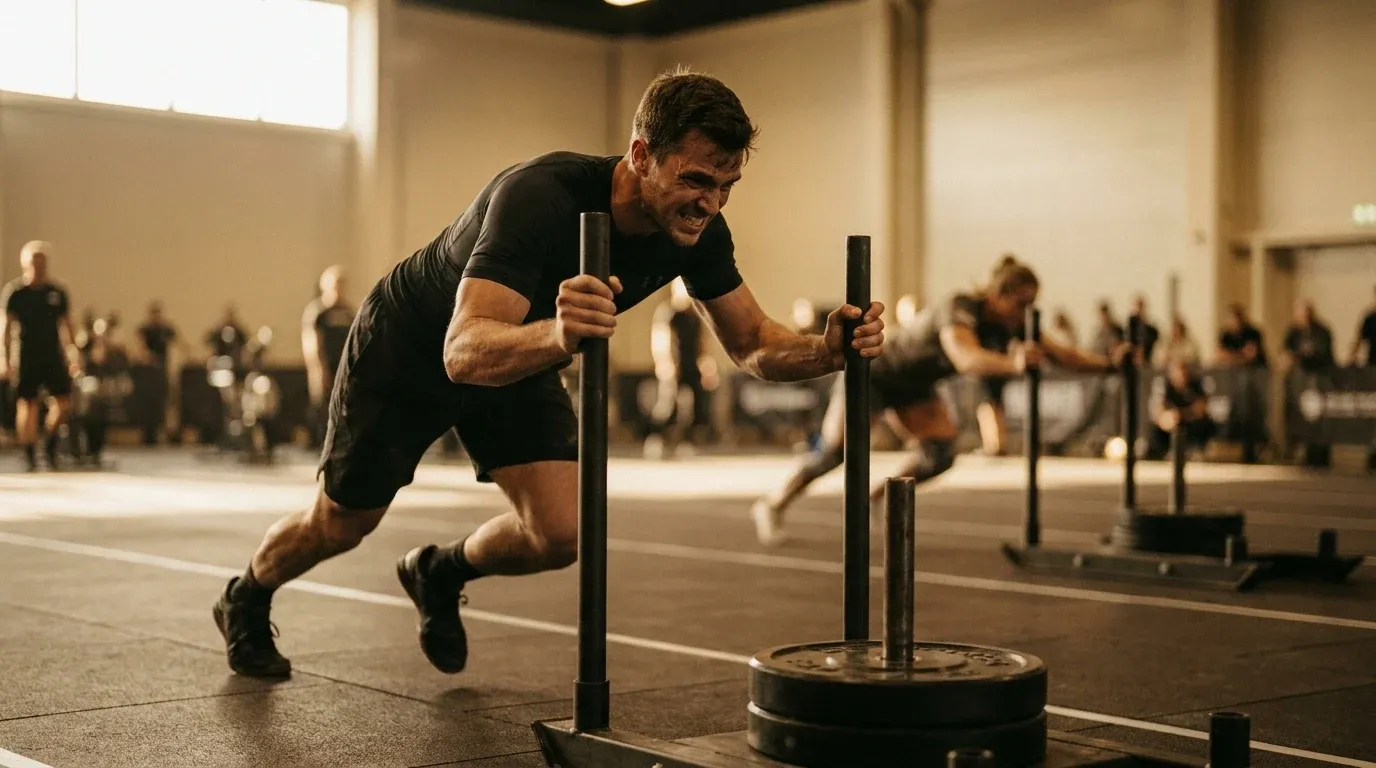
Athens delivered one of the most competitive HYROX races of the 2026/27 season opener. Held on September 4, 2026, at the Athens Olympic Sports Complex, the event drew over 4,000 registered athletes from more than 40 countries, with elite fields that reflected just how sharply the global competitive ceiling has risen in the past 12 months.
Whether you were racing, spectating, or tracking results from halfway around the world, here's everything that mattered from the Athens start line to the finish tape.
Men's Elite: Tight Margins at the Top
The men's elite division produced a finish that had the crowd on its feet. Norwegian athlete Lars Eriksen crossed the line in 55:14, taking gold by a margin of just 23 seconds over Germany's Tobias Kreft (55:37) and Spanish athlete Marcos Delgado (56:02) rounding out the podium in third.
Eriksen's strategy was textbook patience. He held back through the first three running segments, staying within 15 seconds of the lead pack while conserving energy for the functional fitness stations. His sled push splits were the fastest in the field, and he pulled ahead decisively during the rowing station at station six before holding the gap through a strong final 1km run.
Kreft, for his part, went out hard and paid a small but measurable toll on the ski erg and burpee broad jump later in the race. The 23-second deficit is flattering given the pace he sustained. Delgado's third-place finish is worth noting: he was the fastest athlete on the wall balls, logging a station time that beat the field by nearly 40 seconds, but his running transitions cost him a realistic shot at silver.
Women's Elite: A Dominant Performance From Midfield
The women's elite race told a different story. British athlete Chloe Hartley ran a near-perfect race to finish in 1:01:48, with Swiss competitor Anna Favre taking second in 1:02:55 and Australian Jessie Moran claiming third at 1:03:29.
Hartley's win was built on consistency. Her running pace deviated by less than 8 seconds per kilometer across all eight running segments, which is exceptional at this level. She also posted the second-fastest sandbag lunge time in the women's field, a station that historically separates athletes who've specifically trained the movement from those who've only conditioned around it.
Favre pushed hard on the rowing station and briefly held the lead through stations four and five. But Hartley's composure on the back half of the course proved decisive. Moran's podium finish is significant context for the season. She entered Athens ranked outside the top five on the global leaderboard and now sits in a position to compete for championship qualification heading into the winter circuit.
Open Division Standouts
Outside the elite heats, the open division produced some of the day's most compelling performances. In the men's open category, American athlete Derek Hollis finished in 1:04:11, a time that would have placed him inside the top five in elite just two seasons ago. That compression at the top of the sport is a real trend.
In women's open, Canadian Priya Nair finished in 1:09:44, with a wall ball station time that matched the pace of several elite competitors. Nair has been vocal about her structured approach to station-specific training, and her Athens result validates that model for athletes at every competitive level.
If you're building toward a HYROX qualifier and want a structured framework to develop your capacity across all eight stations, HYROX 2026: Build Your Training Foundation Right covers the periodization logic that separates athletes who plateau from those who keep progressing.
Race Conditions and What They Revealed
Athens in early September comes with heat. Indoor temperature at the Olympic Sports Complex reached 29°C (84°F) by the second wave start, with humidity hovering around 62%. Those conditions didn't wreck race times, but they absolutely shaped how smart athletes raced.
Several athletes in the elite field reported adjusting their pacing targets on the fly, particularly through stations one through three, to manage core temperature before the race reached its most demanding functional stations. The athletes who stuck rigidly to pre-planned splits and didn't adapt to the conditions tended to drop off sharply in the final two running segments.
Heat also appeared to widen the gap between athletes with strong aerobic bases and those who rely more on raw strength. The sled pull and farmer's carry are punishing in any environment, but under thermal load, recovery between stations becomes a genuine skill. Athletes who've trained that skill deliberately performed noticeably better in the back half of the race.
It's also worth noting that hydration strategy played a visible role at the elite level. Several top finishers in both divisions used aid stations more aggressively than lower-finishing competitors, suggesting that ego-driven skips at aid stations are still a tactical mistake even among experienced HYROX athletes.
Pacing and Station Strategy: What Athens Is Telling Us
Athens 2026 reinforced a pattern that's been building across the 2026/27 season opener circuit: the athletes winning races are not necessarily the fastest runners or the strongest at any individual station. They're the athletes with the smallest variance across the full event.
Eriksen's win in the men's elite is a clear case study. His running economy and station-to-station transition speed were both average by elite standards. His consistency was not. When you look at his split sheet, there's almost no station where he lost significant time relative to his overall pace. That's the profile of an athlete who has mapped the event precisely and trained every component to match the others.
The burpee broad jump continues to be the station where the most time is either lost or gained relative to potential. In Athens, the spread between the fastest and slowest athletes at that station in the elite field was over three minutes. For a movement that's largely technique and efficiency rather than raw fitness, that variance signals a clear training opportunity for anyone competing seriously in 2026/27.
The wall balls showed a similar story. Athletes who trained the movement to a rhythmic, unbroken standard gained time they didn't have to spend on the run. Athletes who hit the wall balls as a conditioning exercise rather than a skill lost that ground immediately. Specificity matters.
For athletes planning their next race block, the Athens results suggest that station-specific drills should represent a significant share of weekly training volume, not just supplemental work tacked onto running and strength days. This is the kind of detail that separates a solid finish from a podium result.
What's Next in the 2026/27 Circuit
Athens opens a demanding fall stretch for the HYROX calendar. The circuit moves through several major European and North American events before the holiday break, with qualification windows for the 2027 World Series opening in November.
If you're planning your race schedule and want to experience HYROX as a spectator before committing to competition, the HYROX DC 2026: The Ultimate Spectator Guide covers everything you need to know about attending the Washington stop on the circuit this fall.
The Athens results will also recalibrate global leaderboard rankings ahead of the qualification cut. Moran's rise into the top three, in particular, opens a genuinely interesting competition for one of the remaining championship spots in the women's elite bracket. The back half of the season just got more interesting.
For athletes thinking about recovery between now and the next race block, the physical demand of a HYROX event puts real stress on joints and connective tissue. Understanding what goes into your recovery support matters. Why Ingredient Testing Doesn't Predict Your Joint Supplement's Results is worth reading before you commit to any recovery supplementation stack.
The Athens 2026 results also fit into the broader story of endurance-hybrid sports growing in both depth and global reach. Across the same September weekend, elite endurance sport delivered compelling racing at every level, from track to road. The Maratona de Vitória 2026: Results and Highlights captures another dimension of where competitive fitness is heading this season.
The Bigger Picture
HYROX Athens 2026 wasn't just a race. It was a signal. The sport is getting faster, the competitive depth in open divisions is beginning to rival what elite fields looked like three seasons ago, and the margin for tactical error at the top level is shrinking to almost nothing.
Athletes like Eriksen and Hartley aren't winning on talent alone. They're winning on preparation, course intelligence, and the ability to execute a plan under physical duress and real heat. That's a template you can apply at any competitive level, whether you're chasing a podium or your first sub-90-minute finish.
The 2026/27 season is shaping up to be the most competitive in the sport's history. Athens just confirmed it.