
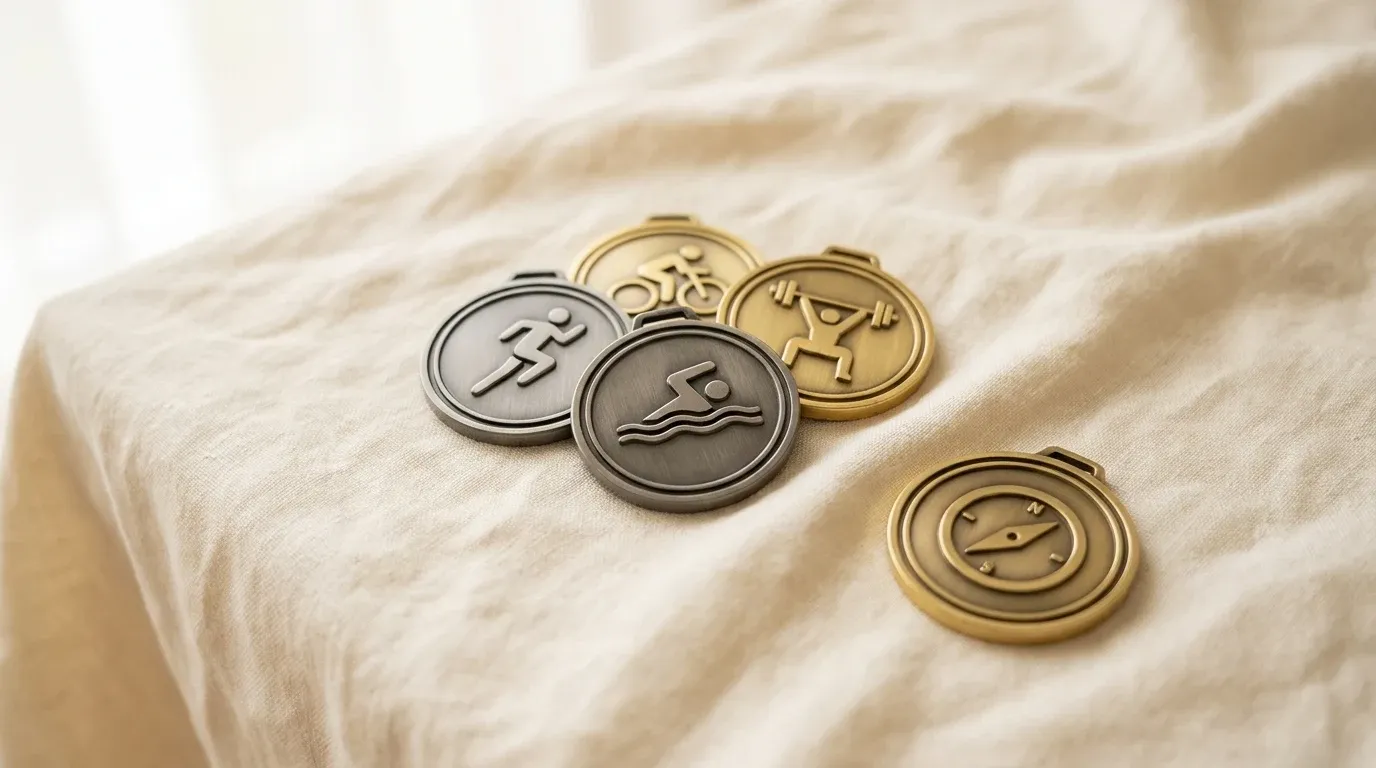
Finishing a HYROX race already comes with its own reward. You've dragged yourself through eight stations, burned through your legs on the ski erg, and somehow survived the wall balls. The medal at the end is supposed to cap it all off. But in China, starting in August 2026, that medal is no longer just a medal. It's a mystery.
HYROX China has introduced blind-bag finisher medals. Cross the line, and you receive one of eight possible medals, each featuring one of the iconic race stations. You don't know which one you'll get until you open it. That's the point.
What the Blind-Bag Format Actually Is
Each HYROX race has eight workout stations: the SkiErg, sled push, sled pull, burpee broad jumps, rowing, farmers carry, sandbag lunges, and wall balls. In the new Chinese medal format, each of these stations gets its own commemorative design. Finishers receive one at random.
It sounds simple. But the implications for how people engage with the race calendar are significant. If you finish a Shanghai event and get the sled push medal, you now have a concrete reason to sign up for the next race. Not just because you want to improve your time, or because you love the format, but because there are seven more medals sitting uncollected.
That's the mechanic. And it's a well-tested one.
Why the Collectible Strategy Works
Blind-bag and random-drop mechanics aren't new. They've been central to gaming culture for years, from trading card packs to loot boxes to limited-edition sneaker drops. Consumer brands have used similar approaches to drive repeat purchases and generate organic social content at scale.
The psychology behind it is straightforward. Incomplete sets create what behavioral researchers call the Zeigarnik effect: people remember and are more motivated by unfinished tasks than completed ones. When you're holding seven of eight medals, that gap doesn't feel abstract. It feels like something you need to fix.
For HYROX, the timing is smart. The format rewards participation first. You have to finish to receive a medal, so the collectible incentive stacks directly on top of the competitive one. You're not buying your way to a complete set. You're racing your way there.
The social content angle is equally deliberate. Unboxing moments, collection reveals, and "which station did you get?" posts are natural social media content. They don't require HYROX to produce anything extra. Athletes generate the content themselves, and it travels to audiences who may have never heard of the brand. If you want to understand why that kind of user-generated content matters, look at how major consumer brands structure their product launches. The formula is reliable.
What This Means for the HYROX Race Calendar
HYROX is targeting 107 races in its 2026/27 season. That's a significant expansion from where the series stood just a few years ago, and China is increasingly central to that growth. The country has shown strong appetite for hybrid fitness formats that blend endurance and functional strength, which puts HYROX in a good position relative to competitors.
But growing a race series isn't just about adding cities. It's about building repeat participation. A runner who enters once is a customer. A runner who enters six times a year because they're chasing a full medal set is a community member. The economics of that difference are substantial, both in direct registration revenue and in the organic marketing that active community members generate.
The blind-bag format gives HYROX a structural reason for athletes to return that doesn't depend entirely on competitive progression. Not everyone is going to shave two minutes off their time in the next race. But almost everyone who gets a wall balls medal is going to want the SkiErg one.
If you're already building toward your next HYROX event, getting your training structure right matters as much as the race-day motivation. HYROX Build Phase: How to Structure Your Winter Block is worth reading before you commit to your next registration date.
The Broader Trend: Race Events as Loyalty Programs
What HYROX China is doing fits into a larger shift in how endurance and fitness events think about participant retention. The traditional model was simple: put on a good race, and people come back because they had a good time. That still matters. But it's not sufficient on its own when the market is crowded and athletes have more options than ever.
Races that survive and grow tend to be the ones that give participants reasons to return beyond the event itself. Community, identity, and yes, collectible rewards are all tools in that kit. Why Local Trail Races Are the Future of the Sport makes a related argument about how smaller events build the kind of loyalty that big-name races often struggle to replicate. HYROX is applying a version of that logic at scale.
The blind-bag mechanic also creates a layer of social differentiation. Two athletes can both be HYROX finishers, but one has a complete set of eight station medals and the other has three. That difference becomes a visible marker of commitment, displayed on a shelf, posted on Instagram, or mentioned in conversation. It's soft status, but it's real status, and it drives behavior.
The Risks Worth Acknowledging
No strategy is without tradeoffs, and it's worth being clear-eyed about where this one could stumble.
First, the collectible format only works if the medals themselves are high quality. A cheap, lightweight disc with a printed graphic isn't going to motivate six repeat race entries. The physical object has to feel worth earning. If HYROX China cuts corners on production, the mechanic loses its pull quickly.
Second, duplicate fatigue is real. If you enter four races and receive the same sled push medal three times, the experience shifts from exciting to frustrating. How HYROX manages duplication, whether through guaranteed non-repeat systems after a certain point or through swap mechanics at future events, will determine how long the collectible enthusiasm holds.
Third, the format needs to be communicated clearly before athletes register. Surprise at the finish line is fun. Confusion about what you're receiving, or feeling like the standard "full" medal has been taken away, is not. Transparency about the format has to be part of the pre-race marketing.
None of these are fatal problems. They're execution risks. The concept itself is sound.
What It Means for the Global HYROX Audience
For athletes outside China, this is worth paying attention to. HYROX has a history of testing formats in specific markets before expanding them. If the blind-bag medal system drives measurable increases in repeat registrations in China, it's reasonable to expect the concept to appear in other regions before long.
That means the way you think about your race schedule may shift. Instead of planning entries around target finish times or travel logistics alone, you might eventually factor in which station medal you're still missing. It's a small change in framing, but it's the kind of thing that quietly reshapes how often you end up on a start line.
The mental side of that kind of goal-setting matters too. Chasing a collection across multiple races requires the same kind of sustained motivation as any long training cycle. Mental Strategies to Get Through Long Runs and Races covers techniques that apply whether you're grinding through kilometer 38 of a marathon or convincing yourself to register for race number five.
And if you're stacking HYROX entries with serious training volume, recovery and fueling become non-negotiable. The supplement market will always try to sell you shortcuts, but knowing what to look for matters. 3 Minutes of Sprinting Does What 90 Minutes of Cardio Can't is a useful reminder that training efficiency and race-day performance aren't always about doing more.
A Simple Idea With Real Teeth
The blind-bag medal format is not a complicated innovation. It takes an existing reward, splits it into eight parts, randomizes delivery, and lets human psychology do the rest. What makes it smart is not the idea itself. It's the fit between the idea and the context.
HYROX already has athletes who are motivated to race repeatedly. The format rewards effort, not spending. The eight-station structure maps cleanly onto eight collectible designs. The social content writes itself. And China is exactly the kind of high-growth market where early loyalty programs tend to stick.
If it works the way the strategy suggests it should, you'll be reading about this format in other markets within a year or two. Consider this the early look.