
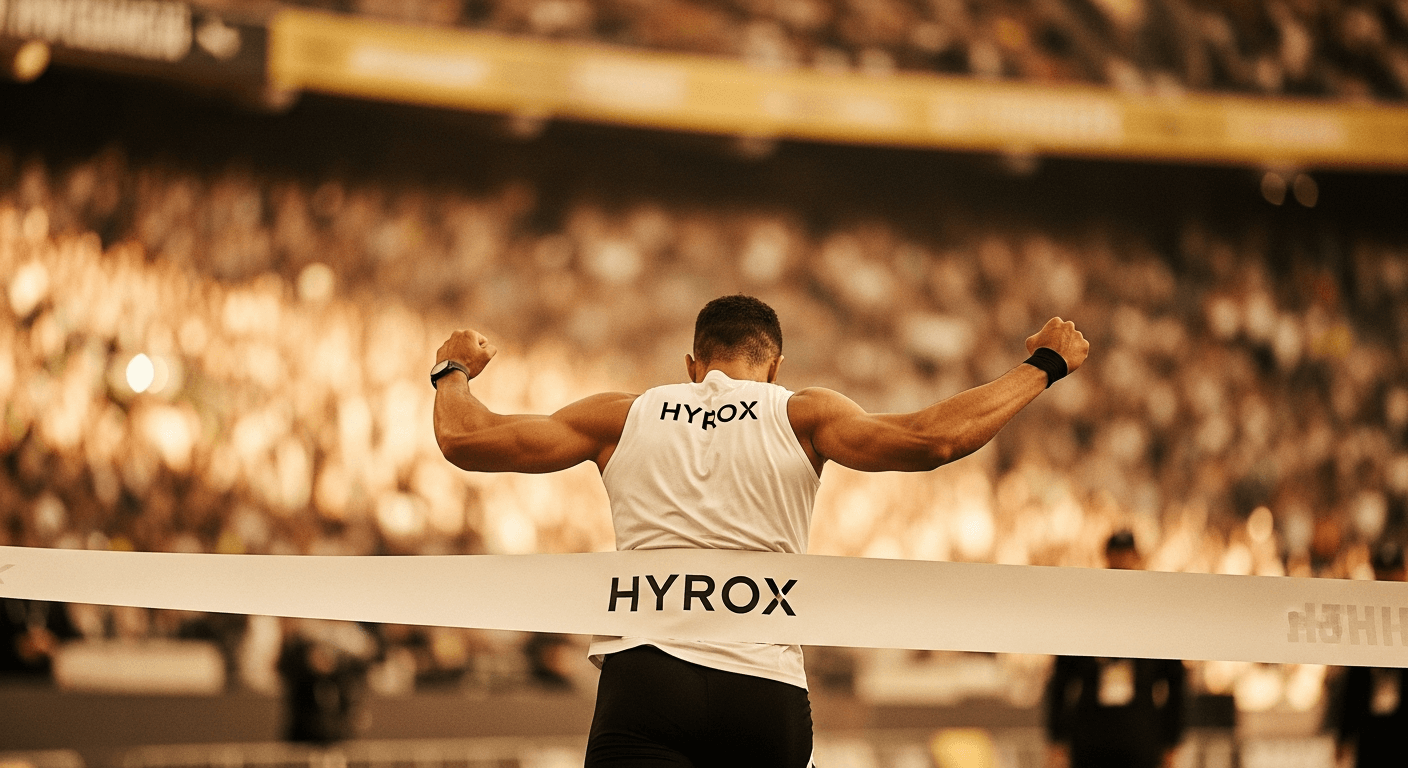
HYROX Elite Racing Will Cost $110 to Enter
HYROX has built its reputation on accessibility. You show up, you suffer through eight functional fitness stations separated by eight one-kilometer runs, and you find out exactly what you're made of. That formula has worked for hundreds of thousands of competitors across dozens of countries. But the sport is entering a new phase, and it comes with a price tag attached.
The organization is introducing a dedicated entry fee of approximately $110 (€100) for its Elite Racing category, separating it clearly from the standard Open and Pro divisions that most competitors know. It's a structural change that says a lot about where HYROX sees itself heading.
What the Elite Racing Category Actually Is
Elite Racing isn't a new concept in HYROX, but it's never been formalized quite like this. The category sits above the Open and Pro divisions and targets athletes who are genuinely competing for podium finishes and prize money rather than personal bests or age group glory.
Races in this tier are run under tighter conditions. Timing, seeding, and competitive standards are all more rigorous. The production value is higher. Prize structures are real. This isn't a category you enter because you had a good training block. It's one you earn your way into through qualifying standards or previous competitive results.
By putting a distinct price on that experience, HYROX is drawing a visible line between participation and professional competition. That line matters, both commercially and symbolically.
Why Separate Pricing Signals a Bigger Shift
The move to dedicated Elite Racing pricing isn't just a ticketing decision. It reflects a broader push to build HYROX into a credible professional sport with a functioning ecosystem around it. Think prize money, sponsorships, broadcast rights, and eventually a class of athletes who can sustain themselves through competition.
That model requires investment, and it requires the organization to demonstrate that elite competition is a distinct product. When you pay $110 to race Elite, you're not paying for the same experience as the Open athlete who paid $60 or $70. You're paying for a different level of race management, crowd focus, and competitive legitimacy.
For context, the broader functional fitness and obstacle racing industry has been moving in this direction for years. Events that tried to blend elite and mass participation into one undifferentiated format often found that neither group was fully satisfied. Elite athletes felt lost in the crowd. Recreational competitors felt intimidated by the front-of-pack energy. Separating the tiers, including on price, creates a cleaner experience for everyone.
It's also consistent with how other endurance sports have handled professionalization. Triathlon's PTO tour, trail running's elite start waves, and road racing's elite fields have all required some form of structural separation before they could attract serious commercial partners. HYROX appears to be following a similar playbook.
The Cost Barrier Question
Here's where the conversation gets more complicated. A $110 entry fee is not prohibitive for most athletes who are genuinely training at an elite level. If you're putting in the volume, paying for coaching, managing your recovery, and optimizing your protein intake for muscle building and performance, the registration cost is a small fraction of your total annual spend on the sport.
But cost barriers don't only filter out athletes who can't afford to compete. They also filter out athletes who aren't sure they belong. And that second group is worth thinking about carefully.
HYROX has attracted a large number of competitive age-group athletes who sit in an interesting middle ground. They're too fast and too serious to find much challenge in Open, but they've never thought of themselves as elite-level competitors. The old structure allowed some of those athletes to drift upward into higher categories without a major psychological or financial commitment. The new structure asks them to make a deliberate choice.
For some, that clarity is motivating. Paying $110 to race in the Elite category is a statement of intent. It forces a level of commitment that can sharpen preparation and focus. For others, that same clarity becomes a deterrent. The combination of qualifying standards and a higher price point can make the Elite path feel like it belongs to someone else.
The question HYROX needs to answer is whether the athletes it might lose from that ambiguous middle ground are ones it actually wants in the Elite field. If the goal is a competitive, high-quality race experience at the top, some filtering is probably the point.
What This Means If You're Targeting Elite Racing
If you're seriously considering the Elite path, the $110 fee is the smallest item on your preparation checklist. The real investment is in the training infrastructure that makes you competitive at that level.
That means structured programming with enough specificity to improve both your running economy and your functional fitness capacity simultaneously. It means taking your nutrition seriously, including understanding the role of supplement safety and contamination risks that become more relevant as your training load increases. It means building aerobic durability across the year rather than peaking for a single event.
It also means understanding that Elite Racing is won on the runs, not just on the stations. The athletes at the top of HYROX leaderboards are strong, but they're also genuinely fast runners. If your one-kilometer run splits are a weakness, no amount of sled push strength will close that gap.
Training load management becomes critical at higher volumes. Athletes who are adding mileage for the first time should review resources like how to train through summer heat without sacrificing progress, particularly if they're building toward a fall racing season.
The Broader Market Signal
From a business perspective, this pricing move tells you something important about where HYROX believes its growth ceiling is. A sport that wants to remain purely participatory keeps its prices flat and its categories simple. A sport that wants to build a professional tier starts segmenting, adding premium experiences, and investing in the spectacle of elite competition.
HYROX is clearly choosing the second path. The global functional fitness market has expanded rapidly over the past decade, and HYROX has positioned itself as the most structured competitive format within it. The next step, building a class of recognizable professional athletes who anchor the brand's visibility, requires the kind of organizational infrastructure that dedicated Elite Racing fees help fund.
Prize money needs to come from somewhere. High-production race days with separate elite heats, dedicated commentary, and curated spectator experiences cost more to run. Athletes who want those things need to contribute to the economics of making them happen.
Whether that model scales globally will depend on how many athletes are willing to pay a premium not just for competition, but for the legitimacy that comes with the Elite designation. Early signs from the broader endurance world suggest there's real appetite for this. Premium race entries in road running, trail, and triathlon have remained resilient even as discretionary spending has tightened in other categories.
The Long-Term Competitive Landscape
One underappreciated effect of a formal Elite pricing and qualification structure is what it does for the sport's depth over time. When the path to elite competition is clear, athletes can train toward it deliberately. Coaches can build programs around it. Brands can identify athletes to support. That clarity tends to produce better competitors, not fewer.
The athletes most likely to be deterred by the $110 fee are probably not the ones who would have contended for Elite podiums anyway. The athletes who are deterred by qualifying standards are a different conversation. But the fee itself, in isolation, is unlikely to be the deciding factor for anyone with a genuine shot at competing at that level.
What matters more is whether HYROX builds the race-day experience, prize structure, and media coverage to match the premium it's charging. If Elite Racing delivers a meaningfully different experience than Open, athletes will pay for it. If it's the same race in a different corral, the pricing will feel hollow quickly.
For now, the direction is clear. HYROX is building toward a professional sport, and it's asking elite-level competitors to invest in that vision alongside the organization. Whether you see $110 as a barrier or a badge depends almost entirely on which side of that elite line you're standing on.