
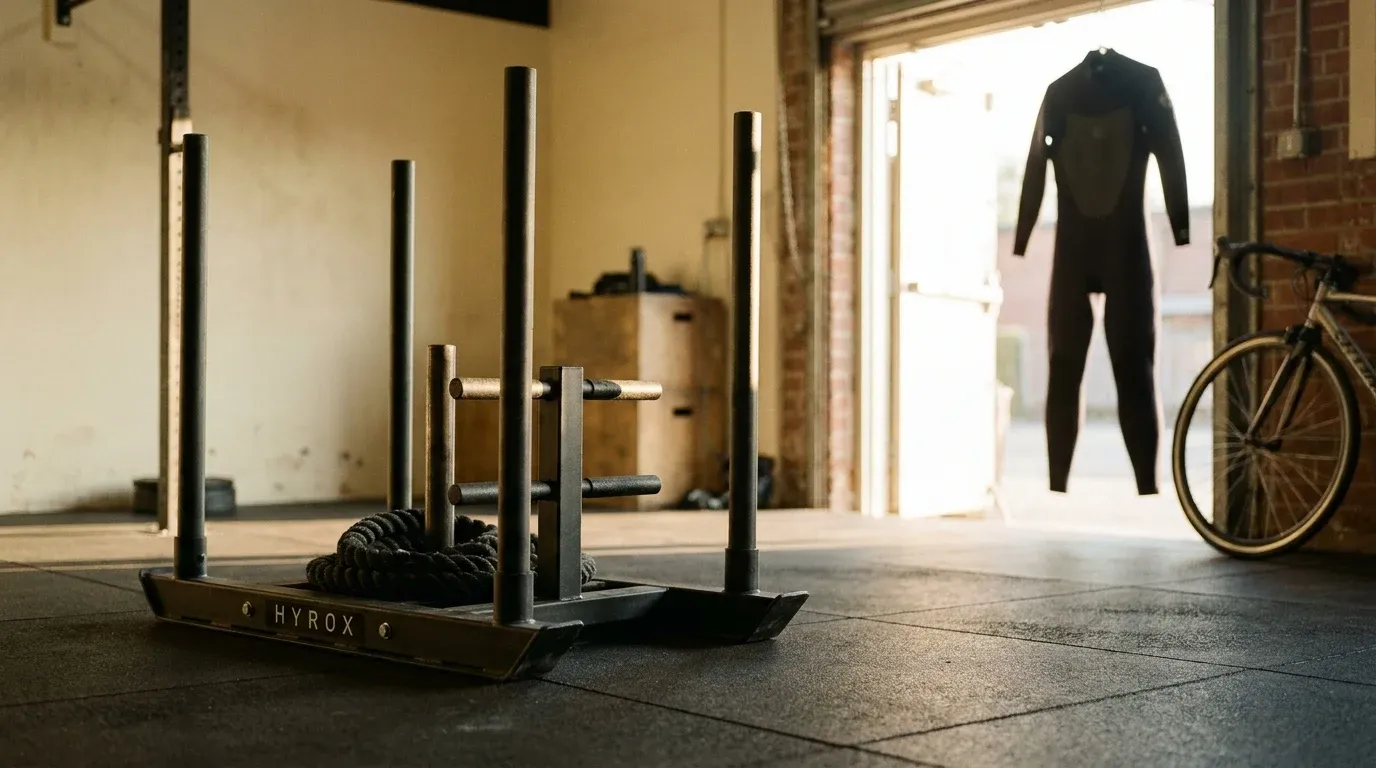
HYROX has spent the last decade building something genuinely new in fitness. It's not a race. It's not a gym competition. It sits somewhere in between, and that ambiguity has turned out to be a strength. Now, with 1.5 million participants logged in the past year alone, the sport is making its most ambitious move yet: a formal push for inclusion at the Brisbane 2032 Olympic Games, pursued through a partnership with World Triathlon.
The question isn't whether HYROX has earned a seat at the table. The numbers suggest it has. The question is what happens to triathlon when it agrees to share that seat.
The Numbers Behind the Olympic Push
Reaching 1.5 million participants in a single year is not a small thing. For context, that figure puts HYROX ahead of many established sports in terms of active global participation growth. The sport has expanded aggressively across North America, Europe, and Australia, with sold-out events becoming the norm rather than the exception.
That scale matters enormously to the International Olympic Committee. The IOC has increasingly prioritized sports that demonstrate broad, existing participation bases rather than waiting for Olympic exposure to build one. HYROX doesn't need the Olympics to prove it's popular. That's exactly the kind of leverage that gets sports onto shortlists.
The partnership with World Triathlon is the structural mechanism making this possible. World Triathlon is an established IOC-recognized federation. HYROX, despite its growth, doesn't have that recognition on its own. By aligning with World Triathlon, HYROX gains a pathway through the existing Olympic architecture rather than trying to build one from scratch.
If you want to understand what elite HYROX performance actually looks like at this level of competition, HYROX Denver 2026: Results and Key Takeaways breaks down the splits and patterns emerging at the top of the field.
The Timeline Is Brutally Tight
Here's where things get complicated. The IOC is scheduled to decide on the Brisbane 2032 sport program next April. That gives the World Triathlon partnership less than a year to demonstrate coherence, governance alignment, and a credible competition format for Olympic consideration.
That's not a lot of runway. Normally, sports pursuing Olympic inclusion spend years building institutional relationships, testing formats at multi-sport events, and working through the bureaucratic layers of IOC recognition. HYROX is attempting to compress that timeline significantly, which introduces real risk.
The optimistic read is that HYROX's growth trajectory is so clear and its format so well-defined that the IOC doesn't need years of evidence. The pessimistic read is that any partnership formed under this kind of deadline pressure is likely to be tested in ways neither side can fully anticipate.
There's also the question of format. Olympic sports need to be legible to a television audience in a compressed window. HYROX events, which combine running kilometers with eight functional fitness stations, translate reasonably well visually. But the Olympic format would almost certainly require modifications, and that negotiation happens inside the World Triathlon framework, not independently.
What Triathlon Is Actually Giving Up
Triathlon has been an Olympic sport since Sydney 2000. It's established, respected, and has produced some of the most compelling endurance racing in Olympic history. It has also, over the past decade, been quietly struggling.
Participation numbers in traditional triathlon have declined in several major markets. The sport skews older than it did a generation ago, with the fastest-growing age groups sitting well above the 18-to-34 demographic that sports organizations and sponsors most covet. Entry fees have risen. The logistical burden of training for three disciplines simultaneously has made triathlon a harder sell to younger athletes with less time and money.
Against that backdrop, the World Triathlon leadership's decision to partner with HYROX reads as a survival strategy as much as an opportunity. If HYROX brings a younger, broader audience into the World Triathlon ecosystem, the federation gains relevance and resources it's struggling to maintain on its own.
But there's a real downside scenario here. If the Olympic spotlight at Brisbane shifts meaningfully toward a HYROX format rather than traditional triathlon, the sport risks accelerating its own erosion rather than reversing it. Athletes, sponsors, and media attention follow Olympic narratives. If that narrative becomes "this is what modern multisport looks like," traditional swim-bike-run triathlon could find itself repositioned as the legacy format rather than the flagship one.
The demographic challenge here is worth taking seriously on its own terms. Aging participation bases in endurance sports reflect genuine physiological and lifestyle realities. Research on VO2max as the biggest HYROX performance predictor highlights how aerobic capacity sits at the center of both sports, but the training demands diverge enough that an athlete choosing between them is often making a lifestyle choice as much as an athletic one.
The Aging Athlete Problem Is Structural
It would be easy to frame triathlon's demographic challenge as a marketing problem. It's more accurately a structural one. As the sport's existing base ages, it faces compounding issues around injury risk, recovery time, and the practical limits of multisport training volume.
Bone health is one underappreciated piece of this. Endurance athletes in general, and triathletes in particular, face bone density concerns that become more significant with age. Swimming, which is non-weight-bearing, doesn't provide the skeletal loading that protects against age-related bone loss. Even dedicated running and cycling may not be sufficient. Research covered in Walking and Weight Training May Not Be Enough for Bone Health underscores how conventional assumptions about exercise protecting bone health don't always hold up under scrutiny.
HYROX, with its emphasis on functional strength alongside cardio, may actually serve aging athletes better in some respects. The integration of sled pushes, burpee broad jumps, and weighted carries creates skeletal loading that pure endurance sports don't replicate. That's not an argument for HYROX over triathlon. It's an argument that the two sports appeal to slightly different physiological priorities, and that World Triathlon may be overestimating how much overlap exists in their actual participant bases.
Who Actually Benefits From This Partnership
HYROX's benefit from the World Triathlon partnership is obvious. Olympic inclusion at Brisbane 2032 would be transformational for the brand, for participation numbers, and for the sport's ability to attract investment and media deals. The federation pathway solves a real problem quickly.
World Triathlon's benefit is less clear but potentially significant. If the partnership brings new participants into the broader multisport ecosystem, and if those participants eventually discover traditional triathlon as a natural progression, the federation gains a feeder pipeline it currently lacks. Some HYROX athletes will inevitably be curious about what a full Ironman or Olympic-distance triathlon demands. That curiosity has value.
The athletes who might get squeezed are traditional triathletes who've built careers, coaching businesses, and competitive identities around the existing Olympic format. If Brisbane 2032 replaces or diminishes the traditional triathlon program in favor of a HYROX-adjacent event, those athletes face a disruption they didn't consent to and can't easily adapt around.
The coaching and professional services ecosystem around triathlon is real and substantial. Triathlon coaches working in the US market charge anywhere from $150 to $500 per month for structured programming. Race-specific preparation plans, nutrition coaching, and training camps represent a significant industry built on the assumption that triathlon's Olympic status is stable. Any shift in that status would ripple through the entire support structure of the sport.
What You Should Be Watching For
If you're a triathlete, a HYROX competitor, or someone who follows multisport athletics, here are the signals worth tracking over the next twelve months.
- The IOC decision timeline. April is the deadline, but signals about the shortlist will emerge earlier. Watch for official statements from World Triathlon and from the Brisbane 2032 organizing committee.
- Format announcements. If a proposed Olympic HYROX format is released, the specific event structure will tell you a great deal about how much traditional triathlon has influenced or been displaced in the conversation.
- Participation data. If HYROX continues growing at its current rate while triathlon participation continues declining, the structural argument for the partnership gets stronger on paper but more complicated in practice.
- Sponsor behavior. Where major endurance sports sponsors put their money in 2025 and 2026 will be a leading indicator of where the Olympic narrative is heading.
The broader context here matters too. HYROX sits inside a fitness culture that's actively renegotiating what elite sport looks like for everyday participants. The sport's growth reflects a real appetite for competition formats that feel accessible without being trivial. That appetite is legitimate. The challenge is managing it without flattening everything that made the existing landscape worth competing in.
Traditional triathlon built something durable over 25 years of Olympic history. HYROX has built something genuinely compelling in a fraction of that time. Whether the partnership between them produces something better than either, or simply accelerates the decline of the slower-growing of the two, is a question that April's IOC decision will begin to answer. It won't finish answering it for years after that.