
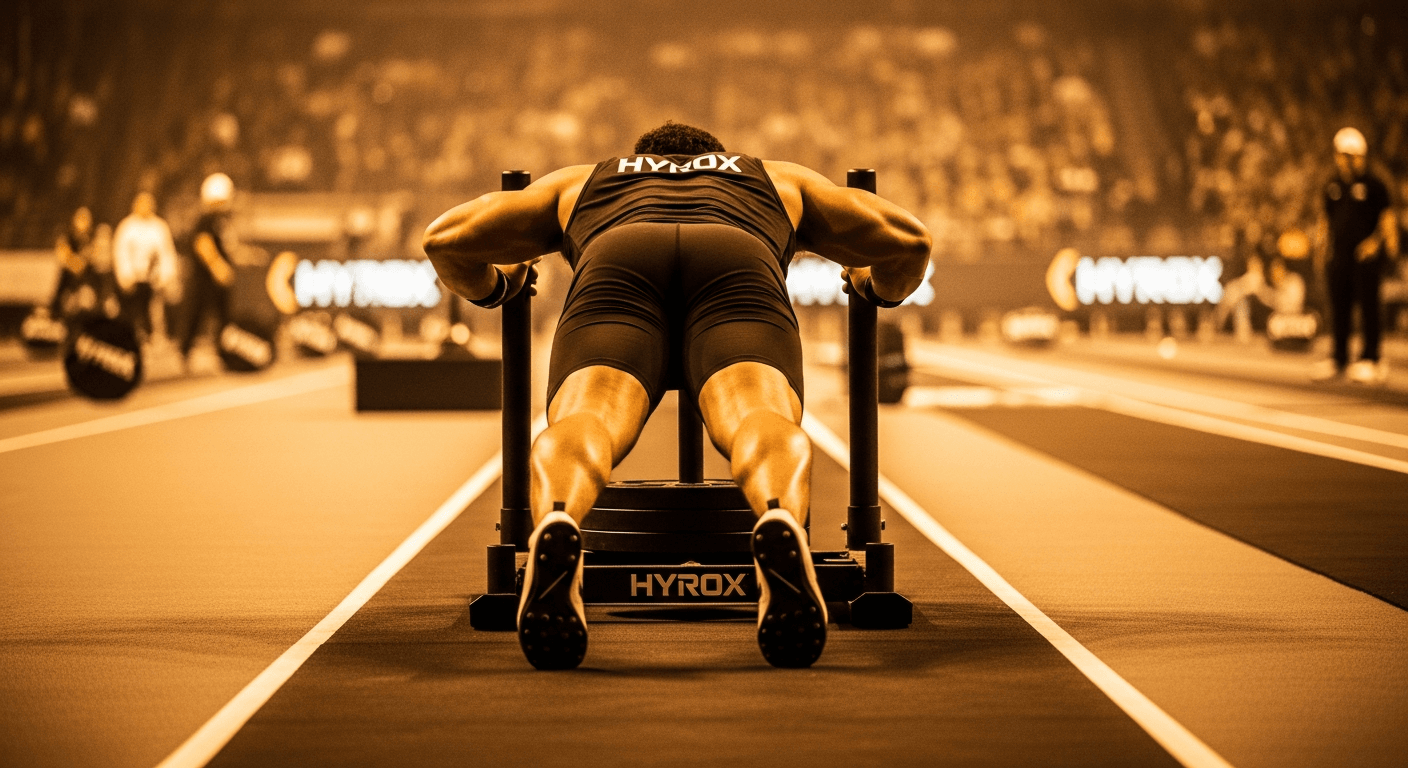
HYROX São Paulo 2026 delivered one of the most competitive hybrid racing events ever staged in Latin America. With over 4,000 registered athletes, a packed venue at Expo Center Norte, and a field that drew competitors from more than 30 countries, this race marked a genuine turning point for the sport in South America. The numbers don't lie: the region is catching up fast.
Whether you competed, watched from the sidelines, or are planning your first HYROX race in the region, here's everything you need to know about how the day unfolded and what the results signal for the sport's trajectory.
Race Overview: Scale, Setting, and Atmosphere
São Paulo's Expo Center Norte provided roughly 40,000 square meters of competition floor, easily accommodating the relay waves, spectator zones, and athlete staging areas. Conditions inside were warm but manageable, with ambient temperatures hovering around 26–28°C (79–82°F) during peak competition hours. Humidity was a factor that caught several European athletes off guard, particularly during the SkiErg and running segments.
Race organizers ran waves from 7:00 AM through to late afternoon, with Pro divisions taking center stage in the mid-morning slots. Local volunteers and a Portuguese-speaking MC team kept energy high throughout, and the crowd noise during the final Burpee Broad Jump and Rowing stations rivaled anything seen at European flagship events.
Pro Division Results: Times That Demand Attention
The Pro Men's division winner crossed the finish line in 57:42, a time that would place competitively at any major European stop on the HYROX circuit. Second place finished in 58:19 and third in 59:04, meaning the top three Pro Men were separated by less than 90 seconds. That kind of depth at a Latin American race would have been unthinkable three years ago.
In the Pro Women's division, the top finisher posted 1:04:31, with the podium rounded out by times of 1:05:12 and 1:06:48. Brazilian athletes took two of the three Pro Women's podium spots, a result that underscores how seriously local competitors have structured their preparation cycles over the past 18 months.
For context, the current HYROX Pro Men's world record sits around 55 minutes, and world-class Pro Women regularly break the 62-minute barrier at elite events. São Paulo 2026 is closing that gap in a meaningful way.
Open Division: Volume, Variety, and a Competitive Surge
The Open division drew the largest participation numbers, as expected. Open Men's winning time came in at 1:02:18, while the Open Women's division was won in 1:14:55. Both performances reflect athletes who have moved well beyond recreational preparation and are training with structured, event-specific programming.
The median Open Men's finisher completed the course in approximately 1:28, and the median Open Women's time landed around 1:45. These figures align closely with global HYROX averages, suggesting that São Paulo's field was not simply a regional curiosity but a genuinely representative competitive pool.
If you're planning to race at a similar level, How to Train for HYROX: The Complete Race Prep Guide breaks down how to structure your build phase across both functional fitness and running components.
Age Group Divisions: Where South American Depth Really Shows
Perhaps the most telling story of São Paulo 2026 was inside the Age Group divisions. The 30–34 Men's bracket produced a winning time of 1:03:44, which would earn a podium finish at several North American HYROX stops. The 40–44 Women's bracket winner finished in 1:19:22, a genuinely elite performance for that category globally.
Across the 35–39 and 45–49 brackets for both genders, Brazilian and Argentine athletes dominated the top five positions in multiple categories. This reflects a demographic trend that HYROX's global data supports: participation growth is strongest among athletes aged 30–49, and South America is replicating the grassroots club culture that drove early adoption in Germany and the UK.
The Doubles categories also showed strong numbers. Mixed Doubles pairs finished as fast as 58:11, and Women's Doubles topped out at 1:08:44. These formats have become increasingly popular in Brazil because they lower the individual barrier to entry while maintaining competitive stakes.
Station-by-Station Breakdown: Where Races Were Won and Lost
Analyzing split data from the top 10% of finishers across all divisions reveals a consistent pattern. The SkiErg and Sled Push stations produced the widest time gaps between competitors. Athletes who lacked specific machine training lost significant ground here, sometimes 45–90 seconds per station compared to the podium finishers.
The running kilometers told a different story. South American competitors, many of whom come from strong running backgrounds given the region's thriving road racing culture, posted above-average 1km splits throughout the race. Several top-10 Open finishers were pulling 4:10–4:25 per kilometer across all eight running segments, which is competitive at any global HYROX event.
- SkiErg (1,000m): Top Pro Men averaged 3:28. Open Men's average was 4:15. Athletes who front-loaded intensity here often paid for it on the Sled Push.
- Sled Push (50m x 8): The station where load management mattered most. Competitors who went conservative in rounds 1–3 consistently outpaced those who faded after round 5.
- Burpee Broad Jump (80 reps): The decisive station for most mid-pack athletes. Pacing in 10-rep sets proved more efficient than trying to push through 20-rep blocks under fatigue.
- Rowing (1,000m): Final station, highest variance. Top finishers averaged 3:35–3:45 per 500m split. Mid-pack athletes often saw splits drift to 4:20 or beyond due to accumulated fatigue.
- Wall Balls (100 reps): Athletes with CrossFit or functional fitness backgrounds consistently outperformed runners here, finishing 60–90 seconds faster than the field average.
Understanding your own split data after a race is where real improvement comes from. Your HYROX Results: How to Decode Them and Actually Improve gives you a structured approach to identifying your weakest stations and building a targeted response.
What the Results Reveal About South American HYROX Growth
HYROX launched its first South American event in 2022. Four years later, São Paulo is producing Pro-level times, a self-sustaining Age Group competitive scene, and a spectator culture that fills expo areas hours before competition starts. That's not accidental growth. It reflects deliberate investment in affiliate gyms, local athlete development, and Spanish and Portuguese-language content from HYROX's global team.
The affiliate gym network in Brazil alone grew by an estimated 60% between 2024 and early 2026, according to regional fitness industry tracking. Chile, Colombia, and Argentina have all seen similar upticks, with Buenos Aires and Bogotá expected to host their own standalone HYROX events within the next 18 months if current growth holds.
One factor that doesn't show up in finish times but shapes participation culture significantly is race-day experience. If you haven't navigated a large-scale HYROX event before, HYROX Under the Tent: What No One Tells You Before Race Day covers the logistics, atmosphere, and practical details that separate a confident race from a chaotic one.
Athlete Strategies Worth Borrowing
Several patterns emerged from post-race interviews and split data that offer direct takeaways for competitors at any level.
Pacing the early SkiErg: Every podium finisher in the Pro and competitive Open brackets reported holding back on the opening SkiErg, targeting 85–90% of their maximum sustainable pace. Athletes who went out at full intensity on station one consistently showed degraded Sled Push and Burpee times in the back half of the race.
Fueling between stations: Top finishers reported consuming 30–45 grams of fast-acting carbohydrate during the race, typically via gels consumed on the run legs between stations 3 and 6. Sodium replacement was also a priority given the warm venue conditions. Your fueling strategy going into a race matters as much as what you consume on the day itself.
Wall Ball pacing: The top-performing athletes in this station used a strict 10-rep-on, brief-reset structure rather than chasing unbroken sets under fatigue. The data supports this: athletes who broke Wall Balls into controlled sets consistently posted faster overall station times than those who pushed for longer unbroken runs and subsequently slowed.
What Comes Next for HYROX in Latin America
São Paulo 2026 was not a one-off. It's the clearest signal yet that Latin America is transitioning from a developing HYROX market to a genuinely competitive one. The infrastructure is building. The coaching ecosystem is maturing. And the athletes are arriving at start lines with race-specific preparation that would have been rare in the region just two years ago.
For competitors based in North America, Europe, or Australia who are tracking their own progress against global benchmarks, São Paulo's results are worth studying. The gap between regional and global elite standards is narrowing in real time, and that pressure makes the entire sport faster.
If you're targeting a HYROX race in the next six to twelve months, now is the right time to evaluate your station weaknesses, build your running base, and make sure your nutrition strategy is built for performance over the full duration of the event. The field at every stop on the circuit is getting more competitive. São Paulo just proved that this is a global trend, not a regional one.