
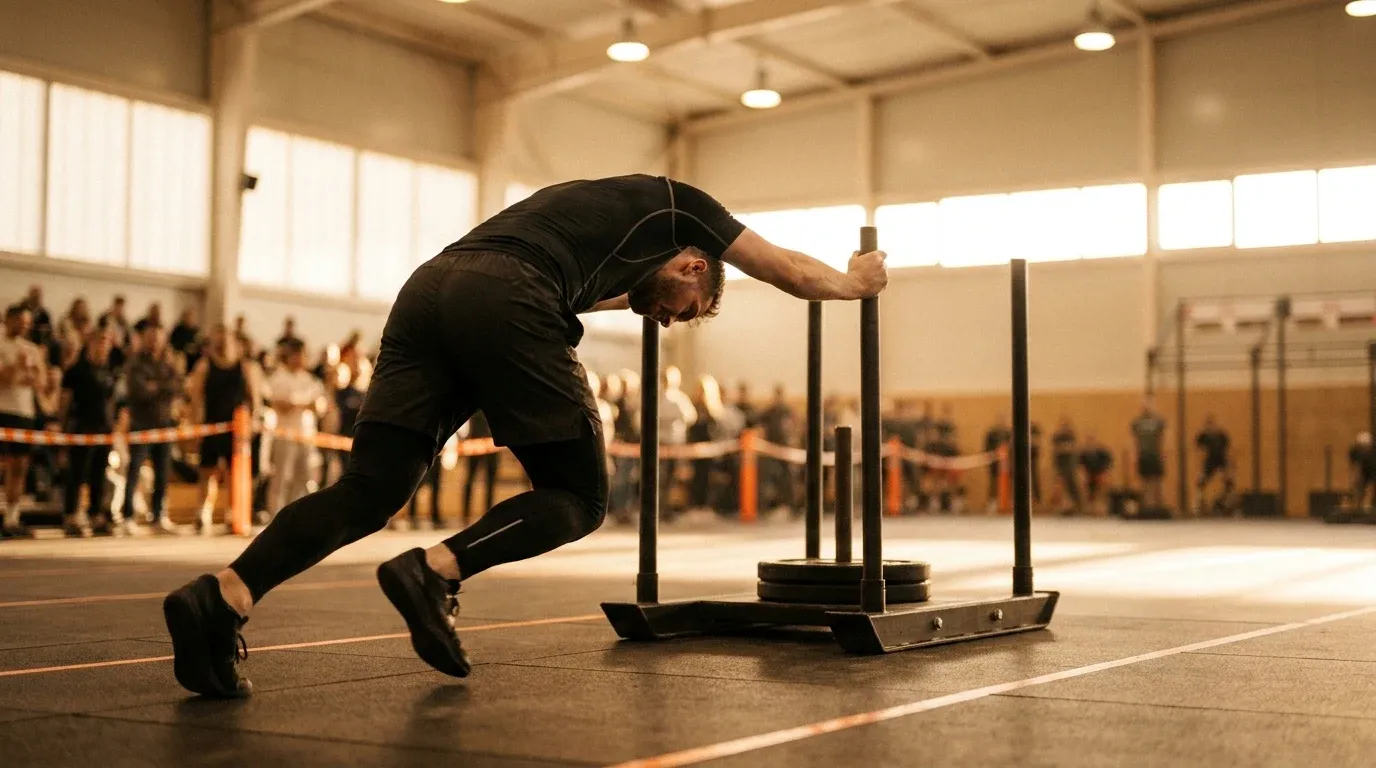
Something shifted in Barcelona. The non-Elite men's field at the recent HYROX race produced multiple finishes under 55 minutes, a threshold that, until recently, existed almost exclusively in Elite heats. That's not a fluke. It's a signal about where competitive amateur HYROX now sits, and what you need to bring to the floor if you want to be part of that conversation.
Sub-55 used to be aspirational shorthand for Elite-level fitness. Now it's becoming the new ceiling for the top tier of the open field. If that's your target, you need to understand exactly what the number demands, because it leaves very little room for error anywhere.
What Sub-55 Actually Looks Like on Paper
A HYROX race covers 8km of running split across eight 1km segments, each separated by a functional station. To finish under 55 minutes, your running has to average somewhere between 4:50 and 5:10 per kilometer. That's a consistent aerobic output held across a full hour of work, not a tempo run where you can back off when it gets uncomfortable.
The stations don't pause your clock. SkiErg, sled push, sled pull, burpee broad jumps, rowing, farmers carry, sandbag lunges, wall balls. Each one chips into your time, and each one arrives when your legs are already carrying fatigue from the kilometer you just finished. The math is unforgiving: if your running is clean but your stations bleed 30-40 extra seconds each, you're looking at four to five minutes gone before you even account for transitions.
At the sub-55 level, athletes are completing the full station workload in roughly 22 to 25 minutes combined. That means your running accounts for about 30 minutes, and your station execution has to stay tight, not just technically clean, but fast under real fatigue.
Station Efficiency Is the New Differentiator
When HYROX athletes first started competing seriously, the gap between finishers was largely about fitness. Who had the bigger engine. Who could push harder on the sled or move faster through wall balls. That gap still exists, but at the front of the non-Elite field, raw output is increasingly similar across competitors. What separates athletes now is what happens between reps.
Rest behavior inside a station is where time bleeds at this level. An athlete who pauses for three to five seconds between burpee broad jump sets, or who breaks wall ball reps into chunks of five instead of holding sets of ten or more, is surrendering time that running fitness alone can't recover. The reps themselves matter less than the rhythm. You're not just doing the work, you're managing the transition from one rep to the next without letting your heart rate spike into an unrecoverable range.
This is a skill that gets trained, not discovered on race day. Athletes targeting sub-55 need to practice stations in a fatigued state, specifically after a running interval, so the body learns to absorb the aerobic demand and keep moving efficiently rather than defaulting to rest. Training for HYROX in isolated blocks, running days on Tuesday, station work on Thursday, is a structure that doesn't reflect the actual race demand.
The Running Standard Is Non-Negotiable
It's tempting to view the running segments as connective tissue between stations. They're not. The 1km splits set the entire pace of your race. If your running drops to 5:30 or 5:40 per kilometer under fatigue, you're already outside the sub-55 window regardless of how efficiently you execute your stations.
The athletes finishing under 55 minutes in Barcelona's non-Elite field aren't necessarily faster runners than their competitors in a standalone 10km. What they've developed is running economy under sustained metabolic load. They arrive at each 1km segment already carrying fatigue, and they hold pace anyway. That's a specific adaptation, and it requires specific training.
Zone 2 base work builds the aerobic platform. But the stimulus that actually prepares you for HYROX running is hybrid: running intervals that follow directly from station work, or station circuits completed immediately before a timed kilometer. Your body needs to learn what 5:00 per kilometer feels like when your legs are heavy from sled pulls and your grip is shot from farmers carry.
If you're tracking gear for race-day running, the conversation around footwear has gotten more interesting. the super-shoe arms race has accelerated significantly, and the options now available to competitive amateurs weren't accessible at this price point two seasons ago.
The Floor Is Rising Across the Entire Sport
Barcelona's results aren't an isolated data point. They reflect a structural change in the HYROX athlete pool as the sport enters its sixth competitive season. The early years of competitive HYROX attracted a mix of CrossFit athletes, runners, and fitness generalists who were learning the race format in real time. Many of those athletes have now accumulated three, four, or five full competitive seasons. Their baselines have risen, and they've brought training methodologies with them that didn't exist in the sport's first years.
The non-Elite field at a major HYROX event now includes athletes who have deliberately built HYROX-specific fitness over multiple years. They're not adapting from another sport. They've trained for this format from the ground up. The result is a compression of finish times at the front of the open field that is raising the standard for anyone trying to compete at the top of their category.
This maturation is also happening against a backdrop of increasing scrutiny around athlete standards. HYROX is now testing athletes out of competition, a development that signals the organization is treating high-level non-Elite performance with the same seriousness as its Elite tier. The sport is professionalizing across the board, and the competitive expectations are following.
For a broader look at how the Elite and non-Elite fields compared at a recent major event, the HYROX Düsseldorf 2026 results and takeaways offer useful context on where performance benchmarks are heading globally.
Building a Sub-55 Training Block
If sub-55 is your target for a race 12 to 20 weeks out, your training structure needs to reflect the event's actual demands from the first week. Here's what that means in practice:
- Run volume first. You need to be able to comfortably hold 5:00 per kilometer for 8km on fresh legs before you start stacking stations on top. If your standalone 8km time is already close to 40 minutes, you have the aerobic floor to work from.
- Train transitions, not just stations. Finish a 1km run, move directly into your station, and practice holding form and pace from the first rep. The first 20 seconds of a station after a kilometer of running is where most athletes lose discipline.
- Build set efficiency under load. Wall balls and burpee broad jumps particularly reward athletes who can sustain larger unbroken sets. Practice holding ten-plus reps without breaking, specifically when your heart rate is already elevated.
- Simulate the race structure weekly. At least once per week, complete a session that mirrors the race format: run, station, run, station, for a minimum of four to five cycles. Time it. Track where you're losing minutes.
- Manage fatigue across the week. Recovery quality directly affects your ability to train at race-specific intensity. Sleep, nutrition timing, and stress load all factor into whether your hard sessions produce adaptation or just accumulated damage.
Tools that help you structure and track this kind of hybrid training are increasingly available. HY AI can turn a gym whiteboard photo into a logged workout, which makes it easier to track session structure without manual logging overhead.
What the Standard Actually Means
Sub-55 in the non-Elite field isn't a participation benchmark. It's a competitive one. Finishing under that mark now puts you in the top fraction of the open field at any major HYROX event, and it demands a level of preparation that most recreational athletes aren't currently running.
The athletes who broke that threshold in Barcelona weren't there by accident. They had running fitness that holds under fatigue, station execution that doesn't bleed time between reps, and enough race experience to manage effort across 55 minutes without going out too hard on the first kilometer or falling apart on the sled pull.
That combination is trainable. But it requires you to treat HYROX as its own discipline, not as a fitness test you can peak for in four weeks by doing extra burpees. The sport has matured. The athletes competing at the front of the open field have matured with it. If sub-55 is the standard you're chasing, your training needs to reflect that reality from day one.