
The question the researchers really wanted to answer
We've long known genetics plays a role in longevity. If your parents and grandparents lived long lives, you've probably inherited genes that help. But does diet follow too? Do the children of people who reach 100 actually eat differently from those whose parents died younger?
That's exactly the question a research team at the Jean Mayer USDA Human Nutrition Research Center on Aging at Tufts University decided to address, in collaboration with Boston University and Harvard T.H. Chan School of Public Health. Their study, published in Innovation in Aging on April 6, 2026, is one of the first to directly examine the dietary habits of centenarian descendants.
What the researchers found
The results don't show a dramatic or radical difference. Children of centenarians aren't following an esoteric diet or a revolutionary eating protocol. But they do show several consistent, measurable differences.
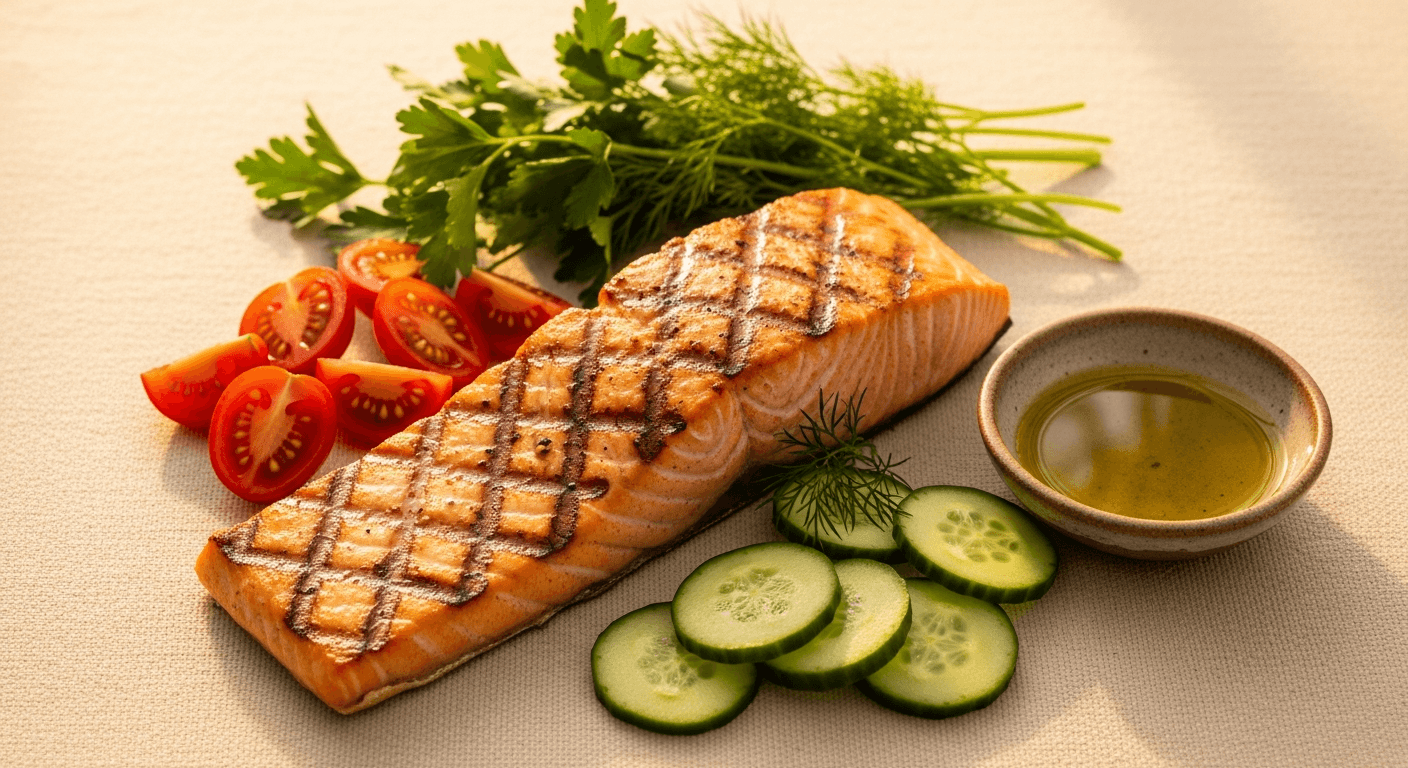
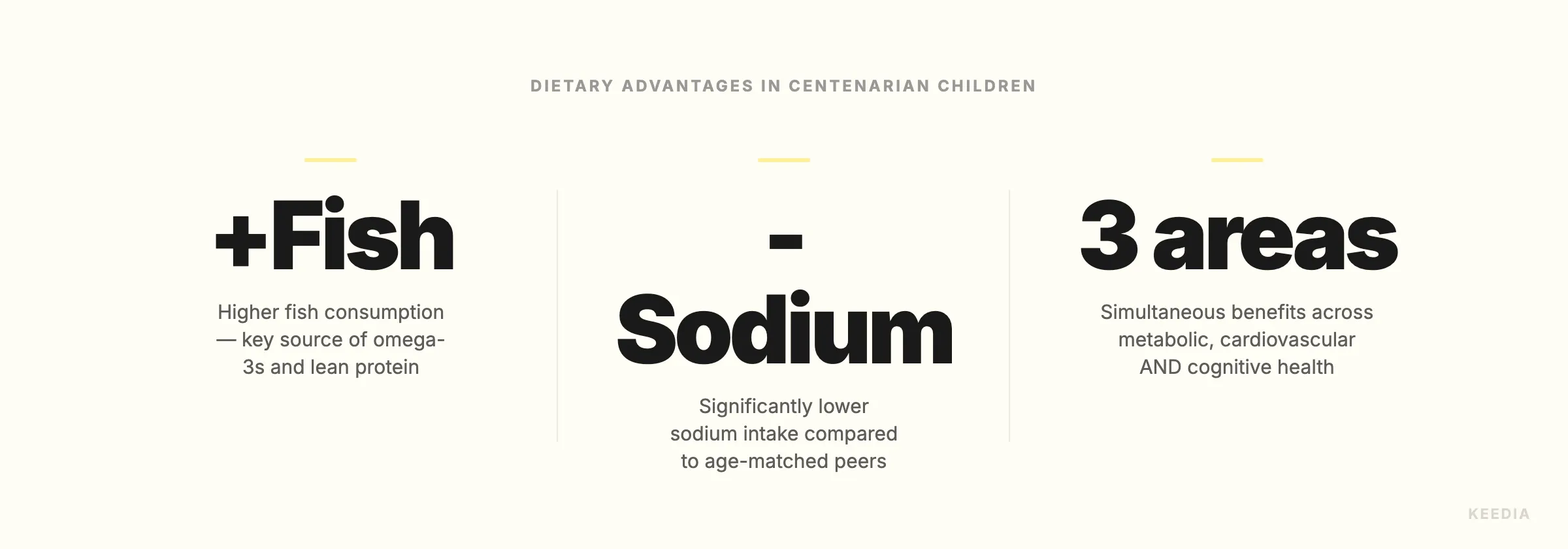
They eat more fish. Fish consumption is higher than in age-matched peers — which translates to higher intake of omega-3 fatty acids and lean, high-quality protein.
They eat substantially less sodium. This isn't a marginal difference — sodium intake is notably lower compared to the comparison group. It's worth noting that excess sodium is one of the most documented and most modifiable cardiovascular risk factors.
They eat more fruits and vegetables, and less added sugar. Again, no secret superfoods — just stronger adherence to the basics of dietary quality.
The team then analyzed the effects of these differences across three health domains simultaneously: metabolic, cardiovascular, and cognitive. Benefits held across all three.
What this says about nutrition and longevity
The interesting angle here isn't just "eat more fish." It's the confirmation that dietary behaviors transmit across generations — and that this transmission has measurable effects on long-term health outcomes.
Children of centenarians likely grew up in households where certain food habits were the norm. Less salt in cooking. Fish on the table regularly. Little ultra-processed food. These habits, learned in childhood, compound over decades.
This mechanism matters because it suggests that longevity isn't only about genetics or luck — it's also about behavior. And behaviors can be changed.
What separates longevity-oriented eating from trendy diets
We live in an era where trendy diets dominate the nutrition conversation. Keto, carnivore, intermittent fasting, alkaline eating — every year brings a new protocol supposed to transform your health.
What this study highlights is that the people who live longest don't appear to follow these protocols. They do something far more boring and far more sustainable: they eat fish regularly, enough vegetables and fruit, and they keep their sodium and added sugar in check.
It's not the Mediterranean diet with a hashtag. It's just that diet, lived day after day for 40, 50, 60 years.
Practical application: where to start
If you're an active athlete already dialing in nutrition for performance, this study gives you a few simple angles to integrate:
- Sodium: check labels on your processed foods — sauces, stocks, canned goods, cheese. These are the main hidden sources. WHO recommends under 2,000mg per day; most adults consume 3,400-4,000mg.
- Fish: aim for 2-3 servings per week. You don't need wild-caught Alaskan salmon — sardines, mackerel, and canned tuna are equally valid omega-3 and protein sources at a fraction of the cost.
- Produce diversity: the goal isn't a specific number of servings but color variety — each color corresponds to a different family of phytonutrients.
None of this is extraordinary. And that might be exactly the point.