
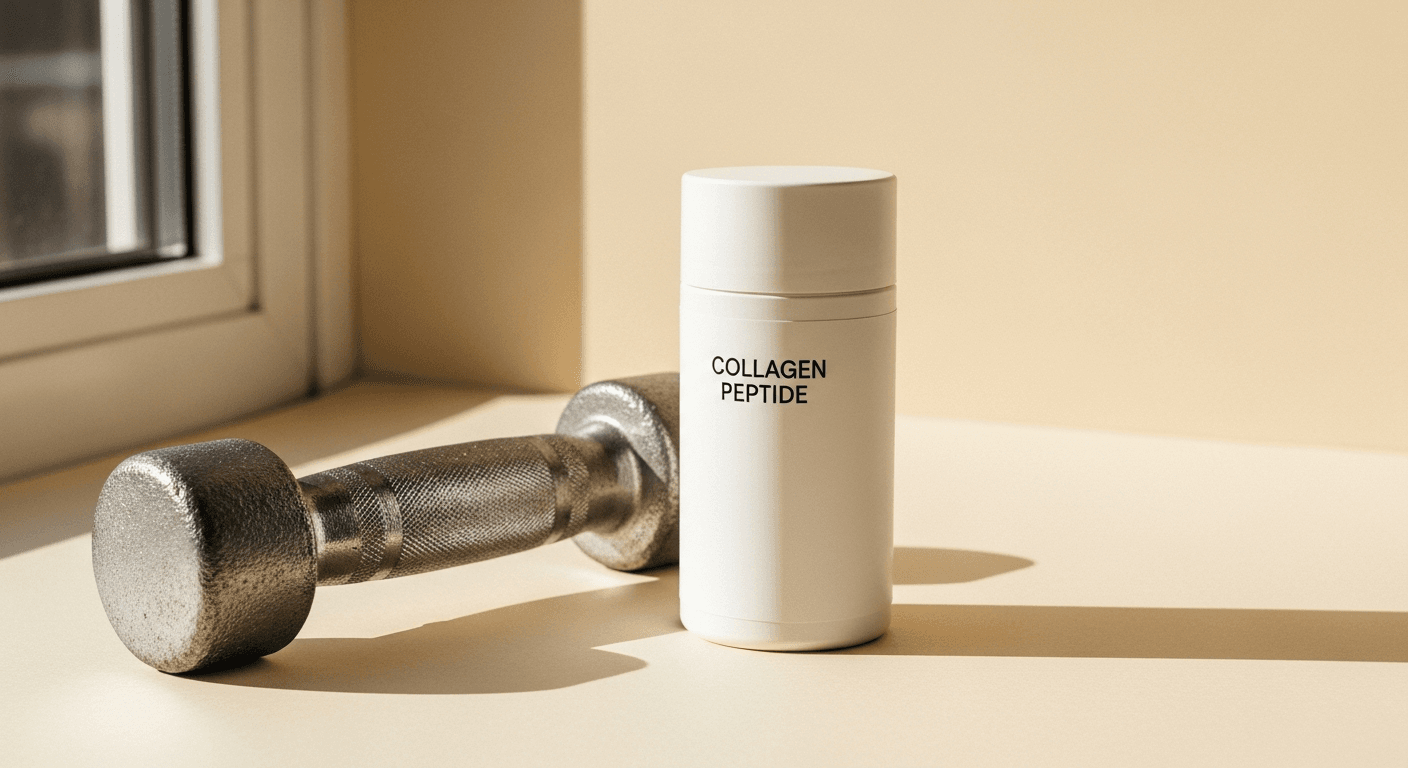
Most gym-goers have their supplement stack figured out: protein powder, maybe creatine, possibly a pre-workout. Collagen, if it shows up at all, tends to live in the skincare drawer. A new randomized controlled trial published in early 2026 suggests that thinking is worth revisiting.
The study found that active adults who took collagen peptide supplements while following a structured resistance training program showed meaningfully greater gains in muscle strength and connective tissue integrity than those who trained with a placebo. It's not a dramatic claim, but it's a significant one, and the way the evidence was gathered matters as much as the result itself.
Why Collagen Has Struggled to Earn Its Place in the Gym
Collagen is already the fastest-growing supplement category globally. Sales have expanded well beyond joint support and beauty formulas into protein bars, ready-to-drink shakes, and recovery blends. The marketing has moved fast. The science, until recently, has not kept up.
Most earlier studies on collagen and exercise performance were small, short, or poorly controlled. Some relied on self-reported outcomes. Others didn't distinguish between hydrolyzed collagen peptides and gelatin-based products, which behave differently in the body. The result was a category full of consumer enthusiasm and limited clinical credibility.
That's a pattern you'll find across supplements. As covered in The Supplement Trust Gap: How the Industry Is Trying to Fix It, the gap between what brands promise and what research supports has long been a structural problem in the supplement space. Collagen has been one of the clearest examples.
What the 2026 RCT Actually Found
The trial enrolled healthy adults between 25 and 60 years old who were already engaged in regular resistance training. Participants were randomly assigned to either a collagen peptide group or a matched placebo group for 16 weeks. Both groups followed the same supervised progressive resistance program, and neither group was told which supplement they were receiving.
By the end of the trial, the collagen group showed statistically significant improvements in lower-body strength output compared to the placebo group. They also showed greater increases in lean mass in the lower limbs, along with reduced markers of connective tissue damage after high-load sessions. The placebo group made solid gains too, which is expected from structured training, but the collagen group pulled ahead on several key measures.
Crucially, the benefits appeared to be additive. Participants who were already consuming adequate dietary protein still showed enhanced outcomes from collagen supplementation, suggesting collagen isn't simply acting as a protein source substitute.
The RCT Design Is the Point
It's easy to skip past study design details when reading health news. Don't. The difference between a randomized controlled trial and an observational study is the difference between establishing causation and noting a correlation.
In an RCT, participants are randomly assigned to groups, which controls for confounding variables like diet quality, sleep habits, or training history. A control group receiving a placebo allows researchers to isolate the specific effect of the intervention. Double-blinding, where neither participants nor researchers know who got what until analysis, removes expectation bias from the equation.
This particular trial used all three of those features at scale. That's what makes it worth paying attention to, and what distinguishes it from the weaker evidence that has surrounded collagen's fitness claims for years. For context on why rigorous funding and methodology matter to the reliability of nutrition science, Nutrition Science Is Losing Its Funding. Here's Why It Matters is worth your time.
Why Collagen Works Differently Than Whey
Whey protein is rich in leucine, the amino acid most directly responsible for triggering muscle protein synthesis. That's why it's been the gold standard post-workout protein for decades. Collagen has a very different amino acid profile, dominated by glycine, proline, and hydroxyproline. It contains almost no tryptophan and is low in leucine.
Because of that, collagen was long dismissed as an inferior protein source for muscle building. The new research complicates that view. Collagen peptides appear to support muscle adaptation through a different mechanism, primarily by stimulating collagen synthesis in connective tissue, including tendons, ligaments, and the extracellular matrix that surrounds muscle fibers.
When those connective structures are stronger and more resilient, force transfer during lifting improves. Tendons that can handle higher loads without micro-damage allow you to train harder with less breakdown. The muscle gains may be partly downstream of that structural support, rather than a direct result of collagen's amino acids triggering protein synthesis the way whey does.
This also connects to broader research on why resistance training preserves and rebuilds function at the tissue level. Scientists Figured Out Why Exercise Reverses Muscle Aging covers the cellular mechanisms that explain why training quality, not just volume, drives adaptation.
How to Use Collagen Peptides Practically
The trial used a specific supplementation protocol that's worth understanding before you add collagen to your stack. Here's what the research suggests:
- Dose range: Participants in the active group consumed between 15 and 20 grams of hydrolyzed collagen peptides per day. Lower doses used in some earlier studies (5 to 10 grams) didn't produce the same consistent results across the group.
- Timing: Collagen was consumed approximately 45 to 60 minutes before training sessions. The hypothesis is that this timing elevates circulating amino acids during the mechanical loading phase, when connective tissue remodeling is most active.
- Vitamin C co-ingestion: The supplement in the trial included vitamin C, consistent with previous research suggesting that vitamin C is a necessary cofactor for collagen synthesis. Many commercial collagen peptide products already include it, but it's worth checking your label.
- Stack compatibility: The trial specifically confirmed that collagen supplementation was effective on top of normal dietary protein intake. You don't need to replace your whey or casein. The two appear to work through distinct mechanisms and can be used simultaneously.
On non-training days, timing matters less. The structural benefits of collagen synthesis are cumulative, so consistency over weeks appears more important than precise daily scheduling when you're not lifting.
Who Is Most Likely to Benefit
The trial enrolled a wide age range, but the effects were largest in participants over 40. That's biologically logical. Endogenous collagen synthesis declines with age, which partly explains why older adults see more connective tissue injuries and slower recovery. Supplementing the precursor pool for collagen production may have a higher ceiling of benefit when the body's own production is already reduced.
That said, younger lifters doing high-volume training showed benefits too, particularly in injury-adjacent measures like post-session soreness markers and tendon load tolerance. If you're training hard and frequently, the connective tissue support argument holds across age groups.
For those building or adjusting a broader resistance training approach, Free Weights vs Bands vs Bodyweight: What Actually Works covers how different training modalities affect strength and structural adaptation, which is directly relevant to how much connective tissue stress you're actually generating.
Collagen Alongside Creatine: A Reasonable Stack
Creatine remains the most evidence-supported ergogenic supplement available, with a decades-long research base supporting strength, power, and recovery outcomes. The mechanisms are completely different from collagen's. Creatine increases phosphocreatine availability for ATP resynthesis during high-intensity efforts. Collagen works at the structural tissue level over longer timeframes.
There's no known interaction between the two, and they address different physiological bottlenecks. If you're already on creatine, adding collagen pre-workout isn't redundant. It's complementary. And creatine's benefits extend well beyond the gym. Creatine's Brain Benefits: Beyond the Muscle Story covers emerging research on cognitive and mood-related effects that make it an interesting daily supplement for more than just performance.
What to Look for When Buying
Not all collagen products are equal. The trial used hydrolyzed collagen peptides, which are enzymatically broken down into shorter chains that absorb more efficiently than full-length collagen proteins. Products labeled simply as "collagen protein" may not be hydrolyzed, and the absorption kinetics differ.
Look for products that specify hydrolyzed collagen peptides or collagen hydrolysate on the label, include vitamin C in the formula or advise taking it alongside, and carry third-party testing verification. Given the quality control issues that have historically affected the supplement industry, that last point carries real weight.
Price-wise, a quality 30-day supply of hydrolyzed collagen peptides at the 15 to 20 gram daily dose typically runs between $25 and $50 in the US market, depending on the brand and whether additional ingredients are included. That positions it as one of the more accessible additions to a performance-focused supplement routine.
The Bigger Picture
One well-designed trial doesn't settle a field. The 2026 RCT is a meaningful step forward for collagen's fitness credibility, not a final verdict. Longer trials, larger sample sizes, and research across different training styles will sharpen the picture over time.
But the evidence is now strong enough that dismissing collagen peptides as a beauty supplement with no gym relevance is no longer accurate. If you're training seriously and your recovery and connective tissue health are priorities, this is a supplement worth tracking. The mechanism is plausible, the trial design is rigorous, and the practical barrier to trying it is low.
Add the pre-workout timing, confirm the dose, check for vitamin C on the label, and keep your existing protein strategy in place. That's a low-friction way to test whether the research translates to your training.