
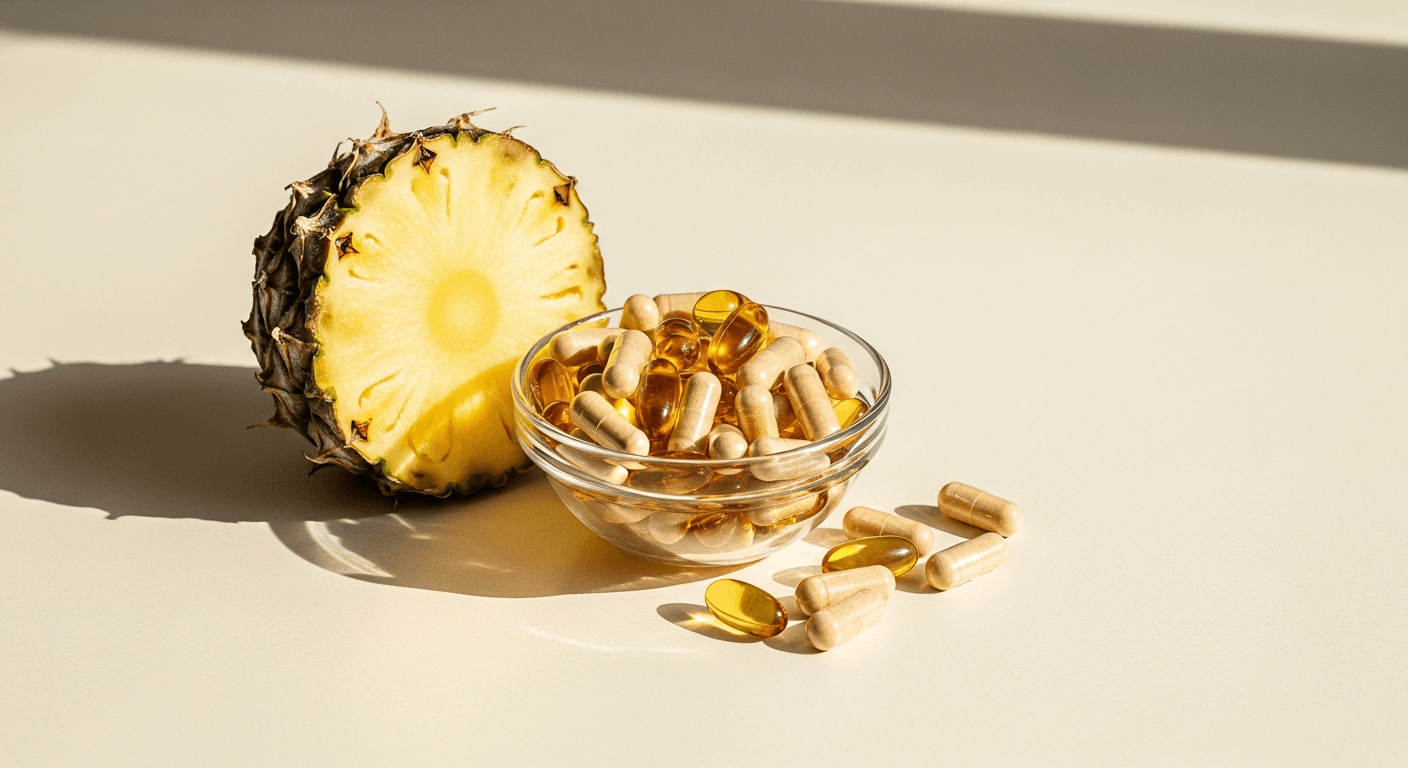
The digestive enzyme supplement market crossed $4 billion globally in 2025, and it's still growing. You'll find bromelain capsules, papain tablets, broad-spectrum blends, and lactase chews on shelves from drugstores to premium wellness boutiques. The problem is that the evidence behind these products ranges from genuinely solid to nearly nonexistent. A series of independent lab audits in 2025 found that several bromelain products contained a fraction of the enzyme activity their labels promised. That scandal didn't just expose one ingredient. It cracked open a wider question: which digestive enzyme supplements are actually worth buying in 2026, and which ones are expensive folklore?
This guide ranks the most researched enzymes by evidence strength, explains what the labels should say, and gives you a clear set of buying criteria so you're not guessing at the checkout.
Why Enzyme Activity Units Matter More Than Milligrams
Before getting into individual enzymes, you need to understand a labeling problem that affects the entire category. Most consumers look at the milligram count on a supplement label and assume more milligrams means more potency. With enzymes, that logic breaks down completely.
Enzymes are biological catalysts. What matters isn't how much of the protein is present by weight. What matters is how active that protein is. Two bromelain products can both list 500 mg on the label. One might have genuine enzymatic activity. The other might have been exposed to heat or poor manufacturing conditions that denature the protein, leaving you with an expensive placebo.
The meaningful numbers are enzyme activity units. For proteolytic enzymes like bromelain, that's GDU (Gelatin Digesting Units) or MCU (Milk Clotting Units). For general digestive enzymes, you'll see FCC units, which are standardized by the Food Chemicals Codex. A credible product lists these. A product that only lists milligrams is giving you incomplete information, and that should raise a flag immediately.
This kind of label literacy is becoming more relevant across the entire supplement space. New tools that score supplement ingredient credibility in real time are helping consumers cut through marketing language, and enzyme products are exactly where those tools earn their keep.
Lactase: The Strongest Evidence in the Category
If you're lactose intolerant, lactase is the one digestive enzyme supplement with a clear, predictable, and well-replicated benefit. Lactase breaks down lactose, the sugar in dairy, into glucose and galactose. People with lactose intolerance produce insufficient lactase in their small intestine, which means undigested lactose reaches the colon and causes bloating, gas, and diarrhea.
Taking lactase with dairy directly addresses the mechanism of the problem. Dozens of controlled trials confirm this. The effect is dose-dependent and timing-dependent. You need to take it at the start of a dairy-containing meal, not an hour before or after. Most effective doses in research fall between 6,000 and 9,000 FCC lactase units per serving, so look for that range on the label.
Lactase is also one of the few enzyme supplements where the manufacturing process is well understood and the activity units are easy to verify through third-party testing. Products from brands with NSF International, USP, or Informed Sport certification are your most reliable options.
Bromelain and Papain: Real Mechanisms, Unreliable Products
Bromelain, derived from pineapple, and papain, derived from papaya, are plant-based proteolytic enzymes. The mechanistic case for their anti-inflammatory properties is legitimate. Both enzymes can degrade certain pro-inflammatory proteins when absorbed systemically, and multiple in-vitro and animal studies support this pathway. Human trials on bromelain for post-surgical swelling and joint discomfort show modest positive effects, though effect sizes are often small and study quality varies.
The real problem isn't the science. It's the products. The 2025 audit findings showed that a significant proportion of bromelain supplements on the market fail to deliver the enzyme activity their labels claim. Some tested products had less than 20% of the stated GDU activity. Others had none. This isn't a minor quality gap. It means you could take a product for months and be consuming an inert powder.
If you're buying bromelain or papain for their anti-inflammatory potential, here's what to look for. The label must state GDU or MCU units for bromelain, not just milligrams. It must carry a credible third-party testing seal. And it should ideally come from a brand that publishes certificates of analysis on request. Without these, you're taking a real financial and efficacy risk.
Worth noting: systemic absorption of orally ingested bromelain requires the enzyme to survive stomach acid. Enteric-coated formulas are designed to help with this, though the research on whether enteric coating meaningfully improves outcomes in humans is still limited.
Broad-Spectrum Blends: Heavily Marketed, Weakly Evidenced
Walk into any supplement retailer and you'll find shelf after shelf of "complete digestive enzyme" blends promising to improve nutrient absorption, reduce bloating, and optimize gut health. These products typically combine amylase (for starches), lipase (for fats), protease (for proteins), and several other enzymes in a single capsule.
For people with diagnosed exocrine pancreatic insufficiency (EPI), enzyme replacement therapy is genuinely necessary and clinically well-supported. But these patients are typically prescribed pharmaceutical-grade pancreatic enzyme replacements under medical supervision, not over-the-counter blends.
For healthy adults without a diagnosed enzyme deficiency, the evidence that broad-spectrum enzyme blends improve digestion or nutrient absorption is weak. Most people produce sufficient digestive enzymes on their own. The stomach, pancreas, and small intestine together generate a substantial enzymatic capacity that handles a normal diet without supplemental support. A few small trials suggest modest reductions in post-meal bloating with enzyme blends, but these studies are often industry-funded, short-term, and lack robust controls.
This doesn't mean these products are harmful. For most people, they're simply unnecessary. If you're experiencing persistent digestive symptoms, the smarter move is to work with a gastroenterologist rather than self-treating with a broad-spectrum blend. Chronic bloating, unpredictable bowel habits, or significant post-meal discomfort can have several causes. Some are nutritional, some are structural, and some are stress-related. Stress management frameworks are often more relevant to functional digestive complaints than enzyme capsules.
Amylase and Protease: Situational Use Cases
Amylase breaks down carbohydrates and is produced naturally in saliva and the pancreas. Protease enzymes break down proteins. Both are included in most broad-spectrum blends and are also sold individually.
Amylase supplementation has been studied in people with certain congenital conditions affecting salivary gland function and in some post-surgical contexts. For general use in healthy adults, there's no strong evidence it improves carbohydrate digestion beyond the body's own output.
Protease supplements have a slightly more interesting research profile in the context of exercise recovery. A handful of trials suggest that taking protease enzymes alongside protein intake may modestly improve protein absorption and reduce delayed onset muscle soreness. The effect sizes are small and the research is early-stage. If you're deep into optimizing recovery alongside high-volume training, the evidence is worth knowing about. It's not a priority intervention, but it's not unfounded either.
For athletes tracking every variable in their nutrition strategy, this kind of ingredient-level thinking fits into a broader personalization framework. How personal nutrition can get at the genomic and epigenetic level is a genuinely evolving area, and enzyme activity may turn out to be one more variable worth individualizing.
Red Flags: When to Skip a Product
The enzyme supplement market has significant quality variation. Here are the specific signals that should make you put a product back on the shelf.
- No enzyme activity units listed. If the label only shows milligrams and not GDU, FCC, or other standardized activity units, you have no way to assess potency. This is the single biggest red flag in the category.
- No third-party testing seal. Look for NSF International, USP, Informed Sport, or Banned Substances Control Group certification. These seals mean an independent lab has verified the product contains what the label claims.
- Proprietary blends that hide individual doses. A label that lists "Digestive Enzyme Blend 350 mg" without breaking out individual enzyme quantities tells you nothing about what you're actually getting. Each active enzyme should be listed with its own activity unit dose.
- Vague structure-function claims without specifics. Phrases like "supports digestive wellness" or "promotes nutrient absorption" are not evidence. Look for specific enzyme types, specific activity levels, and specific use cases.
- Implausibly low prices. Quality enzyme manufacturing is not cheap. Products priced at $8 to $10 for a 60-serving supply are unlikely to contain verified enzymatic activity at meaningful levels.
Practical Buying Criteria for 2026
Here's how to approach this category with a clear framework. First, identify whether you have a specific and diagnosed reason to take an enzyme supplement. Lactose intolerance is the clearest use case. EPI is a medical one. General bloating in an otherwise healthy gut is not, by itself, a strong indication.
Second, match the enzyme to the mechanism. Don't buy a broad-spectrum blend when you only need lactase. Don't buy bromelain for joint support without understanding the evidence limitations and the product quality requirements.
Third, use activity units as your primary comparison metric, not price per milligram. A product with 3,000 GDU of verified bromelain activity is worth more than one with 600 mg and no activity units stated.
Fourth, verify third-party testing. This is non-negotiable in a category with documented quality failures. Spending $30 to $45 on a verified product is a better decision than spending $15 on one that delivers nothing.
Finally, think about enzyme supplements in the context of your overall nutrition strategy rather than as standalone fixes. Evaluating which ingredients actually have evidence is a skill that applies across the entire supplement space, and building that skill will save you money and help you make decisions you can actually trust.
The enzyme supplement market isn't going anywhere, and neither is the marketing pressure to buy more of it than you need. But with the right criteria, you can filter out the noise, identify the products with real evidence behind them, and make choices that are genuinely grounded in how your body works.