
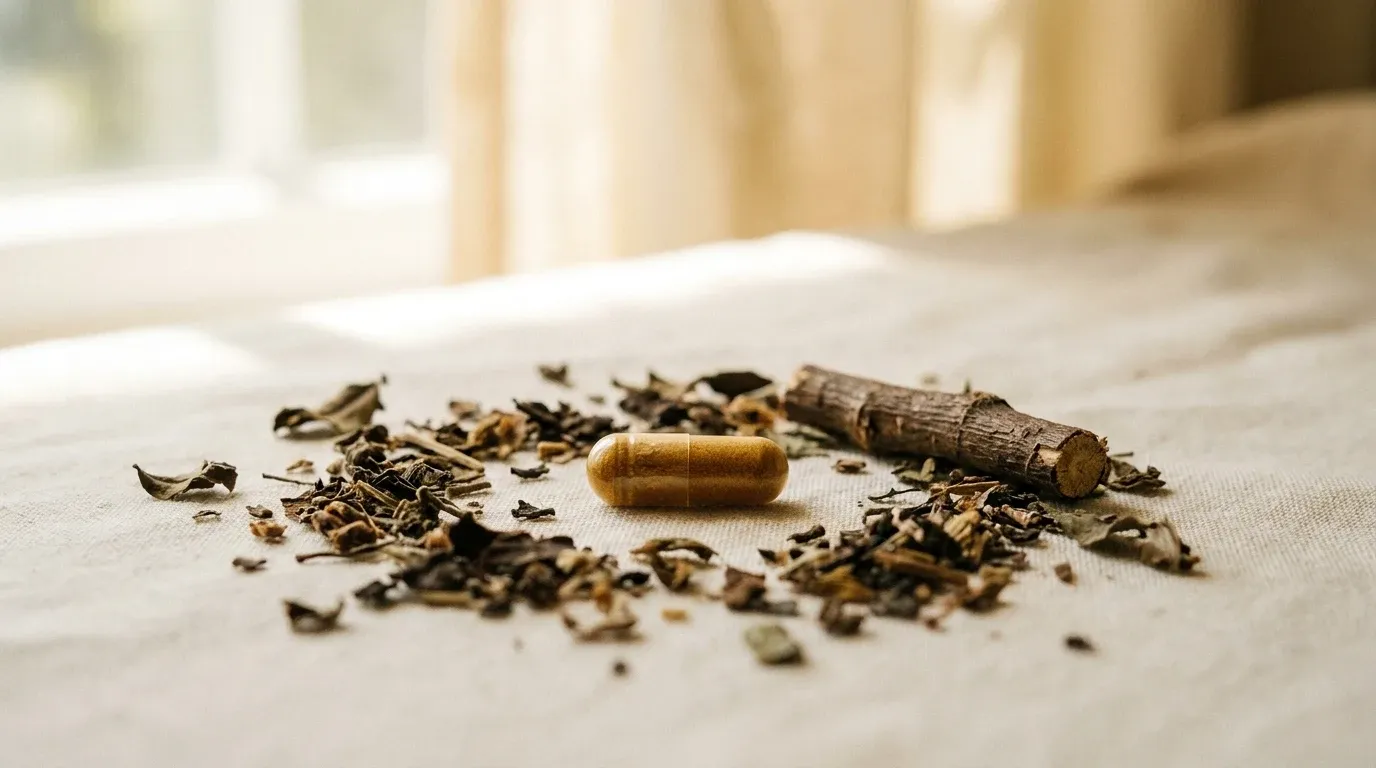
If you've spent any time on fitness podcasts or supplement forums in the past year or two, you've almost certainly heard the name Fadogia Agrestis. It's being marketed as a natural testosterone booster, stacked alongside ashwagandha and tongkat ali, and recommended by influencers with impressive physiques and persuasive delivery. The hype is real. The human evidence, however, is not.
Here's what the research actually shows, what the safety concerns are, and whether this supplement deserves a place in your routine.
What Is Fadogia Agrestis?
Fadogia Agrestis is a shrub native to Nigeria, where its stem extract has been used in traditional medicine for generations. In its modern supplement form, it's typically sold as a standardized extract in capsule form, often positioned as a natural way to support testosterone production and male sexual health.
The supplement industry latched onto it aggressively around 2024 and 2025, and by 2026 it's become one of the most searched ingredients in the testosterone-support category. You'll find it in standalone products and in multi-ingredient "T-booster" stacks, with prices ranging from $30 to over $80 per bottle depending on the brand and dosage.
The marketing narrative is compelling: a plant-based, traditional remedy that raises luteinizing hormone (LH) and, in turn, tells your body to produce more testosterone. The problem is that narrative is built almost entirely on data from rats.
What the Animal Studies Show
The most-cited research on Fadogia Agrestis comes from a series of rodent studies, primarily published in the mid-2000s. In those studies, male rats given aqueous stem extract showed increases in serum testosterone levels and mounting behavior. One study found that testosterone levels increased in a dose-dependent manner, with higher doses producing greater hormonal responses.
Researchers attributed the effect to a stimulation of luteinizing hormone, a signaling compound produced by the pituitary gland that prompts the testes to synthesize testosterone. This mechanism sounds plausible and translatable to humans. That's partly why the supplement industry ran with it.
But animal models are notoriously poor predictors of human response, particularly for hormonal compounds. Many substances that raise testosterone in rodents do nothing measurable in healthy adult men, or produce effects too small to matter clinically. The step from "works in rats" to "works in people" is not a small one. It's a chasm that requires years of controlled human trials to cross.
The Human Evidence Gap
As of 2026, there are no published, well-controlled randomized controlled trials (RCTs) in humans demonstrating that Fadogia Agrestis safely and meaningfully raises testosterone levels in people. That's not a minor caveat. That's the central fact you need before spending money on this supplement.
Some smaller, industry-funded pilot studies have circulated, but these lack the sample sizes, blinding, and independent verification that would allow any credible conclusion. Regulatory and scientific bodies do not consider this quality of evidence sufficient to establish efficacy or safety for human supplementation.
Compare that to what we know about resistance training. Decades of peer-reviewed research confirm that consistent strength training increases testosterone, preserves lean mass, improves insulin sensitivity, and supports long-term hormonal health, particularly in men over 35. If you're looking at what actually moves the needle, understanding what a coach should change first when training after 35 is a far more evidence-based place to start than a supplement with no human trial data.
The Toxicity Signal You Shouldn't Ignore
Beyond the lack of efficacy data, there's a more pressing concern: toxicity. The same rodent studies that showed testosterone increases also flagged dose-dependent adverse effects on organ health, specifically the kidneys and testes.
At higher doses, animal subjects showed markers of testicular toxicity, which is a particularly alarming finding for a supplement marketed to support male reproductive health. Kidney function markers were also negatively affected in some studies. These findings don't confirm that Fadogia Agrestis will damage your organs at typical supplement doses. But they do mean that the burden of proof for human safety is significantly higher than it is for supplements with a clean preclinical profile.
Without human pharmacokinetic data, you don't know how the extract is metabolized in people, what dose reaches systemic circulation, or how chronic use affects organ function over months or years. Supplement labels often list doses between 300 mg and 600 mg per serving, but there's no validated human dose range because no validated human trials exist.
This is not an abstract risk. It's a concrete gap in the safety profile of a compound you'd be ingesting daily.
What Actually Works for Natural Testosterone Support
If your goal is maintaining or optimizing testosterone levels through lifestyle and supplementation, the evidence strongly favors a different toolkit. None of these are as exciting as a Nigerian shrub extract with a mysterious name, but they have decades of human research behind them.
- Resistance training: Consistently shown to acutely raise testosterone and preserve hormonal function with age. Progressive overload, compound movements, and adequate volume are the key variables.
- Zinc: Deficiency is directly associated with lower testosterone. Correcting a zinc deficiency through diet or supplementation has well-documented effects on testosterone levels in clinical studies.
- Vitamin D: Low vitamin D status correlates with reduced testosterone in multiple population studies. Supplementation in deficient individuals shows meaningful improvements in hormonal markers.
- Sleep: Testosterone is primarily secreted during deep sleep. Poor or shortened sleep is one of the fastest ways to suppress your natural production. Research on how deep sleep builds muscle, burns fat, and supports hormonal health makes it clear that no supplement replaces quality rest.
- Stress management: Chronically elevated cortisol suppresses testosterone synthesis through a well-established endocrine pathway. Reducing psychological stress through structured interventions has measurable hormonal benefits.
- Body composition: Excess adipose tissue, particularly visceral fat, is associated with lower testosterone and higher estrogen conversion. Fat loss through diet and exercise supports healthier hormonal balance.
None of these cost $60 a bottle. Most of them are free or close to it. And all of them have human randomized controlled trial data behind them. That's the standard Fadogia Agrestis doesn't yet meet.
The Supplement Industry's Evidence Problem
Fadogia Agrestis is a useful lens for understanding how the supplement market operates more broadly. A compound with promising animal data and a traditional use story gets picked up by a few high-profile podcasters, manufacturers rush to produce it, and consumer demand outpaces the science by years.
This cycle is not unique to testosterone boosters. It plays out across categories, from nootropics to fat burners to recovery aids. The brands aren't necessarily lying when they say the research is "promising." They're just selectively presenting what exists while omitting what doesn't.
It's also worth noting that testosterone-support supplements exist in a regulatory gray area. In the US, the FDA does not require supplements to prove efficacy before going to market. The burden of proving a supplement is unsafe falls on regulators, not manufacturers. That structure allows products with thin evidence bases to reach consumers with confidence-inspiring labels and clinical-sounding language.
Being an informed buyer means knowing that "backed by research" can legally mean a single rodent study from 2005.
Should You Take Fadogia Agrestis?
Based on the current evidence, no. Not because it definitely doesn't work, but because you don't have the data to know that it does, and you don't have the safety data to know chronic use is without risk. That combination is a reasonable basis for caution.
If you're concerned about testosterone levels, the first step is getting a baseline blood panel through your doctor. Low testosterone has genuine clinical implications and warrants a real conversation with a healthcare provider, not a supplement purchased online based on podcast recommendations.
If your levels are in a normal range and you're looking to optimize, the interventions with the strongest human evidence are lifestyle-based. Regular physical activity matters significantly here. Research increasingly shows that exercise is so effective for cardiovascular and hormonal health that doctors are now formally recommending it as a medical intervention. That framing alone should tell you something about where the evidence sits.
And if you're over 35 and thinking about long-term hormonal health, the smartest investments are consistent training, adequate sleep, a nutrient-dense diet, and managed stress. Those aren't glamorous recommendations. But they're the ones that hold up when you read the actual studies.
The Bottom Line
Fadogia Agrestis is not a proven testosterone booster. It is a plant extract with interesting rodent data, a plausible mechanism, a real toxicity signal at higher doses, and zero well-controlled human trials to its name. The gap between where the science is and where the marketing claims it is couldn't be wider.
That might change. Future human research could validate the animal findings and establish a safe, effective dose range. If that happens, this article will need updating. Until then, your money and your attention are better spent on what already has human evidence behind it.
Recovery quality, sleep, strength training, and micronutrient sufficiency aren't exciting to talk about. But they work. Fadogia Agrestis, as of right now, is a bet on a rodent study. You deserve better odds than that.